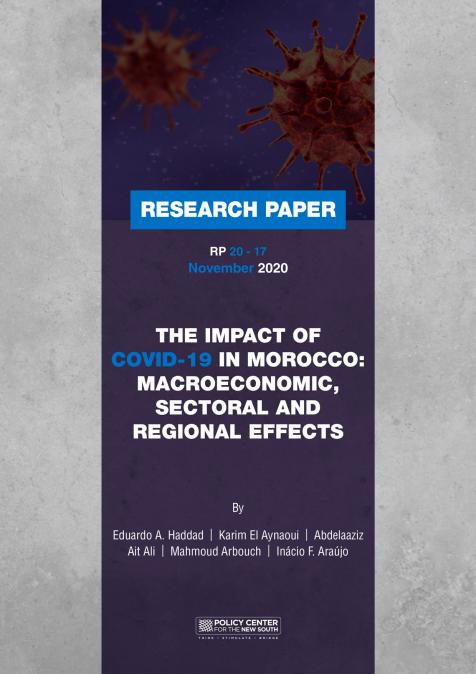
Présentation du rapport « Croissance et emploi au Maroc »

May 5, 2026

Présentation du rapport « Croissance et emploi au Maroc » par Javier Diaz Cassou, Économiste Senior à la Banque mondiale, qui analyse les dynamiques de croissance de l’économie marocaine et leur impact sur la création d’emplois. Le rapport met en évidence les principaux moteurs de la croissance ainsi que ses limites structurelles. Il examine les écarts entre performance économique et capacité d’absorption du marché du travail. Enfin, il propose des leviers de réforme pour favoriser une croissance plus soutenue et génératrice d’emplois.

Speakers

Oumayma Bourhriba
Senior Economist
Oumayma Bourhriba is a Senior Economist at the Policy Center for the New South (PCNS).At the PCNS, which she joined in 2019, Oumayma Bourhriba conducts research focusing on macroeconomic policies and international trade, with a particular emphasis on services.She has contributed to major publications on the Moroccan economy, such as the IMF’s Morocco's Quest for Stronger and Inclusive Growth (2023) and the World Bank’s Trade Policy in Morocco: Taking Stock and Looking Ahead (2023). Beyond her research, she has coordinated the Africa Economic Symposium, one of the flagship convenings organized by the PCNS.Oumayma Bourhriba holds a master’s degree in applied economics from University Mohammed V (UM5), where she is currently a PhD candidate.She is fluent in Arabic, English, ...
RELATED CONTENT

  • December 16, 2020
    The COVID-19 pandemic has hit the Moroccan economy hard, as elsewhere in the world. A collapse in external demand and a lockdown lasting more than three months have profoundly altered economic activity in Morocco, causing its first recession since 1995. The implementation of the confinement and social distancing measures was strict and came two weeks after the detection of the first cases of COVID-19 in Morocco on March 2, 2020. The lockdown was extended three times and lasted aroun ...
  • Authors
    September 11, 2020
    Latin American and Caribbean economies need help, but organizations like the IDB are also stretched thin. First appeared at Americas Quarterly With Latin America and the Caribbean potentially facing years of difficulties due to the pandemic and related economic crises, attention has shifted to what multilateral institutions like the International Monetary Fund (IMF) might do to help. There’s no doubt they can play a crucial role in preventing another lost decade in the region. But ...
  • Authors
    August 10, 2020
    The International Monetary Fund (IMF) released, on August 4th, its ninth annual External Sector Report, where current account imbalances and asset-liability stocks of 30 systemically large economies are approached. This time the report went beyond looking the previous year and tried to anticipate what will be some of the impacts of the still on-going COVID-19 crisis. The report shows that the global economy entered the COVID-19 crisis with a configuration of external imbalance ...
  • Authors
    July 20, 2020
    There are signs of recovery in various parts of the global economy, starting in May, after the depressive dip imposed by Covid-19. Such signs emerged after the easing of restrictions on mobility established to flatten out the pandemic curves, and also reflected policies of flattening the recession curve (income transfers to part of the population, credit lines to vulnerable companies and others). Besides remaining far from giving back the GDP lost, in all countries, the r ...
  • Authors
    July 20, 2020
    This article was originally published on Bruegel. The global economy is showing signs of recovery from the economic crisis caused by COVID-19, though the spread of the coronavirus is accelerating in some countries. In this circumstance, policymakers must weigh up the trade-offs involved in dealing with the pandemic while easing lock downs and sustaining economic activity. Differences in age structures, urbanisation rates and other factors will inform decision making in different co ...
  • Authors
    June 10, 2020
    Three features of the post-pandemic global economy can already be anticipated: the worldwide rise in public and private debt levels, accelerated digitization, and a partial reversal of globalization. The first arises from the public sector's role as the ultimate insurer against catastrophes, government policies to smooth pandemic curves and the coronavirus recession. These will leave a legacy of massive public-sector debt worldwide (as discussed in a previous post. Lower tax re ...
  • Authors
    Souha Majidi
    June 5, 2020
    Face à l’ampleur des retombées économiques et sociales des crises sanitaires, comme la Covid19, l’aide publique au développement peut jouer un rôle essentiel dans l’atténuation de l’impact des épidémies sur les économies les plus fragiles et vulnérables. L'aide publique au développement (APD) vise non seulement à combler le manque de capital nécessaire à amorcer une dynamique forte de développement, mais aussi à amorcer la capacité des Etats à répondre aux risques sanitaires et sécu ...
  • June 1, 2020
    تدور خطة العمل التي تم وضعها في مواجهة جائحة كوفيد 19 حول ثلاثة محاور: الصحة والاقتصاد والنظام الاجتماعي. وفي كل مجال من هذه المجالات، ساعدت مبادرات المؤسسات العامة والقطاع الخاص وأعضاء المجتمع المدني حتى الآن على الحد من أضرار الوباء على الصعيد الصحي، تسعى الجهود المبذولة إلى التحكم في انتشار المرض من أجل ضمان احتواء المنظومة الصحية لتدفق الحالات بشكل أفضل، خصوصا بالنظر إلى الموارد المحدودة والموزعة بشكل متفاوت على مستوى التراب الوطني. وقد تم إعطاء الأولوية في هذا السياق إلى الزيا ...
  • Authors
    May 27, 2020
    COVID-19 has delivered a powerful double punch to the chin of the global economy, combining a terrifying pandemic with a collapse in production because of the withdrawal into their homes of half the world’s workers. The uncertainty generated by the medical and economic shock is paralyzing consumers and investors, and the dispersion of short-term economic forecasts is far wider than at any time in modern history, about six times greater than during the Great Financial Crisis. The GD ...
  • Authors
    May 18, 2020
    Alors que commence le déconfinement de l'économie française, la grande inquiétude est de savoir comment éviter une « seconde vague » de l'épidémie. Parmi les nombreuses précautions et mesures à prendre, l’augmentation du nombre de tests et le traçage systématique des contacts sont les plus souvent mis en avant par les épidémiologistes. L'idéal serait de tester fréquemment tous les habitants du pays et ses visiteurs étrangers. Pour cela, il faudrait effectuer bien au-delà d ...