Post Covid-19 Commodity Finance with Helyette Geman (4/5)

May 14, 2020

Retrouvez les analyses de nos expert-e-s au sujet de l'impact de la crise Covid 19 en une série de 5 entretiens

Speakers
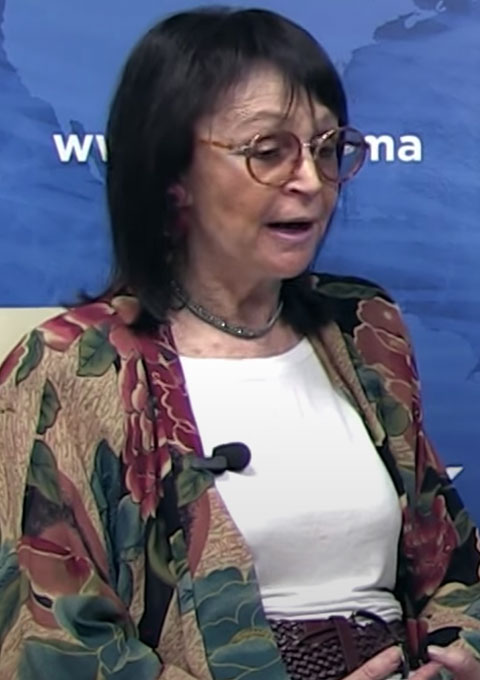
Helyette Geman
Senior Fellow
Helyette Geman is Senior Fellow at the Policy Center for the New South, Director of the Commodity Finance Center at Birkbeck, University of London, and a Research Professor at the Johns Hopkins University, who focuses on Probability, Commodities and Finance. She was Chairman of the Finance Department at ESSEC Business School from 1988 to 1995, and the Director of Dauphine Master 203 at the University of Paris Dauphine from 1995 to 2005. Helyette Geman is a Graduate from Ecole Normale Supérieure in Mathematics and holds a PhD in Probability and a PhD in Finance. She worked as a scientific expert for EDF Trading, Louis Dreyfus, BMP Billiton, Bunge Invivo and financial institutions. Her book “Commodities and Commodity Derivatives” published in 2005 by Wiley Finance has become th ...


RELATED CONTENT

  • Authors
    March 8, 2016
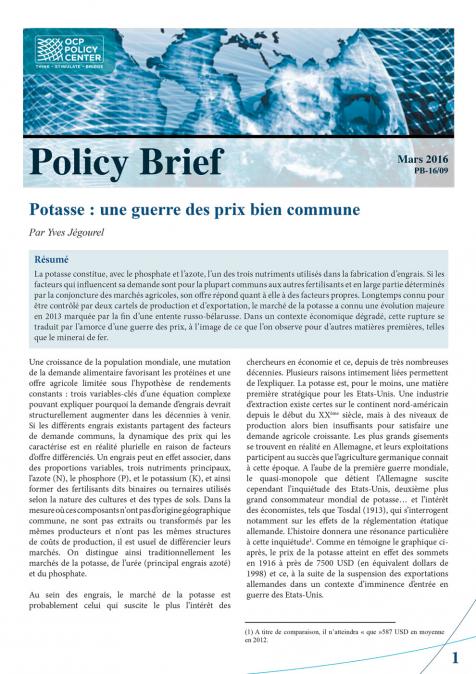
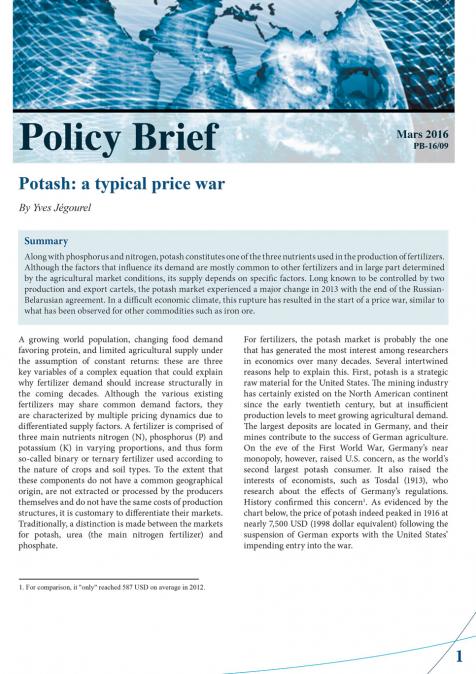
    Along with phosphorus and nitrogen, potash constitutes one of the three nutrients used in the production of fertilizers. Although the factors that influence its demand are mostly common to other fertilizers and in large part determined by the agricultural market conditions, its supply depends on specific factors. Long known to be controlled by two production and export cartels, the potash market experienced a major change in 2013 with the end of the RussianBelarusian agreement. In a ...
  • March 01, 2016
    Ce podcast est délivré par Carole Mathieu. A sa clôture le 12 décembre 2015, la COP21 a été saluée comme un grand succès diplomatique. En adoptant l’accord de Paris, les 196 Parties à la ...
  • Authors
    February 16, 2016
    West African countries, on top of which is Côte d’Ivoire, represent the bulk of the world supply of cocoa beans. From the end of the nineteenth century to their independence, and to recent times, their histories have been marked by boom and bust cycles that were sometimes desynchronized from one country to another, especially for Ghana and Côte d’Ivoire, due to differentiated political and economic backdrops. As for now, cocoa producers seem to be insulated from the rout which has h ...
  • Authors
    Philippe Chalmin
    February 4, 2016
    Rarement, la tendance sur les marchés mondiaux de matières premières et de commodités aura été aussi marquée qu’en 2015. Pratiquement tous les marchés se sont inscrits en baisse et celle-ci a été en général très forte à l’image de l’indice Cyclope-Rexecode en retrait en moyenne de 38 % en 2015 par rapport à 2014. Il est à la limite plus simple de citer les quelques produits pour lesquels le bilan de l’année a été positif : le cacao et de manière plus anecdotique le thé et l’huile d’ ...
  • Authors
    Russel Dinh
    January 27, 2016
    The IMF recently revised down its growth forecasts, making large changes in the forecasts for some emerging markets, in particular Brazil and oil-producing countries (such as Nigeria and Saudi Arabia). This report presents a snapshot of the global unemployment outlook and discusses what the recent revisions could mean for the unemployment outlook for these countries based on past relationships between growth and unemployment. We conclude with a look at the growth-unemployment link f ...
  • Authors
    January 13, 2016
    Due to the existing geographical distance between the main consumption and production regions and the resulting significant logistical costs, the liquefied natural gas (LNG) market has historically been structured around long-term supply contracts indexed to oil prices. With the recent development of shale gas and sluggish European growth, excess LNG supply now fosters the development of spot markets, particularly in Asia, by nature more flexible and disconnected from oil prices. In ...