Mobiliser la finance climat pour la transition énergétique en Afrique

March 13, 2026

Dans cet épisode, nous examinons comment la finance climat peut catalyser la transition énergétique en Afrique, en mobilisant des instruments innovants et des partenariats public-privé pour soutenir des projets durables, tout en surmontant les défis d’accès au capital et d’infrastructures, et en créant des opportunités pour un développement économique inclusif et une transition vers une énergie plus verte.

Speakers

RELATED CONTENT

  • Authors
    Sous la direction de Larabi Jaïdi
    September 29, 2022
    La succession des chocs pandémique, climatique et géopolitique a éprouvé les économies africaines. Les liens commerciaux et financiers avec le monde ne sont plus seulement considérés comme des moteurs de performance, mais aussi comme des sources potentielles de vulnérabilité. La défiance à l’égard de la mondialisation s’est accrue. Parce qu’elle est venue souligner la dépendance du continent, le dérèglement de ses rapports à la nature et sa vulnérabilité face aux tensions géopolitiq ...
  • Authors
    March 16, 2022
    The 2021 German federal election brought about a historic reshuffle of the political parties’ hierarchy in Europe’s biggest economy. The Social Democratic Party are back in control of the Chancellery for the first time since 2005, as part of a three-party coalition at the federal level with the Greens and the Liberals, a first in Germany’s post-war history. Now, the federal government has turned its gaze towards its founding mission: more progress. The first 100 days of the three-pa ...
  • March 1, 2022
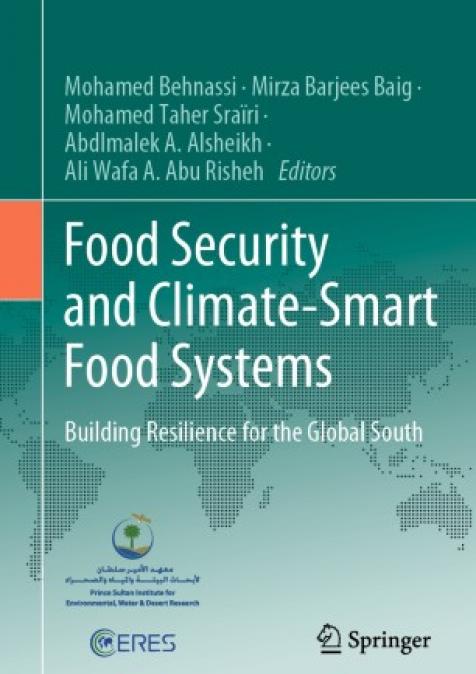
    Known for being a climate change hotspot, Morocco is at the forefront of a climate disaster. Consequences are already being felt, whether in the form of increasing temperature or a downward trend in precipitations, which directly threaten the water security and, by extension, the social-ecological systems of the country. The systems by which food, energy, and water are produced, distributed, and consumed heavily depend on one another. Their implicit feedbacks and links are not linea ...
  • Authors
    February 9, 2022
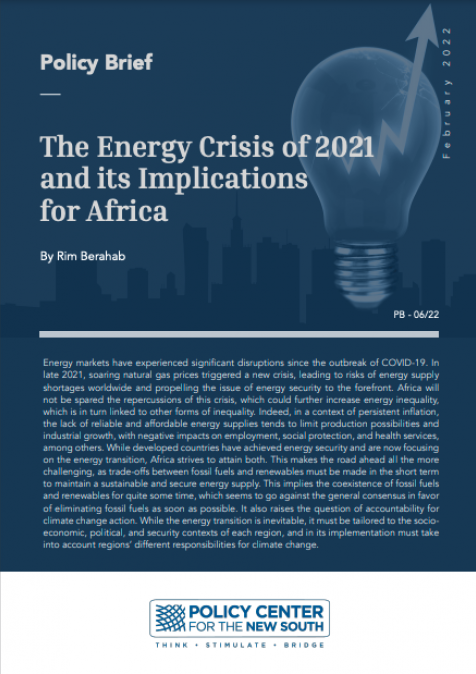
    Energy markets have experienced significant disruptions since the outbreak of COVID-19. In late 2021, soaring natural gas prices triggered a new crisis, leading to risks of energy supply shortages worldwide and propelling the issue of energy security to the forefront. Africa will not be spared the repercussions of this crisis, which could further increase energy inequality, which is in turn linked to other forms of inequality. Indeed, in a context of persistent inflation, the lack o ...
  • Authors
    Raffaele Della Croce
    Miguel Vazquez
    September 29, 2021
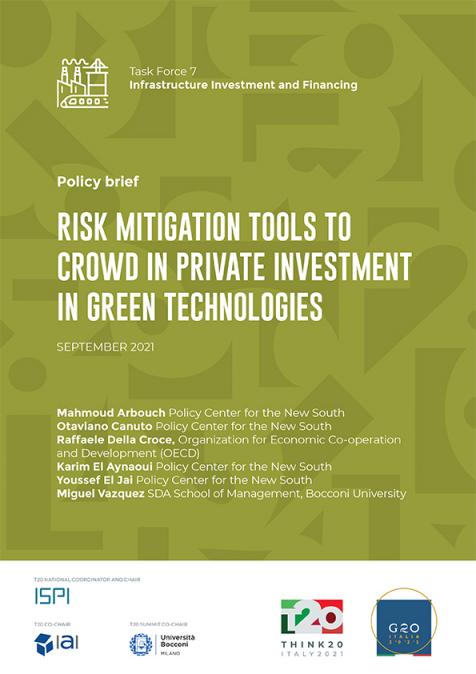
    In order to close the financing gap in green technologies, finding new mechanisms to enhance the participation of the private sector, combined with that of the public sector, in financing sustainable and climate-resilient infrastructure is a must. In this context, some unlisted instruments are going to be needed to enhance financing of green infrastructure. Besides, the development of properly structured projects, with risks and returns in line with the preferences of the different ...
  • Authors
    Chami Abdelilah
    Derj Atar
    Hammi Ibtissem
    Morazzo Mariano
    Naciri Yassine
    with the technical support of AFRY
    July 29, 2021
    As decarbonization is a long-term process and requires significant investments, specific financial and non- financial measures will need to be implemented, both in the short and long term, to facilitate this transition. In Part II of Morocco’s decarbonization pathway Policy Brief series, an update of the decarbonization scenarios was presented. It revealed that the Increased Ambition and Green Development scenarios achieve higher decarbonization targets than current policy. It showe ...
  • Authors
    Chami Abdelilah
    Derj Atar
    Hammi Ibtissem
    Morazzo Mariano
    Naciri Yassine
    with the technical support of AFRY
    July 23, 2021
    La décarbonisation est un processus à long terme qui nécessite des investissements importants. Ainsi, des mesures financières et non financières spécifiques devront être mises en œuvre, à la fois à court et à long termes, pour faciliter cette transition. Dans la deuxième partie de la série de Policy Briefs sur la trajectoire de décarbonisation du Maroc, une mise à jour des scénarios de décarbonisation a été présentée. Elle révèle que les scénarios « Ambition accélérée » et « Dévelop ...
  • Authors
    Chami Abdelilah
    Derj Atar
    Hammi Ibtissem
    Morazzo Mariano
    Naciri Yassine
    with the technical support of AFRY
    July 19, 2021
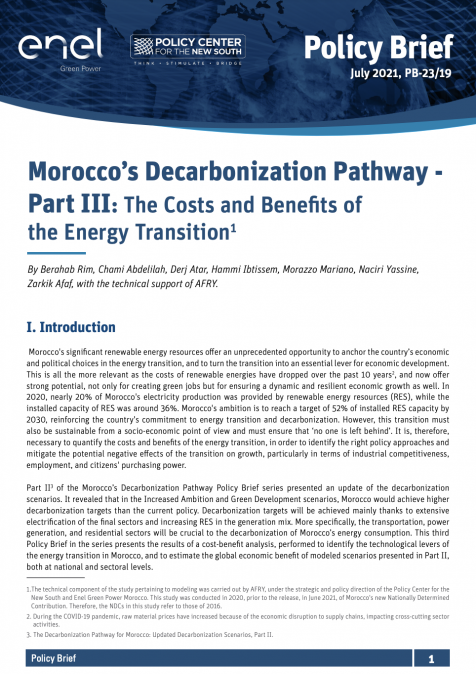
    Morocco's significant renewable energy resources offer an unprecedented opportunity to anchor the country’s economic and political choices in the energy transition, and to turn the transition into an essential lever for economic development. This is all the more relevant as the costs of renewable energies have dropped over the past 10 years2, and now offer strong potential, not only for creating green jobs but for ensuring a dynamic and resilient economic growth as well. In 2020, ne ...
  • Authors
    Chami Abdelilah
    Derj Atar
    Hammi Ibtissem
    Morazzo Mariano
    Naciri Yassine
    with the technical support of AFRY
    July 9, 2021
    Les conséquences du changement climatique sont de plus en plus visibles au Maroc. Le schéma changeant des précipitations et de la sécheresse, l'augmentation des températures moyennes et des canicules, les inondations et l'augmentation du niveau de la mer affectent de plus en plus de nombreuses régions. Et pourtant, le taux d'émission de gaz à effet de serre (GES) du Maroc est relativement faible, comparé à celui d'autres pays. En 20162, les émissions totales de GES du Maroc ont atte ...
  • Authors
    Chami Abdelilah
    Derj Atar
    Hammi Ibtissem
    Morazzo Mariano
    Naciri Yassine
    with the technical support of AFRY
    July 9, 2021
    The consequences of climate change are becoming progressively more visible in Morocco. Changes in rainfall patterns and drought, increases in average temperatures and heatwaves, flooding, and rising sea levels are increasingly affecting several regions. Yet, Morocco has a relatively low greenhouse gas (GHG) emission rate, compared to other countries. In 20162, Morocco’s total GHG emissions reached 86127.7 gigagram of carbon dioxide equivalent (Gg CO2-eq), totaling around 0.2% of glo ...