
RELATED CONTENT
-
 June 7, 2017In 2016, the countenance of Africa emerged slightly reassured. While global growth has remained fairly dull, with sluggish international trade and economic packages on the continent continuing to fail, the rebound of prices for many commodities along with a sustained investment dynamics have somewhat dispersed the threatening clouds that had obscured its economic horizon in 2015. A slight improvement therefore, but which should not make us forget that the macroeconomic performance o ...
 -
 May 25, 2017For its 6th edition, the Tana High-Level Forum on Security in Africa, held in Bahir Dar on Lake Tana in Ethiopia from April 22 to 23, 2017, focused on the theme of Natural Resource Governance in Africa. One of the forum session’s key discussion points sought to "understand and explain why the exploitation of these resources is increasingly a source of tension and violence, which have dramatic repercussions on the continent’s peace and stability." During the various events throughout ...
 -
 April 25, 2017Chinese investors are increasingly interested in Africa. Some criticize them for privileging mining investments. A 2017 analysis of these investments shows that investments in mining have not been the only ones privileged by the Chinese operators. Many other sectors such as transport and energy have benefited from Chinese investments, much more so than the mining sector, for example. ...
 -
 April 25, 2017Chinese investors are increasingly interested in Africa. Some criticize them for privileging mining investments. A 2017 analysis of these investments shows that investments in mining have not been the only ones privileged by the Chinese operators. Many other sectors such as transport and energy have benefited from Chinese investments, much more so than the mining sector, for example. ...
 -
 April 12, 2017We argue in this paper that electricity production needs to be multiplied by a large factor in the coming years for East Africa to reach the economic growth rate it deserves after the improvement of its socio-political situation. The rural electrification rate in North Africa as represented for instance by Morocco was higher than 99.50% in the first quarter of 2017 while it was barely 10% in some parts of Western Kenya. We also make the case for hydroelectricity as the adequate ren ...
 -
 March 29, 2017Dans un contexte mondial de plus en plus préoccupé par les aléas climatiques, comprendre l’impact de la croissance économique sur l’environnement devient crucial, notamment pour les pays en voie de développement. Ce papier aborde cette problématique sous le prisme des émissions de dioxyde de carbone (CO2) et examine comment la croissance économique se répercute sur l’environnement. L’objectif de cette étude est de tester la validité de la courbe environnementale de Kuznets (CEK) pou ...
 -
 December 30, 2016Le paysage énergétique du Maroc a connu une évolution rapide au cours des dernières décennies. La croissance démographique, l'industrialisation et la hausse du niveau de vie, qui se sont accompagnés d'une augmentation des taux d'accès à l'électricité, ainsi que de taux élevés d'exode rural, ont tous contribué à l'expansion des besoins énergétiques du Maroc. Étant voisin d'une Algérie riche en pétrole et en gaz à l'Est, et d'une Europe avide d'énergie au nord de la Méditerranée, le M ...
 -
 November 28, 2016Le présent ouvrage se propose d’apporter quelques éléments d’appui supplémentaires aux policy-makers pour une meilleure identification des défaillances des marchés au Maroc et une mise en place d’une stratégie de diversification et une politique industrielle efficientes, sans toutefois tomber dans la situation inverse où une stratégie mal définie et des outils mal choisis peuvent se traduire par une défaillance des politiques publiques. L’appréhension des difficultés qu’éprouve l’é ...
 -
 November 11, 2016Africa is endowed with an abundance of renewable (forestry, water, wind, solar) and non-renewable (extractives, oil, gas, minerals) natural resources. It is estimated that the continent accounts for about 7% of global oil reserves, 7% of natural gas, 20% of land area, 9% of renewable water resources and 17% of forests. The continent is also home to the largest or second largest world reserves of bauxite, cobalt, industrial diamonds, manganese, phosphate rock and platinum group ...
 -
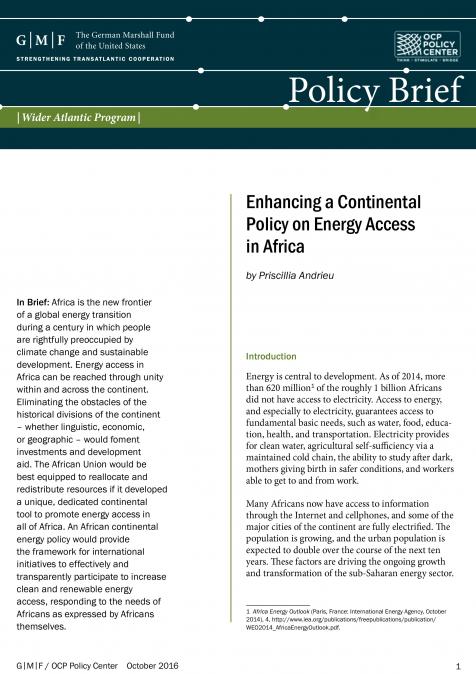 October 24, 2016Africa is the new frontier of a global energy transition during a century in which people are rightfully preoccupied by climate change and sustainable development. Energy access in Africa can be reached through unity within and across the continent. Eliminating the obstacles of the historical divisions of the continent – whether linguistic, economic, or geographic – would foment investments and development aid. The African Union would be best equipped to reallocate and redistribute ...

