Interview with Helmut Sorge "European elections – European menace"

May 23, 2019

Helmut Sorge - Columnist, PCNS - www.policycenter.ma

Speakers
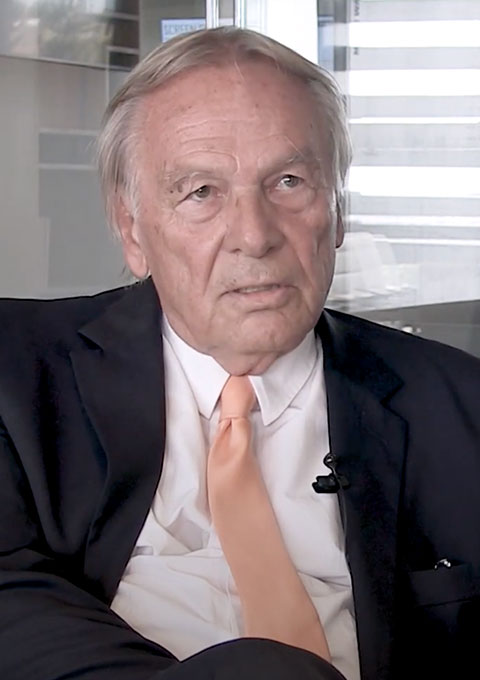
Helmut Sorge
Columnist
Helmut Sorge is a columnist at the Policy Center for the New South, where he publishes opinion pieces in the format of international press reviews of current events related to the Middle East and European affairs, and conducts interviews with high level policy makers and PCNS researchers. He is also a lecturer on journalism and the media. For over 40 years, Helmut Sorge served as a writer, former Foreign correspondent, Foreign editor, and Middle East expert for Germany's leading newsmagazine "Der Spiegel" to Washington, London, Paris and Los Angeles. He reported from Vietnam, the Middle East, wrote about safaris, nuclear accidents, visited prisoners on death row in the United States. The German weekly “Gala” summarized in 2011, when his latest book, a collection of biographies ...
RELATED CONTENT

  • February 18, 2026
    Following Donald Trump’s statements asserting that the United States should acquire Greenland, fundamental questions about sovereignty, alliances, and the authority of international law have resurfaced. The Greenland case reveals the tensions between security imperatives, alliance cohes...
  • February 13, 2026
    Le général Olivier Tramond analyse la réduction de la présence militaire française en Afrique comme un changement stratégique profond plutôt qu’un renoncement. Au-delà des coups d’État et ...
  • Authors
    February 13, 2026
    Le 27 janvier 2026, le gouvernement espagnol a adopté par décret royal une mesure de régularisation extraordinaire visant les personnes en situation administrative irrégulière ou engagées dans une procédure de protection internationale. Le choix du décret royal permet une mise en œuvre rapide de la mesure, sans passage par un débat parlementaire, dans un contexte politique fortement polarisé sur les questions migratoires.La régularisation concerne les personnes pouvant justifier d’u ...
  • Authors
    February 12, 2026
    Divergent regulatory regimes for data, driven by different motivations, ranging from privacy protection in the European Union to information control in China, could eventually produce distinctively different, and possibly contradictory, bodies of data. Artificial-intelligence models trained on those datasets could produce differing and possibly even conflicting outputs. To the extent that AI outputs start to shape human perception and to influence decisions, in governments and ...
  • January 30, 2026
    En 2019, Donald Trump a proposé d’acheter le Groenland, déclenchant un refus catégorique du Danemark et une tension diplomatique transatlantique. Cette initiative reflétait l’intérêt stratégique et économique des États-Unis pour l’Arctique et ses ressources. L’épisode a mis en lumière l...
  • Authors
    Gabriela Keseberg Dávalos
    January 26, 2026
    This Opinion was originally published by the Hanns Seidel Stiftung on January 19th, 2026. The author of this opinion, Gabriela Keseberg Dávalos, is a 2013 alumna of the Atlantic Dialogues Emerging Leaders Program. The signing of the EU–Mercosur agreement is a small geopolitical miracle. Signed on 17 January 2026 in Paraguay, it arrives at a moment when Europe is unmistakably being cast aside by the United States. Meanwhile Latin America, and with it, the Mer ...
  • Authors
    December 18, 2025
    The return of President Donald Trump to the White House at the start of 2025 was expected to signal an American retreat from international engagement, especially in regions of traditional security interest, such as southern Europe, North Africa, and the Middle East. To the surprise of many observers around the Mediterranean, and perhaps to the dismay of some in the Trump administration’s ideological orbit, this has not happened. If anything, the second half of 2025 has seen a high d ...
  • Authors
    December 16, 2025
    An unusual gesture indeed—the dictator, more often than not a recluse, withdrawn behind his fortress and protected by 1.2 million armed soldiers, finally admitted what had long been seen on the battlefield in Ukraine and by spy satellites far above. North Korean soldiers—possibly 12,000 of them—are fighting on front lines alongside Russian troops, and they are falling or being wounded; some 4,000 men so far, by current estimates.  ...