Interview Harry Verhoeven - University of Oxford

June 12, 2014

Interview with Harry Verhoeven - International Conference on The Water-Food-Energy Nexus in Drylands: Bridging Science and Policy 11-13 June 2014, Rabat, Morocco

Speakers

Harry Verhoeven
University of Oxford
Dr. Harry Verhoeven is a Senior Research Scholar at the Center on Global Energy Policy, focusing on the political economy of climate change, international relations and the linkages between water, energy and food security. His regional focus is on Africa, the Middle East and the Western Indian Ocean. He is the author of Water, Civilisation and Power in Sudan. The Political Economy of Military-Islamist State Building (Cambridge University Press) and Why Comrades Go To War. Liberation Politics and the Outbreak of Africa's Deadliest Conflict (with Philip Roessler, Oxford University Press/Hurst). He is also the editor of Environmental Politics in the Middle East. Local Struggles, Global Connections (Oxford University Press/Hurst) and of Marx and Lenin in Africa and Asia: Socialis ...

RELATED CONTENT

  • Authors
    Youssef Amrani
    December 22, 2015
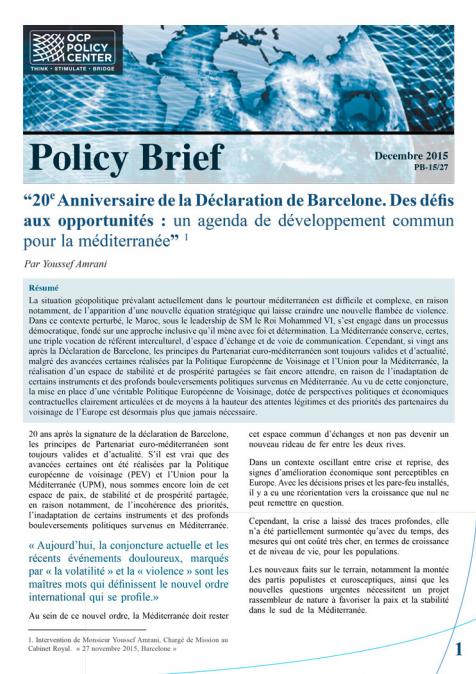
    La situation géopolitique prévalant actuellement dans le pourtour méditerranéen est difficile et complexe, en raison notamment, de l’apparition d’une nouvelle équation stratégique qui laisse craindre une nouvelle flambée de violence. Dans ce contexte perturbé, le Maroc, sous le leadership de SM le Roi Mohammed VI, s’est engagé dans un processus démocratique, fondé sur une approche inclusive qu’il mène avec foi et détermination. La Méditerranée conserve, certes, une triple vocation ...
  • Authors
    December 14, 2015
    The end of supply chain is the natural corollary of the sustained price fall of virtually all commodities observed over the past many months. If it appears premature to state exactly what is the impact of this deconsolidation in the commodities value chain, it is believed that the strategic role of physical trading is strengthening. Under such circumstances, the industrial strategies of developing countries and commodity exporters may have to evolve and, in priority, foster optimizi ...
  • Authors
    August 28, 2015
    The African endowment in mineral resources is well known and has often been a mixed blessing, according to the socalled “natural resources curse”. Bauxite, an ore that serves as a feedstock for aluminium production, is particularly present in Guinean soil but, notwithstanding its efforts to do so, this country has not yet succeeded in transforming this red treasure into a real source of social and economic development. Despite the difficult economic context and a long road ahead, th ...
  • Authors
    Karim EL MOKRI
    July 6, 2015
    « Les asymétries et l’instabilité du marché des matières premières dans les pays en développement : politiques et impacts sur le développement », une problématique d’un intérêt particulier pour ces pays, a fait l’objet d’un séminaire de recherche organisé par la Fondation pour les Etudes et Recherches sur le Développement International (Ferdi), les 24 et 25 juin 2015 à Clermont-Ferrand. Cet évènement a été tenu la veille du workshop co-organisé par la Ferdi et OCP Policy Center ...
  • Authors
    April 30, 2015
    Pour une économie ouverte, l’analyse des échanges internationaux recèle une importance capitale pour analyser ses perspectives de croissance. Bien des décisions individuelles portant sur la consommation, l’épargne et l’investissement sont, en effet, liées aux termes de l’échange. L’évolution de ces derniers, définis comme le rapport entre les prix à l’exportation et ceux à l’importation, est considérée comme un indicateur du pouvoir d’achat d’un pays et constitue une variable fort ...
  • Authors
    Benjamin Augé
    March 6, 2015
    L'appétit des pétroliers pour l'Afrique de l'Est a bien changé depuis 2006, où les premières découvertes en Ouganda ont été mises au jour. Il reste cependant encore difficile, pour un grand nombre d'investisseurs qui s'intéressent à cette région, d'appréhender l'ampleur du phénomène. Cette note permettra notamment de revenir sur la localisation des réserves, leurs volumes, le moment où elles seront développées, ce à quoi elles serviront et les freins à leur développement. Outre l'Ou ...
  • Authors
    Benjamin Augé
    March 6, 2015
    The position of oil companies toward East Africa has changed considerably since 2006 when the first reserves in Uganda came to light. However, for many investors interested in the region, it remains difficult to get a clear picture of the scale of developments of this sector. This paper will discuss the locations of reserves, their volumes, when they will be developed, what they will be used for, and possible impediments to their development. In addition to Uganda, Kenya, Tanzania a ...