Interview avec Yves Jégourel (Présentation du rapport ARCADIA 2019)

March 29, 2019

Présentation du rapport ARCADIA 2019 : l’Afrique et les marchés mondiaux de matières premières Yves Jégourel, Senior Fellow, Policy Center for the New South www.policycenter.ma

Speakers
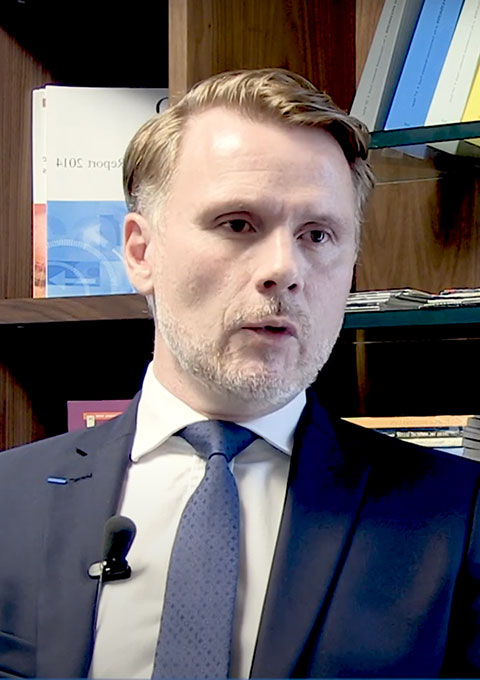
Yves Jégourel
Senior Fellow
Yves Jégourel is Senior Fellow at Policy Center for the New South as well as Full Professor and head of the Chair in “Economics of Raw Materials and Sustainable Transitions”, at the Conservatoire national des arts et métiers. He was previously a professor at the University of Bordeaux, where he directed the Master program in Banking, Finance and Commodity Trading (BFCT) and was vice-dean in charge of relations with companies in the Faculty of Economics, Management and ESA (EGAES). He devotes his teaching and research activities to the economics of commodities, with a particular focus on the common dynamics that characterize the agricultural, energy, and mineral and metal sectors: the internationalization of physical markets, the macroeconomic dependence of exporting countries ...
RELATED CONTENT

  • Authors
    May 22, 2026
    This paper, the fourth in a research series on services-led growth in the Global South, examines Egypt’s potential for growth and economic transformation through the integration of services into Global Value Chains (GVCs). It employs a new taxonomy that classifies services into Knowledge Services (KS), Enabling Services (ES), and Local Services (LS) and applies OECD 2025 Trade in Value-Added (TiVA), Trade in Employment (TiM), and input-output databases to benchmark Egypt against Mor ...
  • May 21, 2026
    Cette interview revient sur les enjeux du système financier marocain, son rôle dans le développement économique et les défis liés au financement des TPME. Le professeur Ben Moussa analyse également les limites du modèle bancaire actuel, l’internationalisation des banques marocaines en A...
  • May 20, 2026
    La participation des femmes au marché du travail au Maroc demeure l'un des défis les plus structurels du développement économique et social du pays. Avec un taux d'activité féminin de seulement 19 % en 2023, contre 69 % pour les hommes (HCP, 2024), le Maroc présente l'un des écarts de genre les plus prononcés parmi les économies en développement (Banque mondiale, 2024). Ce Research Paper propose une analyse économétrique rigoureuse et multiniveaux des déterminants de cette participa ...
  • May 20, 2026
    تتناول هذه الحلقة واقع المنظومة المينائية في المغرب ودورها الاستراتيجي في تعزيز مكانة المملكة كفاعل رئيسي في الاقتصاد الأزرق على مستوى أفريقيا. وتسلط الضوء على تطور البنيات التحتية المينائية، خاصة مع مشاريع كبرى مثل ميناء طنجة المتوسط، التي تساهم في تعزيز الربط التجاري واللوجستي بين أفر...
  • Authors
    Eugène Berg
    May 19, 2026
    L’Organisation pour la coopération et le développement économiques (OCDE), forte de 38 membres, a longtemps fait figure d’Organisation regroupant les « démocraties industrielles développées ». Cette image n’est plus vraie, du fait de l’adhésion en son sein de pays, qualifiés jadis en développement, et que l’on considère souvent comme faisant partie du « Sud global ». C’est ainsi que l’ont intégrée : le Mexique (1994), qui lui a donné un Secrétaire général, Angel Gurria, la Corée du ...
  • Authors
    May 15, 2026
    This paper is the third in a series of country and comparative studies that together comprise a research program on services as drivers of economic growth and structural transformation in the Global South. The paper analyzes the pattern of Tunisia's services-led economic growth from 2012- 2022 using a specialized three-category framework: knowledge services (KS), enabling services (ES), and local services (LS). Using data from the OECD Trade in Value Added (TiVA), Trade in Employmen ...
  • May 15, 2026
    In this podcast recorded during the Growth Summit, Naomi Kengurungu, Director of Marketing and Communication at the African Management Institute, discusses the key conditions needed for h ...
  • Authors
    Jorge Arbache
    May 14, 2026
    Decarbonization is reconfiguring global relative prices. As clean energy, natural capital, and location-specific assets become dominant industrial inputs, the relative cost of producing low-carbon goods is increasingly determined by geography. Two systematic distortions explain why the expected reallocation of investment toward renewable-rich economies remains incomplete. First, industrial policy interventions, including subsidies, trade barriers, and certification systems, disconne ...
  • May 14, 2026
    In this episode of Africafé, Neema CHUSSI discusses the opportunities and challenges artificial intelligence presents for Africa. She highlights the need for the continent to develop its own AI governance approach, rooted in African democratic values, while addressing critical issues su...