Interview avec Yves Jégourel (Présentation du rapport ARCADIA 2019)

March 29, 2019

Présentation du rapport ARCADIA 2019 : l’Afrique et les marchés mondiaux de matières premières Yves Jégourel, Senior Fellow, Policy Center for the New South www.policycenter.ma

Speakers
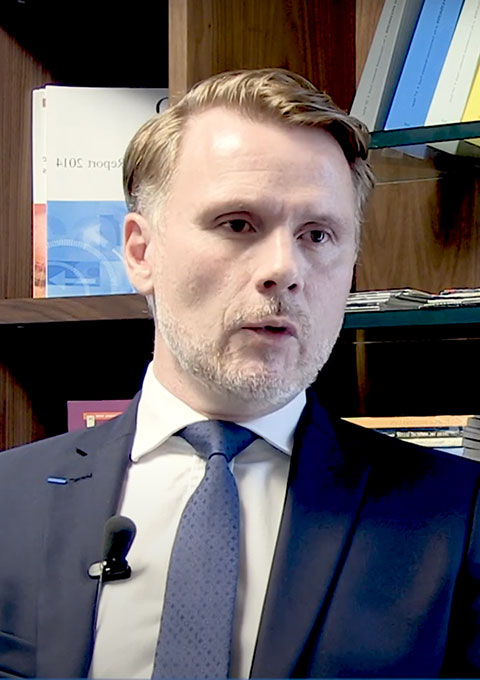
Yves Jégourel
Senior Fellow
Yves Jégourel is Senior Fellow at Policy Center for the New South as well as Full Professor and head of the Chair in “Economics of Raw Materials and Sustainable Transitions”, at the Conservatoire national des arts et métiers. He was previously a professor at the University of Bordeaux, where he directed the Master program in Banking, Finance and Commodity Trading (BFCT) and was vice-dean in charge of relations with companies in the Faculty of Economics, Management and ESA (EGAES). He devotes his teaching and research activities to the economics of commodities, with a particular focus on the common dynamics that characterize the agricultural, energy, and mineral and metal sectors: the internationalization of physical markets, the macroeconomic dependence of exporting countries ...

RELATED CONTENT

  • Authors
    January 30, 2026
    The 2026 World Economic Forum (WEF) Annual Meeting took place in an environment of elevated economic uncertainty and structural risk repricing. According to the Global Risks Report (GRR) 2026, geoeconomic confrontation and economic downturn rank among the most severe near-term risks, while inflation-related risks and economic volatility have risen sharply in perceived severity compared with the previous edition. Notably, 50% of respondents to the Global Risks Perception Survey ...
  • January 29, 2026
    Le Mali, le Burkina Faso et le Niger, réunis au sein de l’Alliance des États du Sahel (AES), affirment l’ambition de bâtir une souveraineté nationale qui leur permettrait de s’émanciper de la domination et des influences extérieures et de se doter d’une liberté d’action dans les choix de développement politique et économique. Cependant, cette ambition se heurte à de nombreuses contraintes économiques et sécuritaires.La souveraineté ne peut se construire sans une base économique soli ...
  • Authors
    January 27, 2026
    This paper revisits Big Push industrialization theory in the context of open economies deeply integrated into global value chains (GVCs). While classical Big Push models emphasize demand complementarities and coordination failures in largely closed economies, many middle-income countries now industrialize through foreign-owned, import-intensive production networks. We develop an extended Big Push framework that incorporates GVC integration and import leakage, and show how these feat ...
  • January 23, 2026
    The post-1945 international order, an architecture born of war-weariness and colonial twilight, is now a majestic but empty shell. Its foundational promise—a universal system of rules administered impartially—has been hollowed out by decades of selective enforcement, instrumentalized law, and a chasm between the rhetorical ideals of its custodians and their geopolitical practice. This is not a temporary dysfunction, but a systemic failure of legitimacy. From the invasion of Iraq und ...
  • Authors
    January 23, 2026
    Introduction: COP30 as a Test of Reality, Not AmbitionCOP30 in Belém was never going to be a breakthrough. In a world marked by fiscal exhaustion, geopolitical rivalry, and eroding trust in multilateralism, expecting transformational climate cooperation bordered on denial. The choice of the Amazon as host carried symbolic weight, but symbolism does not override power, interests, or institutional capacity.The outcome of COP30 confirms a deeper truth: the global climate regime has ent ...
  • Authors
    January 21, 2026
    In response to developing countries’ dissatisfaction with the New Collective Quantified Goal (NCQG) of $300 billion, which was decided at the Twenty-Ninth Conference Of the Parties (COP29) to the United Nations Framework Convention on Climate Change, in 2024 in Baku, Azerbaijan, the COP29 and COP30 presidencies promised to develop a roadmap to achieve $1.3 trillion in external climate finance that developing countries need, and to present it at COP30 in Belém, Brazil[1]. The two pre ...
  • Authors
    January 20, 2026
    This policy brief examines what the 2025–2026 period reveals about the future of global energy risk and the energy transition. After the shocks of 2021–2023, 2025 brought broad price easing: oil and coal prices declined as supply growth outpaced demand, and the World Bank projects further declines in the global energy price index in 2026, offering short-term relief for energy-importing economies. The brief argues, however, that the macroeconomic relevance of energy entering 202 ...
  • January 13, 2026
    Central banks are facing a new era where crypto and AI are reshaping how money is managed. Traditional monetary policies are evolving to meet these technological and financial challenges. This episode explores the risks, opportunities, and innovations redefining the future of finance. D...
  • Authors
    January 13, 2026
    This policy brief was originally published on : euromesco.net This paper examines the nexus between governance structures, digital transformation, sustainability, and port service efficiency through an international comparative lens, with a specific focus on the Tanger Med–Algeciras corridor in the strait of Gibraltar. Using global best practices—from Singapore to Busan and Kaohsiung—it explores how public-private coordination, digital innovation, and green transition policies ...