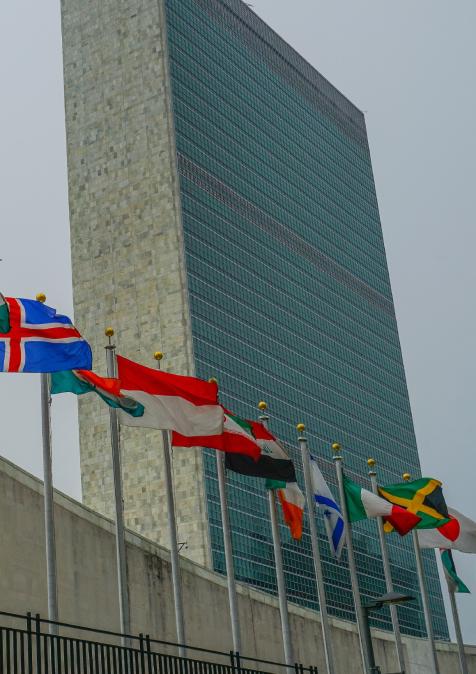
Gouvernance et biens communs : repenser la coopération dans un monde fragmenté

January 16, 2025

Alors que les défis globaux – changement climatique, transition énergétique, montée des conflits – s'accumulent, les outils multilatéraux peinent à offrir des solutions efficaces. La montée du protectionnisme et des intérêts nationaux exacerbe ces tensions, tandis que l'Afrique, riche en ressources stratégiques, s'impose comme un acteur incontournable. La souveraineté économique, la transformation locale des ressources et l'équité dans les échanges deviennent des impératifs pour une gouvernance mondiale qui réponde véritablement aux besoins des populations et des générations futures.

Speakers

Akram Zaoui
Chargé de Mission to the Executive President
Akram Zaoui is a Senior International Relations Specialist and Chargé de Mission to the Executive President at the Policy Center for the New South (PCNS). Prior to this, he was Manager of Research Support and the Public Policy Lab at the PCNS. His main area of interest is the geopolitical economy of the Extended Middle East and North Africa (MENA) region. From 2018 to 2020, Zaoui was the coordinator of a network of 70+ civil society organizations (CSOs) across France, working with foundations, government, local communities, and the private sector. Zaoui holds a dual degree in corporate and public management from HEC Paris and Sciences Po, as well as a bachelor's degree (licence) in history from Université Paris 1 Panthéon-Sorbonne. He audited courses in Iranian and Shia Stud ...


  • February 20, 2026
    تناول هذا البودكاست، المنظم على هامش الدورة الرابعة عشرة من منتدى الحوارات الأطلسية، الدور الاستراتيجي للممرات البحرية باعتبارها رافعة للتنمية ومحركاً لإدماج اقتصادات الجنوب في التجارة ال ...
  • February 19, 2026
    This Africafe's episode examines Brazil-Africa relations: historical ties shaped by the slave trade and diaspora, Lula’s trade expansion, and competition with China/EU. It explores South-South diplomacy’s potential to reshape global institutions, the role of “South Atlanticism,” and fut...
  • February 18, 2026
    Following Donald Trump’s statements asserting that the United States should acquire Greenland, fundamental questions about sovereignty, alliances, and the authority of international law have resurfaced. The Greenland case reveals the tensions between security imperatives, alliance cohes...
  • Authors
    February 17, 2026
    La Marche Verte fait partie de ces moments féconds qui n’ont pas cessé d’influer sur le cours des événements politiques du Maroc, par la place qu’elle a prise, dès le départ, dans la longue durée, le contexte dans lequel elle s’est déployée, la logique des interactions dans laquelle elle s’est inscrite par ses causes et ses effets, et comme une des figures éclatantes du récit national. ...
  • February 13, 2026
    Le général Olivier Tramond analyse la réduction de la présence militaire française en Afrique comme un changement stratégique profond plutôt qu’un renoncement. Au-delà des coups d’État et ...
  • Authors
    Sofia Formigli
    February 13, 2026
    There is a story told by Václav Havel, the Czech dissident writer who later became president after the fall of communism. In his essay The Power of the Powerless, Havel describes a shopkeeper who, every morning, places a sign in his window reading: “Workers of the world, unite!” He does not believe in it. Nor do the people around him. Yet the sign remains. ...
  • Authors
    February 13, 2026
    Le 27 janvier 2026, le gouvernement espagnol a adopté par décret royal une mesure de régularisation extraordinaire visant les personnes en situation administrative irrégulière ou engagées dans une procédure de protection internationale. Le choix du décret royal permet une mise en œuvre rapide de la mesure, sans passage par un débat parlementaire, dans un contexte politique fortement polarisé sur les questions migratoires.La régularisation concerne les personnes pouvant justifier d’u ...
  • Authors
    February 12, 2026
    Divergent regulatory regimes for data, driven by different motivations, ranging from privacy protection in the European Union to information control in China, could eventually produce distinctively different, and possibly contradictory, bodies of data. Artificial-intelligence models trained on those datasets could produce differing and possibly even conflicting outputs. To the extent that AI outputs start to shape human perception and to influence decisions, in governments and ...