(FR) The Moroccan fishing sector and sustainable development

June 3, 2026

Cet épisode met en lumière les défis et perspectives du secteur halieutique marocain à travers l’analyse du Pr. Abdelkabir Kamili. Il souligne que la durabilité des ressources marines n’est pas un frein à la croissance économique, mais une condition essentielle pour garantir la performance future du secteur, grâce à une gestion scientifique des stocks, la valorisation des produits et le développement d’une aquaculture durable. Face aux défis du changement climatique et à la volatilité des marchés internationaux, l’entretien met également en avant l’importance de la diversification, de l’innovation et du renforcement de la résilience du secteur.
 

Speakers

Abdelkabir Kamili
Assistant Professor, Mohammed VI Polytechnic University, Rabat
Abdelkabir Kamili, PhD in Economic and Social Sciences Applied to Agriculture from the Agronomic and Veterinary Institute—Hassan II, also holds a Master’s in Fisheries Economics and Management from the University of Barcelona and an Engineer Diploma in Rural Economics from the National School of Agriculture in Meknes. He teaches National Accounting & Macroeconomic Aggregates, and Global Public Goods & International Aid at Mohammed VI Polytechnic University. A former researcher at the National Fisheries Research Institute, he specializes in bioeconomic and computable general equilibrium (CGE) modelling, promoting sustainable fisheries through his publications on Moroccan fishery systems and contributions to FAO projects. ...

Rim Berahab
Senior Economist
Rim Berahab is Senior Economist at the Policy Center for the New South, which she joined in 2014. She is currently working on themes related to energy issues and their impacts on economic growth and long-term development. Her research areas also cover trade and regional integration challenges in Africa. Previously, she has also worked on questions related to gender inequalities in the labor market of North African countries. Rim spent three months at the International Monetary Fund (IMF), in 2016, in the Commodities Unit of the Research Department. She holds a State Engineering degree from the National Institute of Statistics and Applied Economics (INSEA). ...

RELATED CONTENT

  • Authors
    March 16, 2022
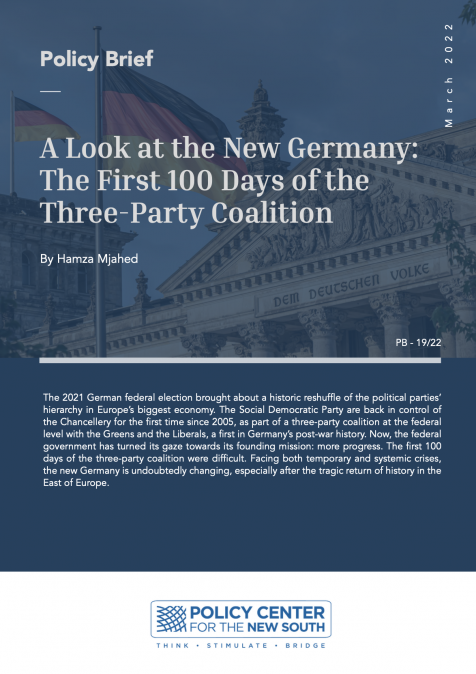
    The 2021 German federal election brought about a historic reshuffle of the political parties’ hierarchy in Europe’s biggest economy. The Social Democratic Party are back in control of the Chancellery for the first time since 2005, as part of a three-party coalition at the federal level with the Greens and the Liberals, a first in Germany’s post-war history. Now, the federal government has turned its gaze towards its founding mission: more progress. The first 100 days of the three-pa ...
  • Authors
    February 9, 2022
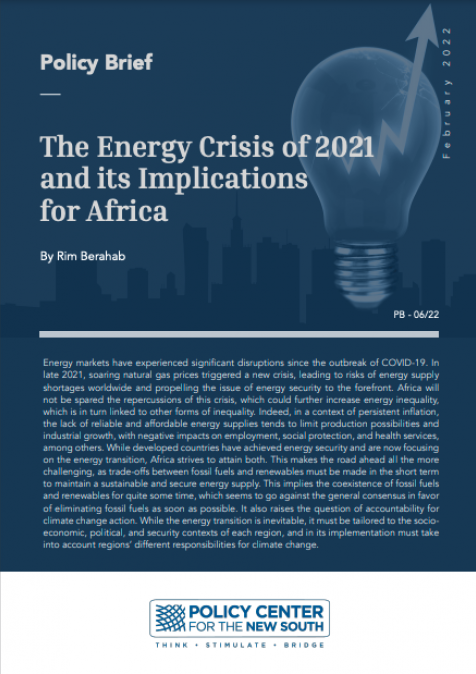
    Energy markets have experienced significant disruptions since the outbreak of COVID-19. In late 2021, soaring natural gas prices triggered a new crisis, leading to risks of energy supply shortages worldwide and propelling the issue of energy security to the forefront. Africa will not be spared the repercussions of this crisis, which could further increase energy inequality, which is in turn linked to other forms of inequality. Indeed, in a context of persistent inflation, the lack o ...
  • Authors
    Morten Seja
    Charlie Knight
    Hadley Hilgenhurst
    Amlan Banerjee
    Omair Azam
    January 31, 2022
    Setting the Scene for the Current State of Inclusive Green FinanceClimate change is one of, if not the biggest, challenges facing the world. The challenge extends to banking regulators, who, in addition to other responsibilities, are now tasked with ensuring financial inclusion and climate change mitigation. However, central banks realizing how important inclusion and climate change are is only the first step. As part of this process, they need to understand how to define Inclusive ...
  • Authors
    Morten Seja
    Hadley Hilgenhurst
    Charlie Knight
    January 25, 2022
    Why Green Finance Taxonomies? The increasing effort to mitigate climate change has caused more and more individuals, governments, and companies to shift away from traditional financial investments and activities, and towards more environmentally-friendly alternatives. However, until recently, there has been a lack of consensus on what green finance and its environmental impact is. Thus, green finance taxonomies are needed to provide classification systems that identify how environm ...
  • Authors
    January 13, 2022
    “This opinion was prepared within the framework of the Jean Monnet Atlantic Network 2.0. The European Commission's support for the production of this publication does not constitute an endorsement of the contents, which reflect the views only of the authors, and the Commission cannot be held responsible for any use which may be made of the information contained therein.”   As part of the lengthy fight against climate change, the European Union (EU) has introduced a Border Car ...
  • December 31, 2021
    In 2021 we’ve had the opportunity to host more than 50 experts in 60 episodes. We discussed economic, international relations, commodities, energy, gender, and security issues affecting t ...
  • Authors
    Morten Seja
    December 20, 2021
    A Case for Regulators to Green Financial Inclusion Financial Inclusion is an Excellent Tool for Combating Poverty It is well known that supporting financial inclusion is a relevant tool in lifting people out of poverty. There is plenty of empirical evidence showing that financial inclusion significantly reduces poverty and income inequality in developing countries. Concerted efforts to support financial inclusion globally have existed since the United Nations Capital Development ...
  • Authors
    December 10, 2021
     Accelerating the transition toward low or net-zero carbon emissions is necessary to keep global warming at theoretically safe levels. That will likely bring price shocks associated with rising metal prices, energy costs, and carbon taxes – what has been called “greenflation”. Greening the economy will also require public spending and redistributive policies. ...
  • October 01, 2021
    The climate crisis is a latent threat that has been brewing for several years. Its repercussions affect both individuals and economies. Since the Paris Agreement, progress has stalled in ...