(FR) The financial and banking industry in Morocco

May 21, 2026

Cette interview revient sur les enjeux du système financier marocain, son rôle dans le développement économique et les défis liés au financement des TPME. Le professeur Ben Moussa analyse également les limites du modèle bancaire actuel, l’internationalisation des banques marocaines en Afrique, ainsi que les réformes nécessaires pour renforcer le financement de l’économie et accompagner les grands projets stratégiques du Royaume
 

Speakers

Mohammed Benmoussa
Affiliate Professor, Mohammed VI Polytechnic University, Rabat
Mohammed Benmoussa is a Moroccan economist and senior consultant in economic policy, taxation, and public finance, as well as a former banker and capital market practitioner. He is Professor of Corporate and Market Finance at Mohammed VI Polytechnic University. In December 2019, he was appointed by HM King Mohammed VI to the Special Commission on the New Development Model. He is also President of the Forum of Progressive Economists, President of the Damir Movement and the La Samir Front. He previously served as President of the Brokerage Firms Association and Vice-President of the Casablanca Stock Exchange. ...

Oumayma Bourhriba
Senior Economist
Oumayma Bourhriba is a Senior Economist at the Policy Center for the New South (PCNS).At the PCNS, which she joined in 2019, Oumayma Bourhriba conducts research focusing on macroeconomic policies and international trade, with a particular emphasis on services.She has contributed to major publications on the Moroccan economy, such as the IMF’s Morocco's Quest for Stronger and Inclusive Growth (2023) and the World Bank’s Trade Policy in Morocco: Taking Stock and Looking Ahead (2023). Beyond her research, she has coordinated the Africa Economic Symposium, one of the flagship convenings organized by the PCNS.Oumayma Bourhriba holds a master’s degree in applied economics from University Mohammed V (UM5), where she is currently a PhD candidate.She is fluent in Arabic, English, ...
RELATED CONTENT

  • Authors
    Sandiso Sibisi
    July 17, 2019
    Despite considerable effort from the South African government to drive innovation, the investments to date have not reaped the fruits expected by both government and the private sector. I believe that if we are to realise ‘the new dawn’ in economic growth and transformation the state needs to reorganise itself to be an ‘entrepreneurial state’. This paper will proceed firstly by outlining current government action to support innovation, followed by a summary of the overarching recomm ...
  • Authors
    Comité scientifique :
    Ahmed Bousselhami
    Idriss El Abbassi
    Amine Marrat
    Lahcen Oulhaj
    Aziz Ragbi
    Said Tounsi
    June 13, 2019
    L’analyse des mutations qu’a connues l’économie marocaine après la crise économique et financière de 2008, offre l’opportunité d‘évaluer l’orientation des politiques macroéconomiques gérées dans un contexte relativement difficile, mettant à l’épreuve les décideurs publics en matière de politique économique et leur engagement à préserver la stabilité du cadre macroéconomique. Un diagnostic approfondi revient à apprécier la pertinence des choix de politiques macroéconomiques par rappo ...
  • Authors
    Mohamed Obaidy
    May 30, 2019
    This paper empirically examines the impact of exchange rate arrangements on current account imbalances within the African context. Following Friedman’s hypothesis (Friedman, 1953), we test the propositions stating that flexible exchange rate regimes limit the magnitude of real external shocks and permit smoother adjustments of external imbalances. Using a new de facto exchange rate regime classification, we employ two empirical methodologies to test this hypothesis: we first apply a ...
  • Authors
    Mouhamadou Moustapha Ly
    May 29, 2019
    The world economy has gone through several systems to determine a value between country’s currencies. After the Second World War and the so-called gold standards, major world economies engaged into a system of fixed exchange rate of currencies against the dollar and, the whole system was backed by the value of USD against gold. After the end of that mechanism known as the Bretton Wood system in the 1970s, major world economies decided to liberalize the system of international exchan ...
  • Authors
    Sous la direction de
    Philippe Chalmin
    April 9, 2019
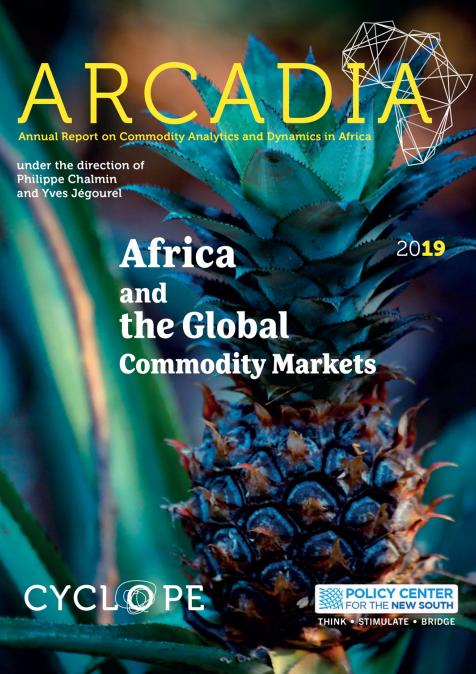
    Les cours des matières premières ont, une fois encore, été marqués par une importante volatilité en 2017 et 2018. Si de nombreux facteurs économiques permettent de l’expliquer, la raison politique fut également bien présente. Les Annual Report tensions commerciales entre la Chine et les États-Unis on Commodity et, plus globalement, la montée des incertitudes ont pesé Analytics and sur les perspectives macroéconomiques mondiales et sur Dynamics « le dynamisme des marchés ». Comptant ...
  • Authors
    April 5, 2019
    Next week, the 2019 Spring Meeting of the International Monetary Fund (IMF) and the World Bank will take place in Washington, in this 75th year since the birth of the two institutions. Christine Lagarde, the IMF's managing director, speaking on Tuesday at the US Chamber of Commerce, offered an appetizer about the macroeconomic projections to be released. Last January, the IMF reduced its forecast of global economic growth to 3.5 percent in 2019 and 2020, lower rates ...
  • Authors
    Ahmed Rachid El-Khattabi
    March 22, 2019
    The author of this blog, Ahmed Rachid El Khattabi, is an alumnus of the 2018 Atlantic Dialogues Emerging Leaders program Rapid urbanization and climate change are two of the biggest challenges for cities. As much of the world is urbanizing, cities are growing thirstier, constantly seeking out new water supplies to keep up with demand. These challenges are especially significant for many growing cities that, due to historical reasons, are not located near water resources. Climate ch ...
  • Authors
    March 5, 2019
    China’s economic growth has been in a downslide trend since 2011, while its economic structure has gradually rebalanced toward lower dependence on investments and current-account surpluses. Steadiness in that trajectory has been accompanied by rising levels of domestic private debt, as well as slow progress in rebalancing private and public sector roles. As the ongoing trade war with the US continues to unfold, it remains unclear at which growth pace China’s rebalancing will tend to ...
  • Authors
    Philippe Chalmin
    February 27, 2019
    Rarement, autant qu’en 2018, les marchés mondiaux de matières premières et de commodités auront été lle jouet non pas des tendances des « fondamentaux » (offre/demande et leur évolution), mais bien des convulsions d’une situation géopolitique mondiale qui, sous la houlette quelque peu déréglée des États-Unis de Donald Trump, a été particulièrement imprévisible. En effet, si 2018 restera dans les annales des marchés, c’est bien parce que les matières premières se sont retrouvées au p ...