Publications /
Policy Brief

Back
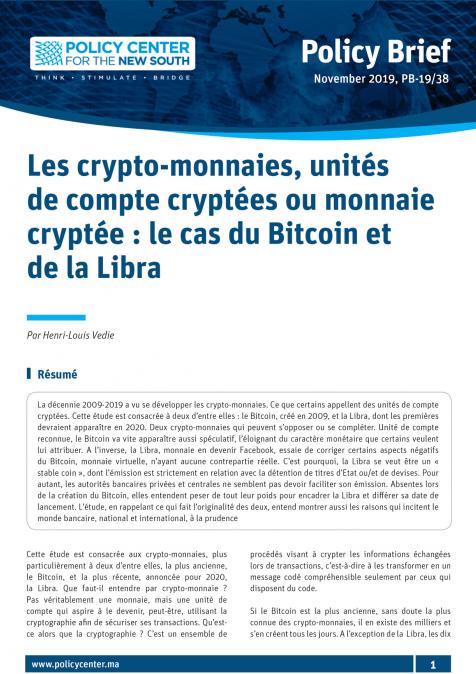
Les crypto-monnaies, unités de compte cryptées ou monnaie cryptée : le cas du Bitcoin et de la Libra
November 13, 2019

La décennie 2009-2019 a vu se développer les crypto-monnaies. Ce que certains appellent des unités de compte cryptées. Cette étude est consacrée à deux d’entre elles : le Bitcoin, créé en 2009, et la Libra, dont les premières devraient apparaître en 2020. Deux crypto-monnaies qui peuvent s’opposer ou se compléter. Unité de compte reconnue, le Bitcoin va vite apparaître aussi spéculatif, l’éloignant du caractère monétaire que certains veulent lui attribuer. A l’inverse, la Libra, monnaie en devenir Facebook, essaie de corriger certains aspects négatifs du Bitcoin, monnaie virtuelle, n’ayant aucune contrepartie réelle. C’est pourquoi, la Libra se veut être un « stable coin », dont l’émission est strictement en relation avec la détention de titres d’Etat ou/et de devises. Pour autant, les autorités bancaires privées et centrales ne semblent pas devoir faciliter son émission. Absentes lors de la création du Bitcoin, elles entendent peser de tout leur poids pour encadrer la Libra et différer sa date de lancement. L’étude, en rappelant ce qui fait l’originalité des deux, entend montrer aussi les raisons qui incitent le monde bancaire, national et international, à la prudence

Cette étude est consacrée aux crypto-monnaies, plus particulièrement à deux d’entre elles, la plus ancienne, le Bitcoin, et la plus récente, annoncée pour 2020, la Libra. Que faut-il entendre par crypto-monnaie ? Pas véritablement une monnaie, mais une unité de compte qui aspire à le devenir, peut-être, utilisant la cryptographie afin de sécuriser ses transactions. Qu’estce alors que la cryptographie ? C’est un ensemble de procédés visant à crypter les informations échangées lors de transactions, c’est-à-dire à les transformer en un message codé compréhensible seulement par ceux qui disposent du code.

RELATED CONTENT

  • Authors
    July 16, 2026
    Thanks to the AI investment boom, the U.S. economy has performed well at the macroeconomic level. However, it is on an unsustainable fiscal and debt path. Mr. Trump’s fiscal policy in his second term has aggravated this trajectory. In turn, Mr. Trump’s tariff-based trade policy has failed to address what he sees as U.S. economic problems associated with the trade balance. Besides explaining why this has been the case, and what its implications are for the U.S. economy and the r ...
  • July 15, 2026
    تناقش هذه الحلقة واقع المنافسة في الأسواق المغربية وعلاقتها بتطور الأسعار والقدرة الشرائية للمواطنين. كما تسلط الضوء على أبرز العوامل المؤثرة في الأسعار، سواء المرتبطة بالمنافسة أو بتكاليف الإنتاج وسلاسل التوزيع. ويتناول الحوار دور مجلس المنافسة والسلطات العمومية والفاعلين الاقتصاديين ف...
  • Authors
    July 13, 2026
    This paper provides a structural assessment of India’s services-led development trajectory, and its integration into global value chains (GVCs) between 2012 and 2022. Applying an analytical framework that categorizes services into knowledge (KS), enabling (ES), and local (LS) sectors, the study utilizes sixteen OECD indicators to move beyond the narrative of India as a ‘services champion’ and reveal a more complex economic reality. The analysis identifies three central structur ...
  • Authors
    July 13, 2026
    This paper examines the evolution of China’s services sector between 2012 and 2022, analyzing the country’s structural transformation based on a novel three-tier taxonomy: knowledge services (KS), enabling services (ES), and local services (LS). Using sixteen quantitative indicators from OECD databases, the study evaluates China’s transition in comparison to the EU15 benchmark, highlighting three core challenges: manufacturing rebalancing, labor absorption, and global integration.Th ...
  • Authors
    Edited by
    July 13, 2026
    Available soon on livremoi. The 2026 edition of the Annual Report on the African Economy examines the issue of the valorization of Africa’s natural resources, particularly its mineral wealth. While the continent holds some of the world’s largest known reserves of a wide range of minerals and metals, the objective is not merely to catalogue these resources, but rather to explore the conditions under which natural resource endowments can be transformed into drivers of Africa’s in ...
  • July 3, 2026
    This Policy Paper has also been published in French and Spanish by Le Grand Continent Morocco offers a compelling example of how a middle-income economy can navigate a more fragmented global environment, characterized by weak growth and slower convergence. Since 2022, economic activity has remained relatively strong, with growth exceeding that of many comparable economies. Non-agricultural growth has averaged 4.4% since 2022, around 1.3 percentage points above its historical av ...
  • Authors
    July 2, 2026
    Africa is facing a massive electricity deficit that is impacting its economic and social development, and its ability to catch up with the rest of the world. It is imperative that the continent increase its electricity production to connect the 600 million people who are currently without access and to improve the quality of service for the millions who are suffering from frequent blackouts and load-shedding. Economic development in the 21st century will crucially depend on the digi ...
  • June 26, 2026
    Au Maroc, la problématique des jeunes NEETs (Ni en emploi, ni en études, ni en formation) constitue une urgence nationale, alimentée par 300 000 abandons scolaires annuels. Face à ce défi, le modèle de l'École de la Deuxième chance nouvelle génération (E2C-NG) a démontré sa pertinence en affichant un taux d'insertion exceptionnel de 81 %.Cependant, ce succès institutionnel repose intégralement sur un tissu associatif local aujourd'hui fragilisé. L'analyse inédite des donné ...
  • June 22, 2026
    History devotes considerable attention to the rise and fall of great powers. Scholars have spent centuries analyzing why empires collapse, why nations decline, and why dominant states eventually lose their position. By comparison, relatively little attention has been devoted to a different question: what happens when a country succeeds beyond its own expectations? ...
  • Authors
    Diogo Ramos Coelho
    Bruno Saraiva
    June 22, 2026
    Global imbalances are back—and this time the risks look different. The 2008 financial crisis showed how persistent current-account deficits and surpluses between major economies can fuel financial instability and trigger sudden, severe reversals of capital flows. After almost two decades, many thought that episode had been resolved. It had not. New imbalances have built up, with a familiar cast: China, Germany, Japan, and oil exporters running large surpluses, and the United States ...