(FR) The external sector of the Moroccan economy

June 4, 2026

Cet épisode revient sur les principaux enseignements du chapitre consacré au secteur extérieur marocain, en mettant en lumière le paradoxe d’un déficit commercial structurel persistant combiné à une forte résilience des équilibres externes. Badr Mandry explique comment les transferts des Marocains résidant à l’étranger, les recettes touristiques et les investissements directs étrangers jouent un rôle d’amortisseurs face aux chocs externes, tout en soulignant la nécessité de diversifier les exportations et d’accélérer la transition énergétique pour renforcer durablement la soutenabilité du modèle marocain.
 

Speakers
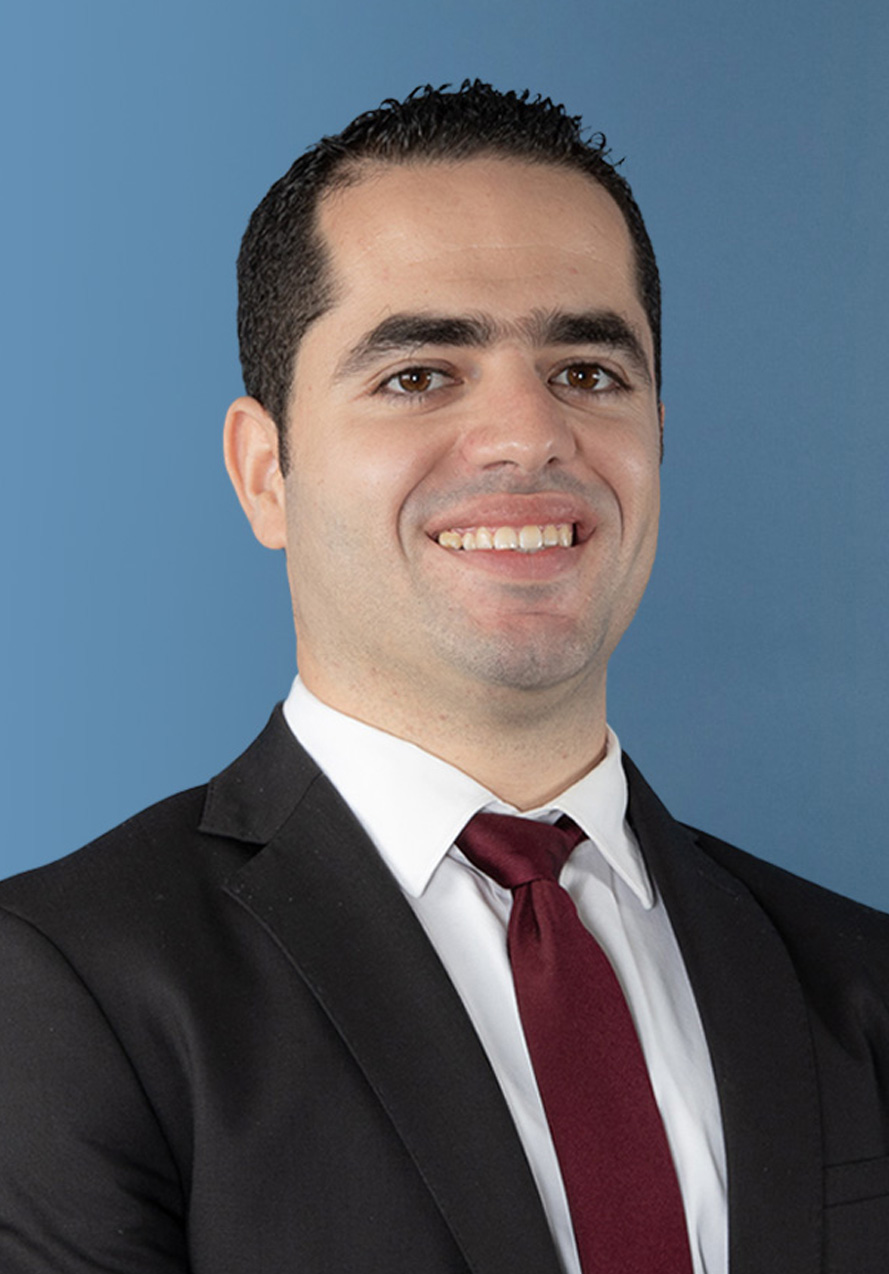
Hamza Saoudi
Senior Economist
Hamza Saoudi is a Senior Economist at the Policy Center for the New South (PCNS).At the PCNS, Hamza Saoudi conducts research on labor market dynamics, social protection systems, and inclusive growth, with a particular focus on Morocco and Africa. He is also interested in macroeconomic stabilization policies, international trade, and long-term economic development.He has contributed to PCNS projects and publications addressing informality, social protection, and inequality in developing economies.He also served as the project coordinator of the Oxford Handbook of the Moroccan Economy, published by Oxford University Press in 2026.Before joining the PCNS in 2017, Hamza Saoudi contributed to the development of quantitative models for bank credit risk management.Hamza Saoudi holds ...
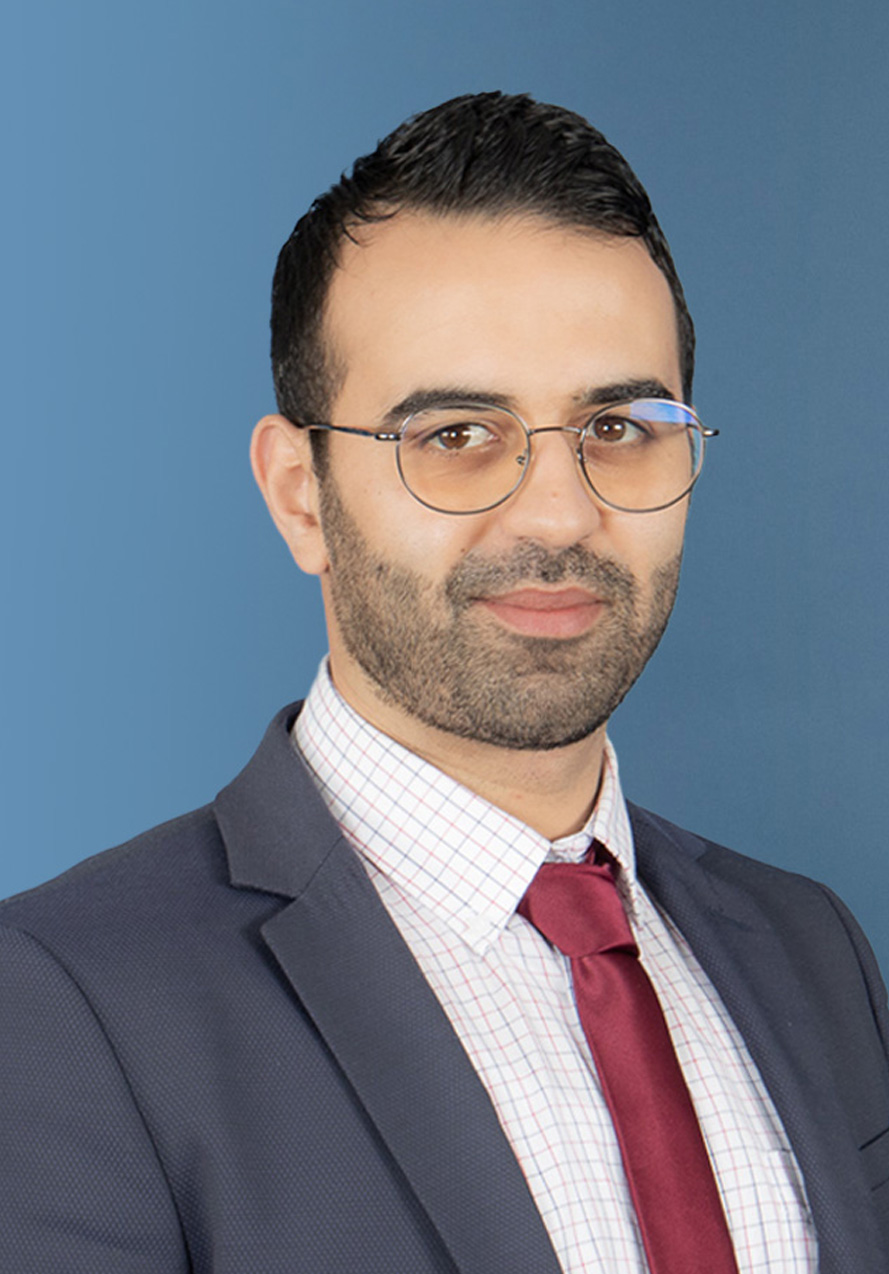
Badr Mandri
Economist
Badr Mandri is a Senior Economist at the Policy Center for the New South (PCNS), after an experience at Morocco's Haut-Commissariat au Plan (HCP). His research focuses primarily on macroeconomics, commodity markets, and development economics, having notably directed a collective volume on human capital. He also serves as an executive trainer at Mohammed VI Polytechnic University (UM6P), delivering specialized programs on public finance and fiscal policy for public sector professionals.Badr Mandri holds a Master's degree in Applied Economics from Mohammed V University in Rabat. ...

RELATED CONTENT

  • Authors
    Mohamed Hamza Sallouhi
    March 23, 2016
     Partie 1. Le ralentissement économique de la Chine : une transition inquiétante  L’incertitude sur les marchés financiers, la transition de l’économie chinoise vers un modèle de croissance moins extraverti et le ralentissement du rythme de la croissance des pays émergents, sont autant de facteurs qui fragilisent considérablement une croissance mondiale durable et synchronisée. Dans ce contexte, l’OCP Policy Center a tenu une table ronde animée par Patrick Artus ...
  • Authors
    Zouhair Aït Benhamou
    March 2, 2016
    Discrepancies in output fluctuations between emerging and developed economies are well documented in the literature. Differences however within developing economies have not been sufficiently scrutinised. This paper argues that global and regional shocks primarily drive the business cycle in emerging economies, and provides estimated results for cycle variance decomposition. The paper also offers a theoretical framework to check on the set of stylized facts common and specific to em ...
  • Authors
    Russel Dinh
    January 27, 2016
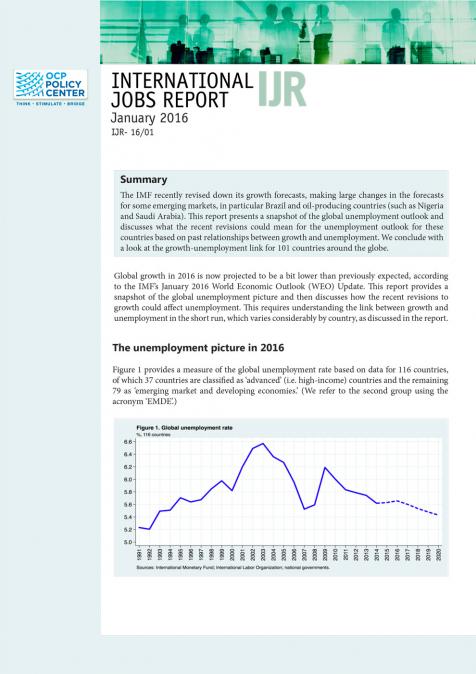
    The IMF recently revised down its growth forecasts, making large changes in the forecasts for some emerging markets, in particular Brazil and oil-producing countries (such as Nigeria and Saudi Arabia). This report presents a snapshot of the global unemployment outlook and discusses what the recent revisions could mean for the unemployment outlook for these countries based on past relationships between growth and unemployment. We conclude with a look at the growth-unemployment link f ...
  • Authors
    December 23, 2015
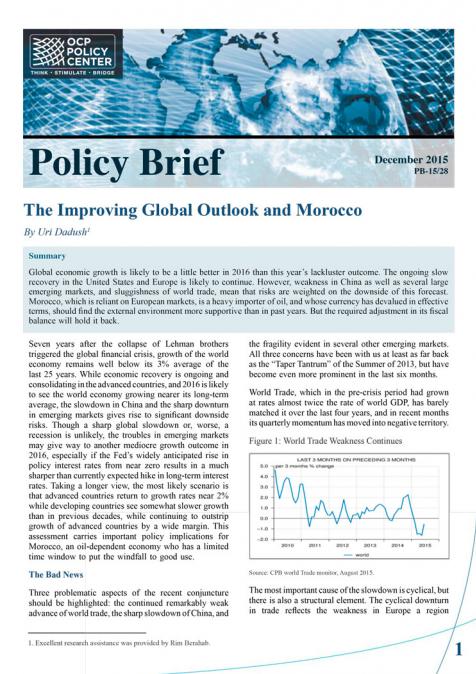
    Global economic growth is likely to be a little better in 2016 than this year’s lackluster outcome. The ongoing slow recovery in the United States and Europe is likely to continue. However, weakness in China as well as several large emerging markets, and sluggishness of world trade, mean that risks are weighted on the downside of this forecast. Morocco, which is reliant on European markets, is a heavy importer of oil, and whose currency has devalued in effective terms, should find t ...
  • Authors
    Karim El Mokri
    Aziz Ragbi
    Said Tounsi
    November 23, 2015
    The issue of a powerful fiscal policy comeback is not only being debated in Europe. It is also interesting for Morocco, in many respects. If in Europe there is controversy between the proponents of the structural budgetary balance rule and critics of restrictive policies in the context of major financial and recessive shocks, in the South of the Mediterranean fiscal policy is caught between the multiple social and economic requirements and the constraint of sustainability. ...
  • Authors
    Edité par:
    Karim El Mokri
    Aziz Ragbi
    Said Tounsi
    November 23, 2015
    Depuis le déclenchement de la crise économique et financière internationale, la politique budgétaire a connu un vif regain d’intérêt dans les arènes académiques et dans les débats des policy-makers, aussi bien dans les pays avancés que ceux en voie de développement. Pour un pays en voie de développement comme le Maroc, l’importance de la politique budgétaire réside dans le potentiel qu’elle offre en matière de stabilisation du cycle économique et de relance de l’activité en période ...
  • Authors
    Clémence Vergne
    November 19, 2015
    Au cours de la dernière décennie, le Ghana a enregistré des taux de croissance moyens supérieurs à 7 % par an, ce qui lui a permis d’accéder au statut de pays à revenu intermédiaire de la tranche inférieure. Toutefois, la croissance a récemment marqué le pas pour s’établir à 4,2 % en 2014, ce qui soulève la question de la pérennité du modèle de développement du pays. Le Ghana se trouve désormais à un stade critique de son processus de développement. Une transformation structurelle ...