Cooperation for a just energy transition in Africa on the eve of the COP28

November 28, 2023

To achieve a fair Energy Transition in Africa, it is imperative to consider the diversity of African nations, their unique resources, and how each solution should be tailored to the needs and means of the country. The world must address these challenges while confronting issues such as insufficient infrastructure and financing mechanisms on the continent. Cooperation can greatly contribute. Based on a contribution made in Trends Research and Advisory's book for COP28, the author examines in this video, the potential for collaboration between African nations and GCC countries, targeting areas of shared knowledge and expertise, as well as more specialized and straightforward fields.

Speakers

Sabrine Emran
Senior Economist
Sabrine Emran is a Senior Economist at the Policy Center for the New South (PCNS).At the PCNS, Sabrine Emran conducts research on the Energy Transition, Climate Finance, and Critical Minerals, focusing on the energy priorities of developing countries in the context of sustainable development, just energy transition, and global climate commitments.Before joining the PCNS in 2022, Sabrine Emran worked as a Commodities Analyst and Risk Management Consultant, specializing in agricultural and energy commodities as well as foreign exchange risk. She also held a position at Lyxor Asset Management as Request for Proposal and Product Specialist, where she focused on alternative investment asset classes and collaborated closely with institutional investors.Sabrine Emran holds a master’s ...

RELATED CONTENT

  • May 19, 2023
    This Policy Paper was originally published on freiheit.org This study explores how Morocco can successfully develop a green hydrogen market and at the same time contribute to the global energy transition. Authors Rim Berahab and Afaf Zarkik show how Morocco’s bold strategies and investments in renewables can shape a promising future for green hydrogen. They chart a path to decipher the potential of this energy vector, while outlining the elements necessary for the emergence o ...
  • Authors
    Abdelmonim AMACHRAA
    May 17, 2023
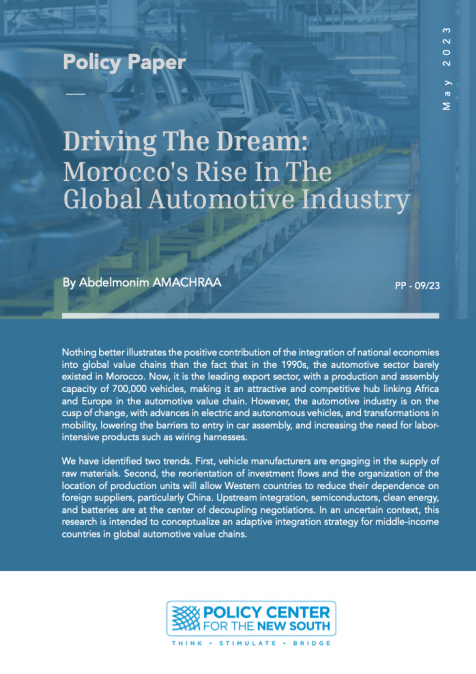
    Nothing better illustrates the positive contribution of the integration of national economies into global value chains than the fact that in the 1990s, the automotive sector barely existed in Morocco. Now, it is the leading export sector, with a production and assembly capacity of 700,000 vehicles, making it an attractive and competitive hub linking Africa and Europe in the automotive value chain. However, the automotive industry is on the cusp of change, with advances in electric a ...
  • Authors
    April 10, 2023
    The contemporary global energy landscape is experiencing noteworthy changes in demand, supply, technology, markets, and investment. These developments transcend conventional oil and gas security considerations. Renewable energy sources, such as wind and solar power, have become increasingly cost-effective compared to fossil fuels, and the minerals required to produce them are gaining importance. Nevertheless, recent events such as the Covid-19 pandemic and the conflict in Ukraine ha ...
  • March 07, 2023
    انطلقت دول وتكتّلات جهوية كثيرة في تطوير قطاع الهيدروجين الأخضر، معتبرة إياه مورد أساسي لتلبية الطلب الدولي للطاقة في المستقبل، حيث يفرض تغير المناخ البحث عن بدائل للنفط والغاز الطبيعي وا ...
  • February 28, 2023
    انطلقت دول وتكتّلات جهوية كثيرة في تطوير قطاع الهيدروجين الأخضر، معتبرة إياه مورد أساسي لتلبية الطلب الدولي للطاقة في المستقبل، حيث يفرض تغير المناخ البحث عن بدائل للنفط والغاز الطبيعي والفحم المهيمنين حاليا ومنذ بداية العصر الصناعي على الاستهلاك العالمي للطاقة. فتم الاعلان عن استراتيجي...
  • Authors
    February 13, 2023
    The volatility in energy markets since the outbreak of the Covid-19 pandemic in 2019/2020 has continued, with unprecedented uncertainty about global energy supply developing over the course of 2022 in the wake of Russia's invasion of Ukraine, against a backdrop of weakening macroeconomic conditions and high inflation. While some perceived this as a potential setback for the energy transition, others saw it as an opportunity to move away from fossil fuels and accelerate the developme ...