
In this episode, we explore pathways to enhance women's participation in mediation and peace processes to ensure their voices are integral to conflict resolution and peacebuilding efforts. Miss Loredana Teodorescu shares insights on strategies to overcome cultural and structural barriers, implement gender equality policies, and emphasize the role of civil society, particularly networks of women mediators, in advancing the Women, Peace, and Security (WPS) agenda.
RELATED CONTENT
-
 September 11, 2026Le marché du travail marocain connaît, depuis les années 2000, une expansion continue de la scolarisation qui ne s'est pas accompagnée d'une transformation équivalente de la structure productive de l'économie, ouvrant la voie à des situations d'inadéquation verticale entre le niveau de formation des actifs occupés et les exigences des emplois qu'ils occupent. La présente étude analyse les déterminants du déclassement (sur-éducation) et du surclassement (sous- éducation) à partir des ...
 -
 August 28, 2026يستضيف بودكاست مركز سياسات من أجل الجنوب الجديد الباحث البارز حافظ غانم للحديث عن العلاقة الدائرية بين عدم المساواة وضعف الإنتاجية في بلدان الجنوب الجديد، حيث يغذي كل منهما الآخر في نوع م ...
 -
 August 4, 2026This paper was originaly published on Middle East Development Journal This article examines the impact of remittances on human capital formation, living conditions, and economic participation of women in North African countries. While prior research has explored remittances’ effects on women’s access to fundamental rights, it has not fully captured the social and economic transformations induced by these funds. Our findings indicate that remittances significantly enhance w ...
 -
 June 30, 2026À l'échelle mondiale, les politiques publiques de jeunesse sont confrontées à un double enjeu : répondre à des défis socio-économiques structurels; chômage, précarité, fractures territoriales, tout en intégrant une demande croissante de participation citoyenne effective. (OIT, 2023 ; Nations Unies, 2020) En Afrique, ce défi revêt une dimension singulière compte tenu du poids démographique de la jeunesse et des fragilités persistantes des démocraties locales. (BAD, 2020 ; Mo Ibrahim ...
 -
June 30, 2026Globally, public policies for youth face a twofold challenge: addressing structural socioeconomic challenges—such as unemployment, precariousness, and regional disparities—while accommodating a growing demand for effective civic participation. (ILO, 2023; United Nations, 2020) In Africa, this challenge takes on a unique dimension given the demographic weight of the youth population and the persistent fragility of local democracies. (AfDB, 2020; Mo Ibrahim Foundation, 2023)Elections ...
-
 June 26, 2026Three years after the adoption of the first National Action Plan (NAP) on the Women, Peace and Security (WPS) Agenda, Morocco has made real institutional progress, but implementation is still inadequate. The extension of the NAP opens a window of opportunity to prepare a second, more ambitious and operational cycle.This Policy Brief identifies four persistent obstacles: a virtually stagnant female employment rate of 19.1%, less than 3% female representation in peacekeeping contingen ...
 -
 June 15, 2026Ce papier a été initialement publié dans la revue Carrefours de l'éducation n°61 L’écart entre les sexes en matière de réussite éducative demeure une préoccupation majeure au Maroc. Cette étude analyse les disparités de genre en lecture et en mathématiques aux niveaux national, urbain et rural, en exploitant des données individuelles issues de l’évaluation PIRLS 2021 (7 017 élèves) et de TIMSS 2019 (13 536 élèves), toutes deux menées auprès d’élèves de 4e année du primaire. En ...
 -
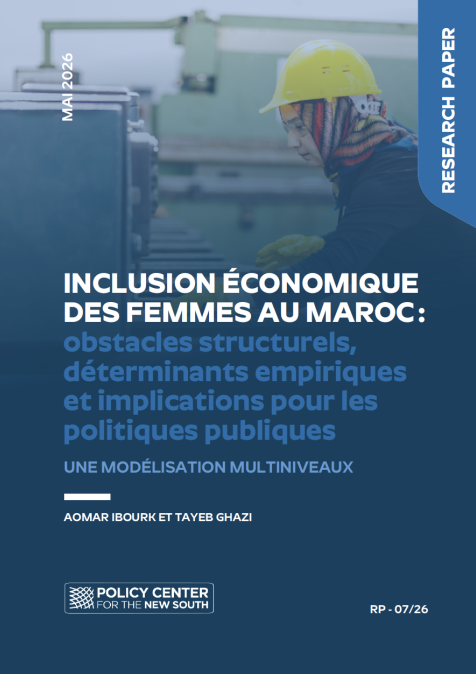 May 20, 2026La participation des femmes au marché du travail au Maroc demeure l'un des défis les plus structurels du développement économique et social du pays. Avec un taux d'activité féminin de seulement 19 % en 2023, contre 69 % pour les hommes (HCP, 2024), le Maroc présente l'un des écarts de genre les plus prononcés parmi les économies en développement (Banque mondiale, 2024). Ce Research Paper propose une analyse économétrique rigoureuse et multiniveaux des déterminants de cette participa ...
 -
 May 11, 2026Closing Morocco's gender employment gap could increase GDP per capita by 40-50 percent; yet female labor force participation stands at just 19 percent—among the lowest in the world and still declining. This policy paper argues that investing in the care economy is not merely a social expenditure, but a productive economic strategy with measurable returns. Drawing on international evidence from Uruguay, Mexico, Colombia, and India, the brief demonstrates that well-designed care syste ...
 -
 April 30, 2026This Africafé episode features Patience Chiradza from the African Union, discussing the critical role of African women in governance and peacebuilding. It highlights existing frameworks like the Maputo Protocol and acknowledges progress, while emphasizing persistent barriers such ...

