Africafé : African Union's Ethical AI Frameworks for Africa

May 14, 2026

In this episode of Africafé, Neema CHUSSI discusses the opportunities and challenges artificial intelligence presents for Africa. She highlights the need for the continent to develop its own AI governance approach, rooted in African democratic values, while addressing critical issues such as infrastructure, data sovereignty, regulation, and digital inclusion. The conversation also explores the African Union’s efforts to build a continental AI strategy and emphasizes the central role of youth in shaping Africa’s technological and governance future.

Speakers
Neema Chusi
Head, Peace and Security Council Secretariat, African Union
...
Fatim Zohra Azouzou
Junior Analyst - International Relations - Policy Center for the New South
...

RELATED CONTENT

  • Authors
    Selassie Tay
    February 15, 2023
    Background The African Union in 2018 agreed to implement the world’s second-largest free-trade area measured by number of countries, people, and geographical size, with the signing of the African Continental Free Trade Agreement (AfCFTA). This agreement will ultimately lead to a continent-wide free trade area consisting of 54 countries with 1.3 billion people and a combined GDP of $3.4 trillion[1]. This equates to about 19%-20% of the GDP of the European Union and China, which ...
  • Authors
    December 27, 2022
    En Afrique, le niveau de la vulnérabilité économique des pays reste élevé et représente un obstacle à la croissance économique et à la réduction de la pauvreté. Ce constat nous mène à étudier cette problématique pour un échantillon des pays africains les plus exposés aux chocs économiques. En effet, ce travail a pour objectif principal d’identifier les effets des composantes des deux indicateurs de vulnérabilité et de résilience économique sur le niveau de reve ...
  • December 8, 2022
    Cette étude concerne 33 États du continent africain où, en 2022, le % des détenteurs de cryptomonnaies de chaque pays, par rapport à sa population est au minimum de 1 %. À eux seuls, trois parmi ce groupe de pays, que sont l’Afrique du Sud, le Kenya et le Nigeria, totalisent plus de 333 millions de personnes, avec des pourcentages de leurs détenteurs de cryptomonnaies proches compris entre plus de 12 % en Afrique du Sud, plus de 11 % au Kenya et plus de 10 % au Nigeria. À l' ...
  • November 24, 2022
    This chapter was originally published in the book "Africa–Europe Cooperation and Digital Transformation", co-edited by Chux Daniels, Benedikt Erfoth, and Chloe Teevan Since the mid-2010s, North African countries have been pursuing what some observers have called a “return to Africa” (Dworkin, 2020). Egypt, Morocco, and Tunisia have attempted to position themselves as major components of Europe- Mediterranean-Africa infrastructure and supply chains corridors (Tanchum, 2020). The thr ...
  • Authors
    November 17, 2022
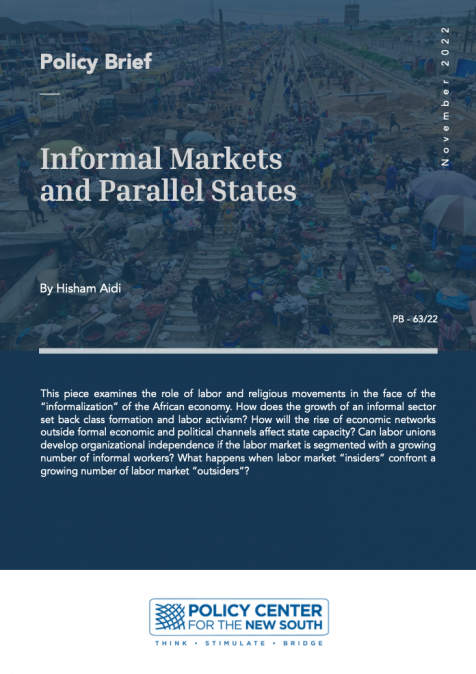
    This piece examines the role of labor and religious movements in the face of the “informalization” of the African economy. How does the growth of an informal sector set back class formation and labor activism? How will the rise of economic networks outside formal economic and political channels affect state capacity? Can labor unions develop organizational independence if the labor market is segmented with a growing number of informal workers? What happens when labor market “insider ...