AD 2021: The Wake Up Call : Bridging Divides in South America (Spanish)

December 3, 2021

El año 2021 marca para los países de América Latina, salvo Bolivia y Cuba, el inicio de un nuevo e intenso período electoral, que se extenderá hasta 2024. Renovaciones o reelecciones de presidentes en un contexto marcado por la incertidumbre económica, la polarización política y por la inestabilidad social. En el plano económico, la pandemia supuso un shock sistémico sin precedentes, exacerbando los problemas estructurales pre-existentes que frustran toda expectativa de mejora socio-económica. En el plano político, si bien el continente latinoamericano solía tener una cierta homogeneidad ideológica (el “giro a la izquierda” de la primera década del siglo XXI y el “giro a la derecha” de mediados del decenio anterior), el contexto actual presenta un panorama lleno de incertidumbre y heterogeneidad. Dónde es más visible esta polarización y fragmentación política? Se puede hablar de una crisis institucional regionalizada? • La oleada de protestas que ha tenido lugar cobró bastante protagonismo puesto que fueron protagonizadas por los jóvenes. ¿Qué papel está desempeñando la juventud latinoamericana?


Speakers
Laura Albornoz
Senior Fellow at the Adrienne Arsht Latin America Center, Former Minister of Women's Affairs, Chile
...
Jorge Castaneda
Global Distinguished Professor of Political Science and Latin American Studies, New York University
...

RELATED CONTENT

  • Authors
    February 24, 2020
    The outbreak in China has already affected economic sectors in Latin America. Is there more to come? China’s economy has come to a sudden stop. Large parts of the country remain in shutdown mode after the end of the Lunar New Year holiday, with national passenger traffic declining by 85% on the Wednesday after the break compared to 2019.   Outside of China, the impact of the slowdown has already been felt, with companies like Apple and Land Rover warning o ...
  • Authors
    January 31, 2020
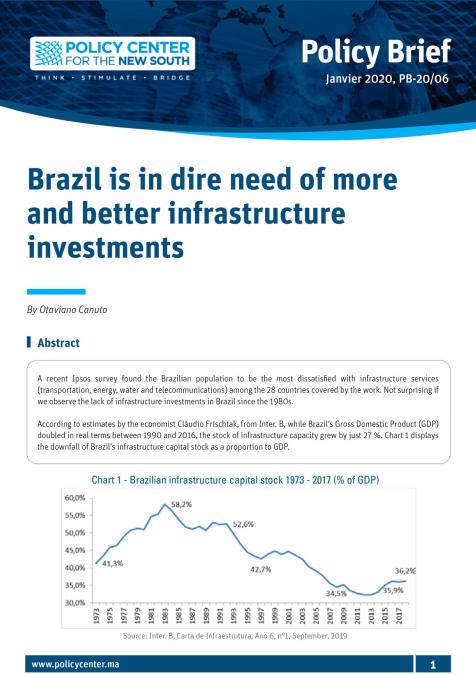
    A recent Ipsos survey found the Brazilian population to be the most dissatisfied with infrastructure services (transportation, energy, water and telecommunications) among the 28 countries covered by the work. Not surprising if we observe the lack of infrastructure investments in Brazil since the 1980s. According to estimates by the economist Cláudio Frischtak, from Inter. B, while Brazil's Gross Domestic Product (GDP) doubled in real terms between 1990 and 2016, the stock of infrast ...
  • December 19, 2019
    Emerging market and developing economies: Engine of the global economic growth despite some vulnerabilities1 After a long spell of slow growth post-crisis, the global economy’s recovery was mainly supported by the improvement of emerging markets and developing economies growth. However, this recovery is subject to wide-ranging uncertainties and is now in some danger. According to the IMF, the global economic growth is expected to fall to 3 % in 2019, the lowest level since 2008. Th ...
  • Authors
    December 2, 2019
    Following the global financial crisis of 2007-08, the International Monetary Fund (IMF) went through a period of self-examination. The old joke that its acronym stood for “It’s Mostly Fiscal” bothered some of its leaders, who believed the organization needed to focus less on austerity and more thoroughly consider issues such as inequality, poverty reduction and gender equality when making loans and other key decisions. There was talk of a “new IMF” that had learned from its old mist ...
  • Authors
    Osama El Mourabit
    November 29, 2019
    During the past few years, the different global ongoing events have left us baffled and astonished. Given the decreasing ability to understand and assimilate the amount of changes, mutations, and crises, one would wonder: what happened to the global order? How has -in this short period of time- the power of its values and institutions that much decreased? What are the causes for these protectionist and massive populist waves? Why are we witnessing an increasing settlement of conflic ...
  • Authors
    November 26, 2019
    Beyond the verbal anarchy celebrated by President Donald Trump, or the annihilation of abandoned Kurdish allies of the United States, the never ending destruction of Yemen, the threatening warfare against Iran, a massacre by Iraqi forces to intimidate protesters against a failing government, more gas and ammunition fired in Hong Kong to oppress untamable activist fearing their loss of freedom, Britain crashing out of the European Union, abandoning common sense and democratic dignity ...
  • Authors
    Pedro da Motta Veiga
    November 14, 2019
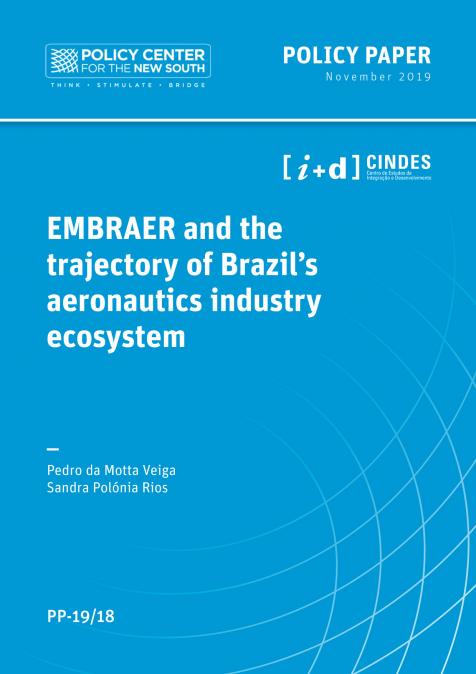
    Created as a State-owned company in the late 1960s, Embraer was privatized in the mid- 1990s and became the main Brazilian company producing and exporting high-technology goods. The company diversified its operations within the aircraft business and added to its portfolio goods and services associated to its core activities. ...