AD 2021: Leveraging Big Data and Innovation for the South in the Global Economy

December 10, 2021

Information is Power; that is the reason the world’s most valuable resource is no longer Oil, but Data. The UN stated, in one of its reports about Sustainable Development, that the volume of data in the world is increasing exponentially, that 90 per cent of it has been created in the last two years and that it is projected to increase by 40 per cent annually. This huge amount of Data that can be estimated actually in dozens of zettabytes includes information about stock markets, natural resources, climate change, security and any other field that can affect the economy and sovereignty of a State. That said, the volume of data held and explored by each country depends on its richness and its investments in innovation and IT, then, the gap is clear between US and China in one hand and the rest of the World in the other hand. This session, being focused on the South, will answer the following questions: Given that only the American GAFAM’s financial value has reached 4 trillion USD while the whole GDP of Africa is still around 2.6 trillion USD, is it possible for African companies to compete locally with the IT giants? If not, will encouraging foreign investments in this sector, through which they acquire funds and expertise will be a better choice? Do the education programs in Southern countries qualify local labor to get involved in cutting edge technology projects, particularly in cyber security, and this, in order to protect their national economic and security data? How the South-South collaborations and the exchange of technology and funds can benefit African countries and ensure a certain independence from the North?


Speakers
Eniola Mafe
Nigeria
Global Advocacy and Partnerships Director, Bridges to Prosperity
Eniola Mafe-Abaga is Global Advocacy and Partnerships Director at Bridges to Prosperity (B2P), where she leads global advocacy, systems-change partnerships and government engagement to position rural transport access as a development priority. Working with national governments and partners, B2P has supported the construction of more than 650 bridges across 21 countries, connecting over 4.5 million people to schools, markets and healthcare. Previously, Eniola led advocacy coalitions at the World Economic Forum, mobilising more than 20 partners, including governments, UN agencies and technology companies, to advance the use of emerging technologies in support of the Sustainable Development Goals. She also managed a USD 90 million social investment initiative for Chevron in Niger ...
Muhammadou M.O. Kah
Vice President for Academic Affairs & Provost; Professor of Information Technologies & Computing, The American University of Nigeria
...

RELATED CONTENT

  • Authors
    Under the supervision of
    July 12, 2024
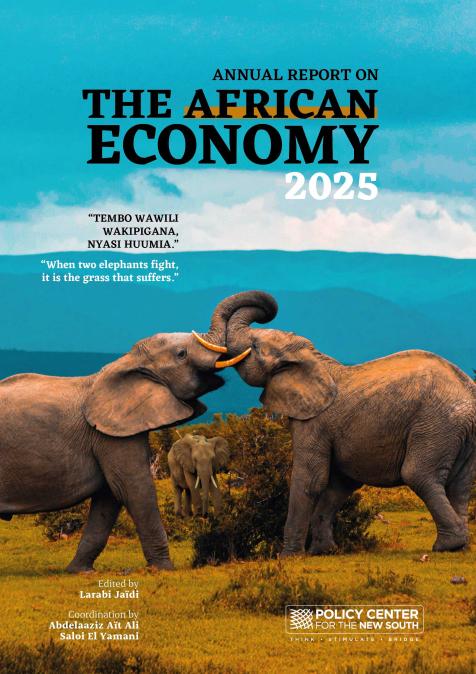
    The 2024 Annual Report on the African Economy is dedicated to monetary and financial issues on the Continent. There are three reasons for this choice. African economies are exposed to macro-financial instabilities partly generated by global monetary and financial turbulence. The Continent’s currencies and financial systems are engaged in very different dynamics, where routine methods and daring, if not risky, practices coexist. The question of the architecture of the internationa ...
  • February 8, 2024
    Depuis 2016, on assiste à une dynamique de création de fonds souverains africains. En 2023, on recense 21 pays et 24 fonds souverains. Sur la seule période 2016-23, celle de la deuxième vague, huit pays vont se doter d’un premier fonds souverain, et d’un deuxième, dans le cas du Maroc, en 2022. Cette étude rappelle tout d’abord l’historique d’une création qui commence, dès 1994, au Botswana, avec le Pula Fund, précisant pour chacun des 24 fonds leur date de création, leur ...
  • Authors
    Ilham Najib
    January 29, 2024
    Morocco is positioned as a new global hub of the automotive industry in an increasingly volatile international context, with various emerging countries competing intensively to gain the best returns on openness and globalization. The Moroccan automotive industry’s recent performance shows it to be the most dynamic sector in the economy: from 2014 to 2019, value-added in the automotive sector increased by almost 70% while the overall national value-added increased by only 15%. In the ...
  • Authors
    January 2, 2024
    This paper was originally published on The South African Institute of International Affairs (SAIIA)Industrialisation is crucial for Africa to improve its standard of living, create productive jobs for its young work force and diversify its exports. ...
  • December 28, 2023
    In this episode, we interviewed Mr. Arkebe Oqubay Metiku, British Academy Global Professor, SOAS University of London around Africa's industrial policies and their impact on growth. We discussed key elements such as innovation, regional collaboration, sustainability, and intellectual pr...
  • November 30, 2023
    In this episode, we dive into the pressing necessity for climate initiatives in Africa. Despite its minimal global emissions, Africa grapples with severe climate challenges and a substantial funding shortfall. Yet, as obstacles persist, including the disconnect between investor expectat...
  • Authors
    Ali Elguellab
    Elhadj Ezzahid
    November 1, 2023
    The role of the production network in shock propagation has been an issue of considerable interest since the Great Recession. However, the empirical literature has only focused on advanced and emerging countries. This paper aims to contribute to filling this gap by examining the case of Morocco, a developing country belonging to the lower-middle-income group. The question is whether its production network is a factor in amplifying idiosyncratic industry-level shocks or, conversely, ...
  • Authors
    Jean Louis-Sarbib
    October 18, 2023
    Addressing inequalities in all their forms has emerged as one of the major global challenges faced by numerous countries across the globe, particularly in Africa. In a context where Africa faces many pressing challenges that are the subject of much analysis (Sarbib et al. 2022), there is a clear gap in conducting comprehensive reviews focused on inequalities, partly due to the lack of available data. Inequalities, which are both consequences and partial causes of poor development o ...