Publications /
Paper in Academic Journals
Back
Remittances and women’s empowerment: empirical evidence from North African countries
Authors
Oussama Zennati
August 4, 2026

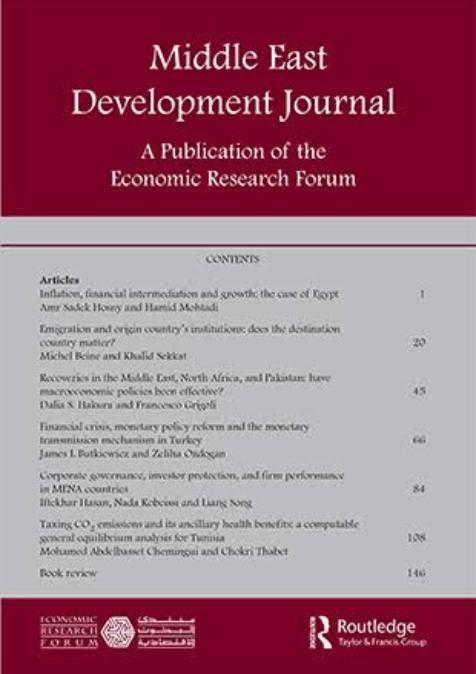
This paper was originaly published on Middle East Development Journal


This article examines the impact of remittances on human capital formation, living conditions, and economic participation of women in North African countries. While prior research has explored remittances’ effects on women’s access to fundamental rights, it has not fully captured the social and economic transformations induced by these funds. Our findings indicate that remittances significantly enhance women’s human capital in the region. Additionally, remittances contribute to increased life expectancy and a reduction in adult female mortality rates. However, they do not show a significant effect on women’s economic participation. A country-by-country analysis further reveals substantial heterogeneity in the effects of remittances across the sub-region, reflecting cross-country differences in migration patterns, the use of remittances by recipient households, as well as the relative importance of remittance as a share of GDP. While remittances increase women’s average years of schooling in Egypt, they are negatively associated with educational attainment in Morocco and Tunisia. Moreover, remittances are linked to improved living conditions for women across the sub-region, with the notable exception of Tunisia which suggests that remittances alone cannot fully compensate for the absence of migrant family members.
RELATED CONTENT

  • July 5, 2017
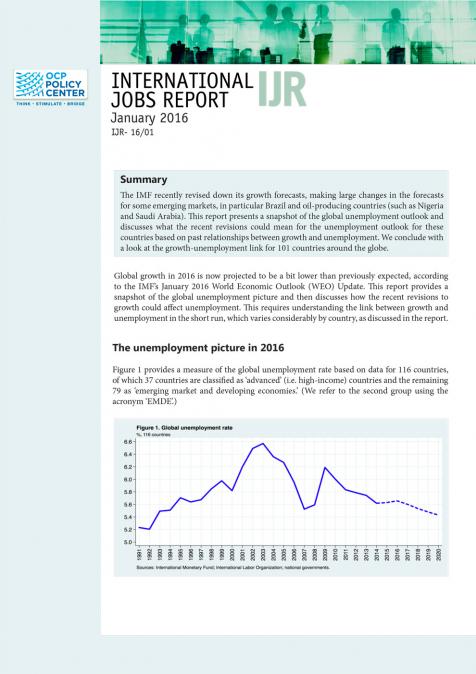
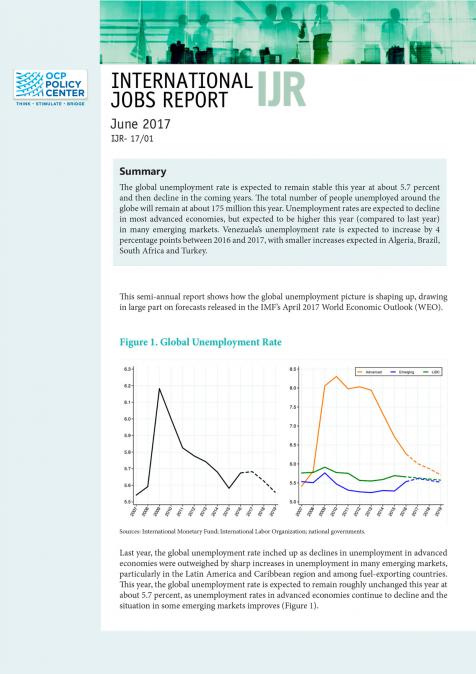
    The global unemployment rate is expected to remain stable this year at about 5.7 percent and then decline in the coming years. The total number of people unemployed around the globe will remain at about 175 million this year. Unemployment rates are expected to decline in most advanced economies, but expected to be higher this year (compared to last year) in many emerging markets. Venezuela’s unemployment rate is expected to increase by 4 percentage points between 2016 and 2017, with ...
  • Authors
    Edité par
    Idriss El Abbassi
    Lahcen Oulhaj
    Aziz Ragbi
    November 28, 2016
    Le présent ouvrage se propose d’apporter quelques éléments d’appui supplémentaires aux policy-makers pour une meilleure identification des défaillances des marchés au Maroc et une mise en place d’une stratégie de diversification et une politique industrielle efficientes, sans toutefois tomber dans la situation inverse où une stratégie mal définie et des outils mal choisis peuvent se traduire par une défaillance des politiques publiques. L’appréhension des difficultés qu’éprouve l’é ...
  • Authors
    June 16, 2016
    L’écart entre filles et garçons en termes de scolarisation, au Maroc, a longtemps préoccupé tant les académiciens que les décideurs. En revanche, très peu d’études se sont penchées sur l’analyse de cet écart sous une toile de fond quantitative. Ce présent travail s’intéresse à l’écart genre en termes d’acquis scolaires en lecture. La finalité étant de mettre en exergue les facteurs influençant les différences de performance entre les genres ainsi que leur ampleur. Pour ce faire, une ...
  • Authors
    May 20, 2016
    The 2015-2030 strategic vision innovates the Moroccan educational system. Unlike previous reforms, this vision addresses problems that have long been ignored. Among these problems is the quality of education. Although educational quality may have been included in previous reform programs, it is considered as one of the priorities in this new vision. The purpose of this Policy Brief is to assess the status of learning achievement, which is an integral part of educational quality, of ...
  • Authors
    Russel Dinh
    January 27, 2016
    The IMF recently revised down its growth forecasts, making large changes in the forecasts for some emerging markets, in particular Brazil and oil-producing countries (such as Nigeria and Saudi Arabia). This report presents a snapshot of the global unemployment outlook and discusses what the recent revisions could mean for the unemployment outlook for these countries based on past relationships between growth and unemployment. We conclude with a look at the growth-unemployment link f ...
  • Authors
    October 2, 2015
    Récemment parue parmi la série de Policy Briefs publiés par OCP Policy Center, une étude réalisée conjointement par Prakash Loungani et Saurabh Mishra a mis l’accent sur la réaction du chômage et l’emploi par rapport à la croissance économique dans les pays du G-20. L’objectif est de quantifier l’apport d’un point supplémentaire de croissance sur l’évolution du taux d’emploi, et sur le taux du chômage sur la période 1980-2014.  Sur la période 1980-2007, les ...
  • Authors
    Pierre-Richard Agénor
    January 24, 2015
    L’économie marocaine fait actuellement face au risque de se retrouver « prise en tenaille », entre, d’un côté les pays à faible revenu en croissance rapide, bénéficiant d’une main-d’oeuvre abondante et bon marché, et, de l’autre, les pays à moyen revenu, capables d’innover rapidement. De plus, les investissements massifs de la Chine en Afrique subsaharienne ont contribué à accélérer la participation de certains pays de cette région à la nouvelle division internationale du travail, p ...
  • Authors
    Pierre-Richard Agénor
    January 24, 2015
    OCP Policy Center est ravi de recueillir vos commentaires et d’engager la discussion autour de la publication de son dernier livre sur la stratégie de croissance du Maroc à l’horizon 2025 dans un environnement international en mutation, co-écrit par Pierre Richard Agénor et Karim El Aynaoui. L’économie marocaine fait actuellement face au risque de se retrouver « prise en tenaille », entre, d’un côté les pays à faible revenu en croissance rapide, bénéficiant d’une main-d’œuvre abond ...