Publications /
Paper in Academic Journals
Back
How to Measure the Digital Economy in 5G Technologies and Digital Silk Road Era
Authors
Davit Gondauri
Nino Enukidze
Mikheil Batiashvili
January 31, 2023

This publication was originally published in https://ijisrt.com/assets/upload/files/IJISRT23JAN789.pdf


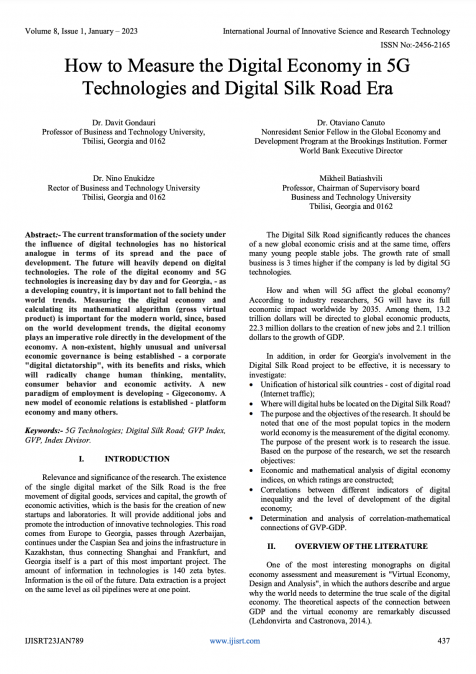
The current transformation of the society under the influence of digital technologies has no historical analogue in terms of its spread and the pace of development. The future will heavily depend on digital technologies. The role of the digital economy and 5G technologies is increasing day by day and for Georgia, - as a developing country, it is important not to fall behind the world trends. Measuring the digital economy and calculating its mathematical algorithm (gross virtual product) is important for the modern world, since, based on the world development trends, the digital economy plays an imperative role directly in the development of the economy. A non-existent, highly unusual and universal economic governance is being established - a corporate "digital dictatorship", with its benefits and risks, which will radically change human thinking, mentality, consumer behavior and economic activity. A new paradigm of employment is developing - Gigeconomy. A new model of economic relations is established - platform economy and many others.

RELATED CONTENT

  • May 12, 2026
    Why only globally connected, knowledge-intensive services — not local services — can drive long-term development and productivity growth. This Commentary was originally published on stimson.org For decades, manufacturing was considered the indispensable engine of economic development, creating jobs, boosting productivity, and integrating countries into global markets. But automation, robotics, and intensifying global competition have made industrialization far harder for d ...
  • May 12, 2026
    Cet épisode analyse le poids du secteur informel dans l’économie marocaine et ses principaux défis. Les intervenants expliquent que l’informel constitue à la fois un mécanisme de survie pour une grande partie de la population et un frein à la productivité, à la fiscalité et à la protect...
  • May 6, 2026
    Dans cette interview, l’évolution de la politique industrielle marocaine est analysée : planification étatique (1960–1980), libéralisation (1980–1990), puis intégration dans les chaînes de valeur mondiales (à partir des années 2000). Aujourd’hui, face au protectionnisme et au nearshorin...
  • Authors
    April 30, 2026
    This paper is the second in a series examining services-led development and global value chain (GVC) integration in the Global South. It applies a three-category analytical framework covering knowledge services (ICT and professional business services), enabling services (transport, logistics, and finance), and local services (retail, hospitality, health, and personal services), to OECD Trade in Value Added indicators. The paper thus  ...
  • April 29, 2026
    Cette chronique a été initialement publiée sur le site lesechos.fr Les économies en développement font face à un double défi : créer des emplois à grande échelle tout en soutenant la productivité. Quels types de services permettent cette convergence ? Les économistes Hinh T. Dinh et Karim El Aynaoui répondent dans la chronique du « Cercle des économistes ».Les services peuvent-ils se substituer à l'industrie manufacturière comme moteur du développement ...
  • April 14, 2026
    Cet épisode met en avant les industries automobile et aéronautique du Maroc en tant que moteurs de transformation industrielle, portées par le Pacte pour l’Émergence et le Plan d’Accélération Industrielle. Un écosystème solide composé de donneurs d’ordre, de fabricants internationaux et...
  • April 13, 2026
    Résumé exécutif stratégiqueLe Maroc s’est engagé avec détermination dans une trajectoire de modernisation fondée sur la transition numérique, la transition verte et l’innovation. Ces dynamiques sont devenues des leviers stratégiques pour la compétitivité, l’attractivité et la création d’emplois à forte valeur ajoutée. Pourtant, l’analyse des données microéconomiques récentes révèle un paradoxe préoccupant : les entreprises les plus modernisées, moteurs de la croissance de demain, re ...
  • March 31, 2026
    تتناول هذه الحلقة كيفية إعادة صياغة السياسة الصناعية في المغرب في ظل التحولات العالمية وإعادة تشكيل سلاسل القيمة، مع التركيز على الانتقال من موقع إنتاجي إلى فاعل صناعي استراتيجي. كما تسلط الضوء على دور قطاعات السيارات والطاقات المتجددة والصناعات التكنولوجية في تعزيز تموقع المغرب دولياً....
  • Authors
    March 12, 2026
    Historically, manufacturing has served as the primary pathway to economic development, offering strong scale economies, learning-by-doing effects, and the capacity to generate the foreign exchange necessary to import capital goods and technology. However, advances in robotization and artificial intelligence (AI) are fundamentally undermining manufacturing’s traditional role, making it increasingly skill- and capital-intensive while limiting its ability to absorb labor. Thi ...