Publications /
Policy Brief

Back
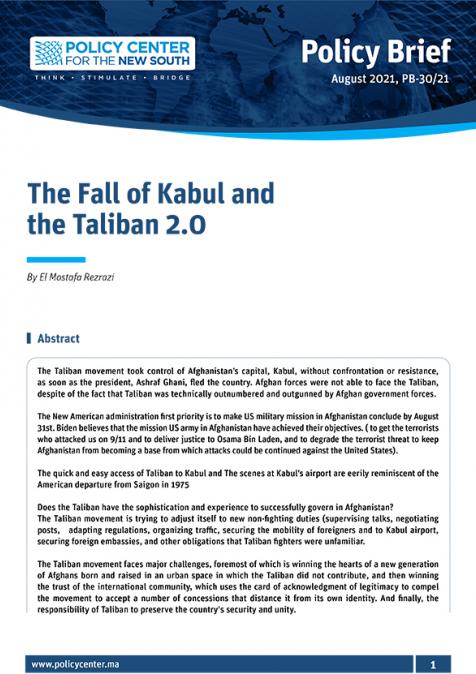
The Fall of Kabul and the Taliban 2.0
August 24, 2021

The Taliban movement took control of Afghanistan’s capital, Kabul, without confrontation or resistance, as soon as the president, Ashraf Ghani, fled the country. Afghan forces were not able to face the Taliban, despite of the fact that Taliban was technically outnumbered and outgunned by Afghan government forces.
The New American administration first priority is to make US military mission in Afghanistan conclude by August 31st. Biden believes that the mission US army in Afghanistan have achieved their objectives. ( to get the terrorists who attacked us on 9/11 and to deliver justice to Osama Bin Laden, and to degrade the terrorist threat to keep Afghanistan from becoming a base from which attacks could be continued against the United States).

The quick and easy access of Taliban to Kabul and The scenes at Kabul’s airport are eerily reminiscent of the American departure from Saigon in 1975
Does the Taliban have the sophistication and experience to successfully govern in Afghanistan?
The Taliban movement is trying to adjust itself to new non-fighting duties (supervising talks, negotiating posts, adapting regulations, organizing traffic, securing the mobility of foreigners and to Kabul airport, securing foreign embassies, and other obligations that Taliban fighters were unfamiliar.

The Taliban movement faces major challenges, foremost of which is winning the hearts of a new generation of Afghans born and raised in an urban space in which the Taliban did not contribute, and then winning the trust of the international community, which uses the card of acknowledgment of legitimacy to compel the movement to accept a number of concessions that distance it from its own identity. And finally, the responsibility of Taliban to preserve the country's security and unity.

Afghanistan will witness in the coming weeks increased interactions, whether about the design of a new governing administration, the preservation of security in various regions of the country, or by confronting Western media campaigns that try to undermine the Taliban’s reputation and credibility. However, it is also expected that the Taliban will strengthen their talks with Washington to secure a peaceful withdraw of American forces, as with Russia, Pakistan, and China, and other countries that sent positive messages with the aim of normalizing their relations.
The duties of governance and the political and technical management of public life put the Taliban in front of several challenges. But these challenges might disrupt the dream of rebuilding the Islamic Emirate, as they are obliged to respect their commitments related to restoring confidence among Afghans, reassuring international public opinion, expanding freedoms, reconstructing the economy, and protecting the country from insecurity—it is possible that pockets of resistance. We should acknowledge that relevant analysis to these changes taking place in Afghanistan, requires to take into consideration: ( a) the transformations that occurred in Afghanistan in terms of demography and urbanization (especially the capital, Kabul), ( b) changes experienced by the Taliban movement in terms of its leading figures, its narratives, and its political and military organizational structures, (c) then the shifts of the American foreign policy and national security doctrine over the past two decades.

Certainly, the fall of Kabul in the post-COVID-19 world order coincides with the birth of the new American new era, and a Taliban 2.0 that we need to understand better.

RELATED CONTENT

  • Authors
    October 13, 2026
    “Every gun that is made, every warship launched, every rocket fired signifies in the final sense, a theft from those who hunger and are not fed, those who are cold and are not clothed.”President Dwight Eisenhower, April 16, 1953 This policy brief examines the economic and human impacts of the first six months of the Iran war—from February to the end of August 2026—on Iran’s Arab neighbors and compares these impacts with those on the three countries directly involved—Iran, Israe ...
  • Authors
    Lina Jaoid
    October 8, 2026
    In the two years since the fall of Bashar al-Assad in Syria, Russia has restructured its Mediterranean presence. Although Russia’s limited and increasingly conditional access to the Khmeimim and Tartus facilities in Syria has been preserved, its presence in the country has morphed from Assad’s ‘patron-client’ configuration to a more negotiated engagement. Simultaneously, Russia has upgraded its force-projection and logistical infrastructure in eastern Libya, giving it an access path ...
  • Authors
    October 2, 2026
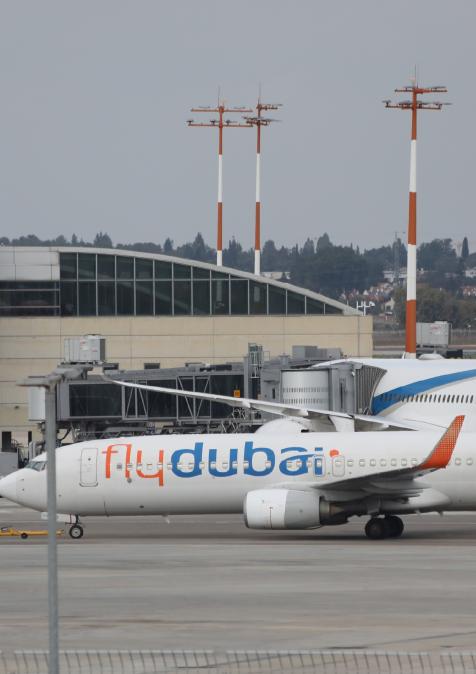
    The incident involving Flydubai Flight FZ1073 between Dubai and Tel Aviv does not yet support any definitive attribution. It does, however, provide a useful warning sign: as aviation security closes off traditional avenues of intrusion, threats may shift towards alternative pathways by exploiting the people, service providers, and systems that the aviation ecosystem must necessarily trust.  ...
  • Authors
    October 2, 2026
    L’incident du vol FZ1073 entre Dubaï et Tel-Aviv ne permet encore aucune attribution définitive. Il constitue en revanche un révélateur utile : à mesure que la sûreté aérienne ferme les voies classiques d’intrusion, la menace cherche à emprunter des voies alternatives en exploitant les personnes, les prestataires et les systèmes auxquels l’écosystème aéronautique doit nécessairement accorder sa confiance. ...
  • Authors
    September 30, 2026
    On August 7, 2026, Saudi Arabia, Turkey, and Pakistan signed the Mecca Joint Défense Agreement, a collective-defense pact widely compared to NATO’s Article 5. This essay argues that the comparison is misleading. Mecca borrows NATO’s language of solidarity without yet possessing NATO’s institutional machinery, and the Houthi offensive against Saudi Arabia in September 2026 provided an early and revealing test of what the agreement actually means in practice. Neither Pakistan nor Turk ...
  • September 25, 2026
    In this episode, Senior Fellow Ian Lesser examines the United States’ longstanding ties with the Mediterranean as the country marks its 250th anniversary. He discusses how a possible shif ...
  • Authors
    September 23, 2026
    Since around 2010, it has been known that the Eastern Mediterranean is a new gas province. Gas resources have indeed been discovered offshore four countries or territories: Egypt, Israel, Cyprus and Gaza. Two of them have become producers and exporters of natural gas, Egypt and Israel. Off the coast of Gaza, the Gaza Marine gas field has never been developed, and it is highly unlikely to be developed anytime soon given the very high tensions between the State of Israel and Hamas. By ...
  • Authors
    September 23, 2026
    Depuis 2010, environ, on sait que la Méditerranée orientale est une nouvelle province gazière. Des ressources gazières ont en effet été découvertes au large de quatre pays ou territoires, l’Égypte, Israël, Chypre et Gaza. Deux d’entre eux sont devenus producteurs et exportateurs de gaz naturel, l’Égypte et Israël. Au large de Gaza, le champ gazier de Gaza Marine n’a jamais été développé et il est très peu probable qu’il le soit prochainement en raison des très fortes tensions entre ...
  • September 16, 2026
    Much of Western debate was revealingly silent on the Shanghai Cooperation Organization (SCO) summit, which took place on August 31 and September 1 in Bishkek, Kyrgyzstan. That relative silence reflects how poorly the organization’s growing significance is still understood. The meeting has not gone unreported. Any gathering of Xi Jinping, Narendra Modi, and Vladimir Putin inevitably attracts&nbs ...
  • Authors
    August 13, 2026
    The Resolution adopted by an overwhelming majority of elected European officials in Strasbourg on June 10, 2021, on "the violation of the UN Convention on the Rights of the Child and the exploitation of minors by the authorities in the migration crisis in Ceuta" (2021/2747/RSP), could not fail to leave its mark.Decoding the ResolutionThe Resolution shocked Moroccans to such an extent that it was quickly set aside at the time, as if there were a wish to forget it as fast as possible. ...