Publications /
Book / Report

Back
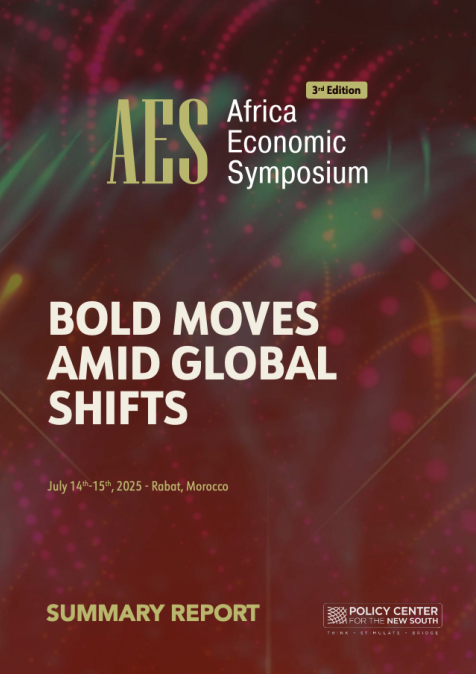
Africa Economic Symposium (AES) 3nd edition - SUMMARY REPORT
Authors
General rapporteur Mahmoud Arbouch
September 2, 2025

The Africa Economic Symposium (AES) has firmly established itself as one of the flagship annual events of the Policy Center for the New South, alongside the Atlantic Dialogues and the African Peace and Security Annual Conference (APSACO). Now in its third edition, AES continues to provide a unique platform for economists, policymakers, and academics from across the continent and beyond to exchange perspectives on the pressing macroeconomic and structural challenges facing Africa. Its mission remains to foster rigorous, evidence-based debates that inform policymaking and support long-term strategies for Africa’s development in an era of uncertainty. 

The 2025 edition, convened under the theme “Bold Moves amid Global Shifts,” explored the difficult policy trade-offs confronting African governments as they navigate a volatile global environment. The continent’s recovery from COVID-19 has been uneven, while debt pressures, supply chain disruptions, and geopolitical tensions weigh heavily on fiscal and economic resilience. Structural challenges such as persistent unemployment, low productivity, and the exclusion of Africa’s youth continue to hinder inclusive growth, even as policymakers are called upon to adapt to deep systemic uncertainty. 

The symposium underscored that many African states are increasingly resorting to short-term stabilization measures—such as accumulating reserves and postponing reforms—that may provide immediate security but risk delaying the structural transformation urgently needed. Against this backdrop, AES 2025 called for a careful balance between fiscal prudence, social investment, and the pursuit of sustainable growth, placing emphasis on reforming governance, improving macroeconomic management, and accelerating structural change. 

The discussions highlighted the urgent need to rethink Africa’s economic strategies in a shifting global order. From debt sustainability and the role of central banks to the promise of financial innovation, digital inclusion, and new instruments such as central bank digital currencies, the symposium emphasized that policy choices must align with long-term transformation goals. The debates also explored the opportunities and challenges of regional integration, trade connectivity, and development finance, all of which are essential levers for Africa’s resilience and prosperity. 

As in previous editions, the Annual Report on African Economies was launched alongside the symposium, offering an in-depth analysis of the continent’s macroeconomic dynamics and structural transformation pathways. More than just a publication, the report reflects the collective intellectual effort of leading scholars and practitioners, providing evidence-based insights to guide decision- makers. Together, the symposium and the report reinforced the Policy Center for the New South’s commitment to fostering forward-looking economic thinking that moves beyond short-term headlines to tackle Africa’s enduring challenges.
RELATED CONTENT

  • Authors
    July 12, 2021
    Frappée de plein fouet par la crise sanitaire de la Covid-19, la République de Zambie, déjà fragilisée, fait face à de nombreux défis sur les plans politique, économique, social et climatique. Outre sa position géographique de pays enclavé, le croissant de l’Afrique australe se positionne comme l’une des premières victimes du réchauffement climatique sur le continent rendant vulnérable une partie de sa population souffrant d’insécurité alimentaire accrue. Par ailleurs, et à l’approc ...
  • Authors
    Chami Abdelilah
    Derj Atar
    Hammi Ibtissem
    Morazzo Mariano
    Naciri Yassine
    with the technical support of AFRY
    July 9, 2021
    Les importantes ressources en énergies renouvelables du Maroc offrent une opportunité sans précédent d’ancrer les choix économiques et politiques du pays dans la transition énergétique, et de faire de cette transition un levier essentiel du développement économique. Ceci est d’autant plus important que le coût des énergies renouvelables a baissé au cours des 10 dernières années2 et présente désormais un fort potentiel, non seulement de création d’emplois verts mais aussi de croissan ...
  • Authors
    Chami Abdelilah
    Derj Atar
    Hammi Ibtissem
    Morazzo Mariano
    Naciri Yassine
    with the technical support of AFRY
    July 9, 2021
    Les conséquences du changement climatique sont de plus en plus visibles au Maroc. Le schéma changeant des précipitations et de la sécheresse, l'augmentation des températures moyennes et des canicules, les inondations et l'augmentation du niveau de la mer affectent de plus en plus de nombreuses régions. Et pourtant, le taux d'émission de gaz à effet de serre (GES) du Maroc est relativement faible, comparé à celui d'autres pays. En 20162, les émissions totales de GES du Maroc ont atte ...
  • Authors
    Chami Abdelilah
    Derj Atar
    Hammi Ibtissem
    Morazzo Mariano
    Naciri Yassine
    with the technical support of AFRY
    July 9, 2021
    The consequences of climate change are becoming progressively more visible in Morocco. Changes in rainfall patterns and drought, increases in average temperatures and heatwaves, flooding, and rising sea levels are increasingly affecting several regions. Yet, Morocco has a relatively low greenhouse gas (GHG) emission rate, compared to other countries. In 20162, Morocco’s total GHG emissions reached 86127.7 gigagram of carbon dioxide equivalent (Gg CO2-eq), totaling around 0.2% of glo ...
  • July 7, 2021
    The world faces a huge shortfall of infrastructure investment relative to its needs. With a few exceptions, such as China, this shortfall is greatest in emerging and developing countries. The G20 Infrastructure Investors Dialogue estimated the volume of global infrastructure investment needed by 2040 to be $81 trillion, $53 trillion of which will be needed in non-advanced countries. The Dialogue projected a gap—in other words, a shortfall in relation to the investment needs foresee ...
  • July 7, 2021
    Otaviano Canuto, Policy Center for the New South The contrast between the scarcity of investments in infrastructure – particularly in non-advanced economies – and the excess of savings invested in liquid and low-return assets in the global economy deserves to be confronted. Greening inf...
  • June 30, 2021
    Otaviano Canuto, Policy Center for the New South The growth and productivity performance of emerging market and developing economies since the 2008 global financial crisis failed to repeat the achievements of the previous decade. Besides frustrating expectations that they might become t...
  • Authors
    Chami Abdelilah
    Derj Atar
    Hammi Ibtissem
    Morazzo Mariano
    Naciri Yassine
    with the technical support of AFRY
    June 28, 2021
    Lors de la Conférence des Parties à la Convention-cadre des Nations unies sur les changements climatiques (CCNUCC) qui s'est tenue à Paris en 2015, les gouvernements se sont engagés à limiter l'augmentation de la température mondiale à un niveau bien inférieur à 2°C par rapport aux niveaux préindustriels. Ils se sont également engagés à atteindre, dès que possible, un pic de leurs émissions et à parvenir à la neutralité carbone au cours de la seconde moitié du siècle. Pour autant, m ...
  • Authors
    Chami Abdelilah
    Derj Atar
    Hammi Ibtissem
    Morazzo Mariano
    Naciri Yassine
    with the technical support of AFRY
    June 28, 2021
    During the 2015 Paris Conference of the Parties to the United Nations Framework Convention on Climate Change (UNFCCC), governments pledged to limit the global temperature increase to well below 2°C above pre- industrial levels, to peak emissions as soon as possible, and to achieve carbon neutrality in the second half of the century. Yet, even assuming full implementation of the commitments made by governments in Paris, the global concentration of greenhouse-gas (GHG) emissions will ...