Publications /
Book / Report

Back
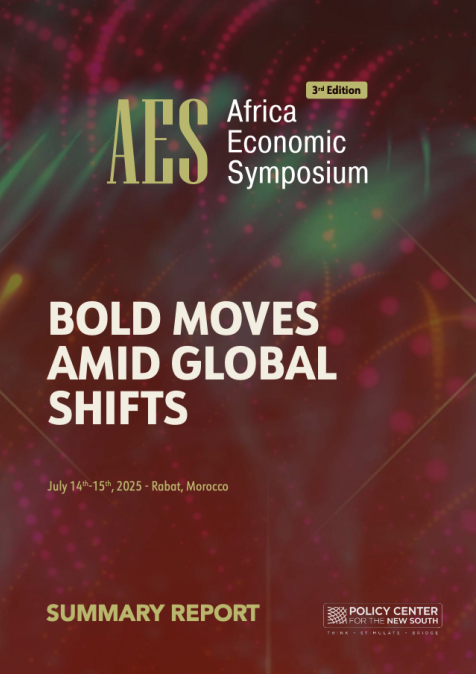
Africa Economic Symposium (AES) 3nd edition - SUMMARY REPORT
Authors
General rapporteur Mahmoud Arbouch
September 2, 2025

The Africa Economic Symposium (AES) has firmly established itself as one of the flagship annual events of the Policy Center for the New South, alongside the Atlantic Dialogues and the African Peace and Security Annual Conference (APSACO). Now in its third edition, AES continues to provide a unique platform for economists, policymakers, and academics from across the continent and beyond to exchange perspectives on the pressing macroeconomic and structural challenges facing Africa. Its mission remains to foster rigorous, evidence-based debates that inform policymaking and support long-term strategies for Africa’s development in an era of uncertainty. 

The 2025 edition, convened under the theme “Bold Moves amid Global Shifts,” explored the difficult policy trade-offs confronting African governments as they navigate a volatile global environment. The continent’s recovery from COVID-19 has been uneven, while debt pressures, supply chain disruptions, and geopolitical tensions weigh heavily on fiscal and economic resilience. Structural challenges such as persistent unemployment, low productivity, and the exclusion of Africa’s youth continue to hinder inclusive growth, even as policymakers are called upon to adapt to deep systemic uncertainty. 

The symposium underscored that many African states are increasingly resorting to short-term stabilization measures—such as accumulating reserves and postponing reforms—that may provide immediate security but risk delaying the structural transformation urgently needed. Against this backdrop, AES 2025 called for a careful balance between fiscal prudence, social investment, and the pursuit of sustainable growth, placing emphasis on reforming governance, improving macroeconomic management, and accelerating structural change. 

The discussions highlighted the urgent need to rethink Africa’s economic strategies in a shifting global order. From debt sustainability and the role of central banks to the promise of financial innovation, digital inclusion, and new instruments such as central bank digital currencies, the symposium emphasized that policy choices must align with long-term transformation goals. The debates also explored the opportunities and challenges of regional integration, trade connectivity, and development finance, all of which are essential levers for Africa’s resilience and prosperity. 

As in previous editions, the Annual Report on African Economies was launched alongside the symposium, offering an in-depth analysis of the continent’s macroeconomic dynamics and structural transformation pathways. More than just a publication, the report reflects the collective intellectual effort of leading scholars and practitioners, providing evidence-based insights to guide decision- makers. Together, the symposium and the report reinforced the Policy Center for the New South’s commitment to fostering forward-looking economic thinking that moves beyond short-term headlines to tackle Africa’s enduring challenges.


RELATED CONTENT

  • May 27, 2021
    En partenariat avec l’ISCAE Dans le cadre de la pandémie de COVID-19, le dialogue entre citoyens, scientifiques et décideurs politiques et la répartition de leurs rôles au sein de la société ont été un élément déterminant dans les réponses apportées à cette crise. Dans chaque pays, la c...
  • May 24, 2021
    Commodity prices have recovered their 2020 losses and, in most cases, are now above pre-pandemic levels (Figure 1). The pace of Chinese growth since 2020 and the economic recovery that has accompanied vaccine rollouts in advanced companies are seen as driving demand upward, while supply restrictions for some items—oil, copper, and some food products—have favored their upward adjustment. Some analysts have started to speak of the possibility of a new commodity price ‘super-cycle’ af ...
  • May 21, 2021
    In these times of crisis, concerns about debt levels in low-income countries, particularly those in Africa, are growing. In recent months, countries on the continent have defaulted on the ...
  • May 20, 2021
    Le Policy Center lance une nouvelle émission. Africafé, le nouveau rendez-vous bimensuel présenté par Youssef Tobi, spécialiste en relations internationales, décryptera l'actualité des organisations africaines et du continent avec des experts africains. Pour ce deuxième épisode, Larabi ...
  • May 20, 2021
    The Policy Brief ‘Pandemic, Preparedness, Morocco, and Africa’ by Uri Dadush provoked a personal reaction: Morocco may never be crowned football’s world champions, alas, but which nation, besides China, New Zealand, Israel, Japan, Denmark, Vietnam, organized its anti-COVID-19 offensive more digitally and in a more modern way than the Kingdom? Morocco’s bureaucracy is at times suffocating and unpleasant, its public hospital system stressed and underfunded. But today I can v ...
  • May 19, 2021
    Otaviano Canuto, Senior fellow, Policy Center for the New South The “middle-income trap” has become a broad designation trying to capture the many cases of developing countries that succeeded in evolving from low- to middle-levels of per capita income, but then appeared to stall, losing...
  • May 17, 2021
    Joe Biden’s victory in the U.S. elections was widely anticipated, and much of what has happened since he took office on January 21 has conformed to his election promise. The progress he helped steer in vaccinations and repairing the pandemic’s economic damage is especially impressive. However, the first 100 days of his term have also seen major unexpected developments. Three of these surprises have both major implications for the U.S. economic outlook, and global repercussions. The ...
  • May 12, 2021
    Otaviano Canuto, Policy Center for the New South Commodity prices go through extended periods during which prices are well above or below their long-term price trend. The upswing phase in super cycles results from a lag between unexpected, persistent, and upward trends in commodity dema...
  • May 12, 2021
    Leonardo Da Vinci’s mechanical knight was a humanoid automaton, designed and possibly constructed by da Vinci around 1495. When a version of the mechanical knight was brought into existence several hundred years later, it could stand, sit, raise its visor, and independently maneuver its arms, operated by a series of pulleys and cables. Today, of course, robots have escaped da Vinci’s fantasies. Today they land on Mars, help nurses treat COVID-19 patients, and slave in car manufactur ...