Publications /
Book / Report

Back
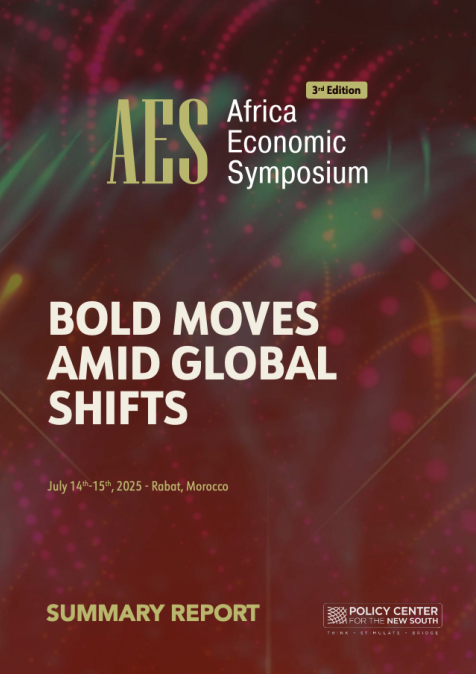
Africa Economic Symposium (AES) 3nd edition - SUMMARY REPORT
Authors
General rapporteur Mahmoud Arbouch
September 2, 2025

The Africa Economic Symposium (AES) has firmly established itself as one of the flagship annual events of the Policy Center for the New South, alongside the Atlantic Dialogues and the African Peace and Security Annual Conference (APSACO). Now in its third edition, AES continues to provide a unique platform for economists, policymakers, and academics from across the continent and beyond to exchange perspectives on the pressing macroeconomic and structural challenges facing Africa. Its mission remains to foster rigorous, evidence-based debates that inform policymaking and support long-term strategies for Africa’s development in an era of uncertainty. 

The 2025 edition, convened under the theme “Bold Moves amid Global Shifts,” explored the difficult policy trade-offs confronting African governments as they navigate a volatile global environment. The continent’s recovery from COVID-19 has been uneven, while debt pressures, supply chain disruptions, and geopolitical tensions weigh heavily on fiscal and economic resilience. Structural challenges such as persistent unemployment, low productivity, and the exclusion of Africa’s youth continue to hinder inclusive growth, even as policymakers are called upon to adapt to deep systemic uncertainty. 

The symposium underscored that many African states are increasingly resorting to short-term stabilization measures—such as accumulating reserves and postponing reforms—that may provide immediate security but risk delaying the structural transformation urgently needed. Against this backdrop, AES 2025 called for a careful balance between fiscal prudence, social investment, and the pursuit of sustainable growth, placing emphasis on reforming governance, improving macroeconomic management, and accelerating structural change. 

The discussions highlighted the urgent need to rethink Africa’s economic strategies in a shifting global order. From debt sustainability and the role of central banks to the promise of financial innovation, digital inclusion, and new instruments such as central bank digital currencies, the symposium emphasized that policy choices must align with long-term transformation goals. The debates also explored the opportunities and challenges of regional integration, trade connectivity, and development finance, all of which are essential levers for Africa’s resilience and prosperity. 

As in previous editions, the Annual Report on African Economies was launched alongside the symposium, offering an in-depth analysis of the continent’s macroeconomic dynamics and structural transformation pathways. More than just a publication, the report reflects the collective intellectual effort of leading scholars and practitioners, providing evidence-based insights to guide decision- makers. Together, the symposium and the report reinforced the Policy Center for the New South’s commitment to fostering forward-looking economic thinking that moves beyond short-term headlines to tackle Africa’s enduring challenges.

RELATED CONTENT

  • November 17, 2021
    The escalating US-China trade tensions has resulted in the rise of two separate spheres of influence in both trade and technology and contributed to reshaping the global trade landscape. In order to de-escalate the conflict, the two hegemonies signed the Phase One trade deal in January ...
  • November 16, 2021
    This edition of the World Bank MENA Economic Update estimates that the Middle East and North Africa (MENA) region’s economies, which contracted by 3.8% in 2020, will grow by 2.8% in 2021. Overall, the output cost of COVID-19 so far in MENA is almost $200 billion, a number estimated by c...
  • November 15, 2021
    The Covid-19 pandemic has plunged the world into a health, social and economic crisis of exceptional magnitude. In economic terms, the restrictions established to contain the spread of the virus have resulted in a sudden stop to entire sectors of activity and major disruptions to supply...
  • Authors
    Alessandro Minuto-Rizzo
    Alessandro Politi
    Claire Spencer
    Abdulaziz Sager
    Mahboub E. Hashem
    Matt Herbert
    Umberto Profazio
    Eman Ragab
    Brahim Oumansour
    Ashraf Mohamed Keshk
    Jean-Loup Samaan
    Ahmad Masa’deh
    Giovanni Romani
    November 11, 2021
    Since its very beginning in 2011, the Middle East and Deep Maghreb have been a fundamental priority for the Foundation. As this year marks the 10th anniversary of the Arab uprisings, our Dossier wants to provide a meaningful understanding of the future dynamics of an area that, despite several positive attempts, is still affected by major instability. Gathering the perspectives of a pool of distinguished regional and international analysts, this publication dives into the socio-econ ...
  • November 8, 2021
    The Taliban takeover of Kabul on August 16, 2021, and the ensuing Afghan regime collapse in face of the Islamists, sent a global shockwave that for a time obscured the country's economic woes during US occupation. This paper examines the situation and implications for the Afghan economy of Taliban rule. U.S. presence was to put it mildly, barely beneficial to the Afghan economy, whose misleading results stem primarily from International Monetary Fund (IMF), World Bank (WB) and weste ...
  • November 8, 2021
     L'arrivée des Talibans dans Kaboul, le 16 août 2021, et l'effondrement du régime afghan au profit des islamistes qui l'accompagne, vont provoquer une véritable onde de choc mondiale, faisant oublier, pour un temps, la situation économique du pays durant la présence américaine. Ce Papier est consacré à cette situation et aux conséquences, pour l'économie afghane, de la prise de pouvoir des Talibans. Le moins que l'on puisse dire, c'est que la présence américaine n'a guère été p ...
  • Authors
    November 5, 2021
    A slowdown in China and winding down of U.S. stimulus threaten a much-needed regional rebound. First appeared at Americas Quarterly The last year has seen some good news for Latin American economies. The region’s recovery has been stronger than expected, and growth forecasts by the World Bank and IMF have improved since six months ago. Vaccination campaigns and fiscal support have sparked an economic rebound since the second half of last year, despite an appare ...
  • Authors
    November 4, 2021
    The African Continental Free Trade Area (AfCFTA) gives Mauritius the golden opportunity to access Africa’s vast market of 1.3 billion people, with an estimated GDP of $3.4 trillion. This opportunity could not have come at a better time, as Mauritius suffered a heavy blow from the COVID-19 pandemic in 2020. It also lost its preferential trade agreements on sugar and textiles in the 2000s, and has struggled with diminished export and productivity growth. To turn this opportunity into ...