Publications /
Book / Report

Back
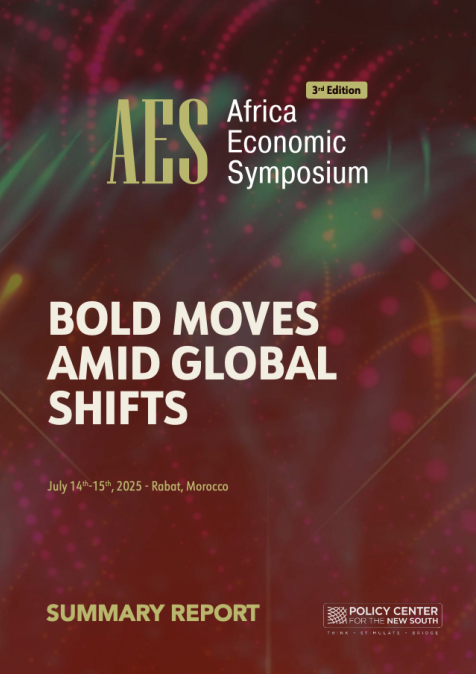
Africa Economic Symposium (AES) 3nd edition - SUMMARY REPORT
Authors
General rapporteur Mahmoud Arbouch
September 2, 2025

The Africa Economic Symposium (AES) has firmly established itself as one of the flagship annual events of the Policy Center for the New South, alongside the Atlantic Dialogues and the African Peace and Security Annual Conference (APSACO). Now in its third edition, AES continues to provide a unique platform for economists, policymakers, and academics from across the continent and beyond to exchange perspectives on the pressing macroeconomic and structural challenges facing Africa. Its mission remains to foster rigorous, evidence-based debates that inform policymaking and support long-term strategies for Africa’s development in an era of uncertainty. 

The 2025 edition, convened under the theme “Bold Moves amid Global Shifts,” explored the difficult policy trade-offs confronting African governments as they navigate a volatile global environment. The continent’s recovery from COVID-19 has been uneven, while debt pressures, supply chain disruptions, and geopolitical tensions weigh heavily on fiscal and economic resilience. Structural challenges such as persistent unemployment, low productivity, and the exclusion of Africa’s youth continue to hinder inclusive growth, even as policymakers are called upon to adapt to deep systemic uncertainty. 

The symposium underscored that many African states are increasingly resorting to short-term stabilization measures—such as accumulating reserves and postponing reforms—that may provide immediate security but risk delaying the structural transformation urgently needed. Against this backdrop, AES 2025 called for a careful balance between fiscal prudence, social investment, and the pursuit of sustainable growth, placing emphasis on reforming governance, improving macroeconomic management, and accelerating structural change. 

The discussions highlighted the urgent need to rethink Africa’s economic strategies in a shifting global order. From debt sustainability and the role of central banks to the promise of financial innovation, digital inclusion, and new instruments such as central bank digital currencies, the symposium emphasized that policy choices must align with long-term transformation goals. The debates also explored the opportunities and challenges of regional integration, trade connectivity, and development finance, all of which are essential levers for Africa’s resilience and prosperity. 

As in previous editions, the Annual Report on African Economies was launched alongside the symposium, offering an in-depth analysis of the continent’s macroeconomic dynamics and structural transformation pathways. More than just a publication, the report reflects the collective intellectual effort of leading scholars and practitioners, providing evidence-based insights to guide decision- makers. Together, the symposium and the report reinforced the Policy Center for the New South’s commitment to fostering forward-looking economic thinking that moves beyond short-term headlines to tackle Africa’s enduring challenges.

RELATED CONTENT

  • Authors
    January 26, 2022
    COVID-19 has caused serious damage throughout the entire world. As of mid-2021, the global fiscal cost of COVID-19—excluding the most important consequences, such as human lives, mental health effects, restrictions of human freedom, and other non-pecuniary components, have amounted to at least $16.5 trillion, about 18% of world GDP (Dinh 2021). Financial support has varied across countries depending on income level, political willingness, and the extent of the pandemic in each econo ...
  • Authors
    Morten Seja
    Hadley Hilgenhurst
    Charlie Knight
    January 25, 2022
    Why Green Finance Taxonomies? The increasing effort to mitigate climate change has caused more and more individuals, governments, and companies to shift away from traditional financial investments and activities, and towards more environmentally-friendly alternatives. However, until recently, there has been a lack of consensus on what green finance and its environmental impact is. Thus, green finance taxonomies are needed to provide classification systems that identify how environm ...
  • January 18, 2022
    يخصص مركز السياسات من أجل الجنوب الجديد حلقة برنامجه الأسبوعي "حديث الثلاثاء" لموضوع التمكين الاقتصادي للنساء مع الطيب غازي، باحث في الاقتصاد بمركز السياسات من أجل الجنوب الجديد. يعد مجال التمكين الاقتصادي للنساء من المداخل الأساسية لإرساء المساواة بين النساء والرجال، ويستمد هذا المجال ...
  • Authors
    January 13, 2022
    “This opinion was prepared within the framework of the Jean Monnet Atlantic Network 2.0. The European Commission's support for the production of this publication does not constitute an endorsement of the contents, which reflect the views only of the authors, and the Commission cannot be held responsible for any use which may be made of the information contained therein.”   As part of the lengthy fight against climate change, the European Union (EU) has introduced a Border Car ...
  • Authors
    January 12, 2022
    Feeble eyesight may hinder you from finding Puntland on a map, the unrecognized Federal member state in Somalia, Khaatumo State, Jubaland, or Somaliland, concerning the planet’s size just large enough to be covered by the shadow of a palm tree. Arab entities surrounded by sun and sand and the Gulf of Aden, Somaliland is surviving as a self-declared nation, located on the southern coast of the Gulf of Aden bordered by Djibouti to the northwest, Ethiopia to the south and west, Somalia ...
  • January 07, 2022
    يخضع سوق الشغل المغاربي منذ سنوات إلى مجموعة من الضغوطات تخص العرض والطلب إضافة الى ميكانيزمات التنظيم. ونعرض هنا أهمها وأبرز ما ينتج عنها من اختلالات. ومن الممكن ان تتفاقم هذه الاخيرة بع ...
  • Authors
    January 4, 2022
    A la fin avril 2021, Total (aujourd’hui TotalEnergies) annonçait le retrait de son personnel du site d’Afungi, dans le nord-est du Mozambique, et déclarait la force majeure pour le projet gazier Mozambique LNG. Ce projet, qui devrait normalement être opérationnel en 2024, porte sur la production et l’exportation de gaz naturel liquéfié (GNL) à partir de très importantes ressources de gaz naturel découvertes dans le bassin de Rovuma (Zone offshore 1) en mer. Ce retrait temporaire du ...
  • December 31, 2021
    In 2021 we’ve had the opportunity to host more than 50 experts in 60 episodes. We discussed economic, international relations, commodities, energy, gender, and security issues affecting t ...