Podcasts

Back

Trapped in the middle: A talk on MENA’s economic challenges

20
October 2023
Akram Zaoui & Mustapha Kamel Nabli
Related topics: 

High unemployment rates, particularly among the urban and educated youth, low accumulation of human capital, and a weak private sector leading to low growth levels have been the key features of the MENA region's economy. Dr. Mustapha Kamel Nabli, former governor of the Tunisian Central Bank and current president of the North Africa Bureau of Economic Studies, unpacks these factors that have been affecting the MENA region in the last decades.
RELATED CONTENT

  • July 3, 2026
    Ce Policy Paper a également été publiée en anglais et en espagnol par Le Grand Continent Le Maroc offre un exemple éclairant parmi les pays à revenu intermédiaire, dans un contexte marqué par une fragmentation croissante de l’environnement international, une croissance mondiale atone et un ralentissement de la convergence. Depuis 2022, sa trajectoire se distingue par une certaine robustesse, avec un rythme d’expansion supérieur à celui des autres économies de même catégorie. Dé ...
  • Authors
    June 30, 2026
    The inventory is worrisomely low The US military has fired off more than 1000 Tomahawk cruise missiles, roughly ten times the number it currently buys each year. The Pentagon used more than 1200 Patriot interceptor missiles, "more than three million dollars a pop", and more than 1000 precision strike, ground based missiles, "leaving the inventories worrisomely low." US commanders were forced to ration interceptors by letting unguided or less destructive missiles hit empty or no ...
  • Authors
    Mehran Haghirian
    June 15, 2026
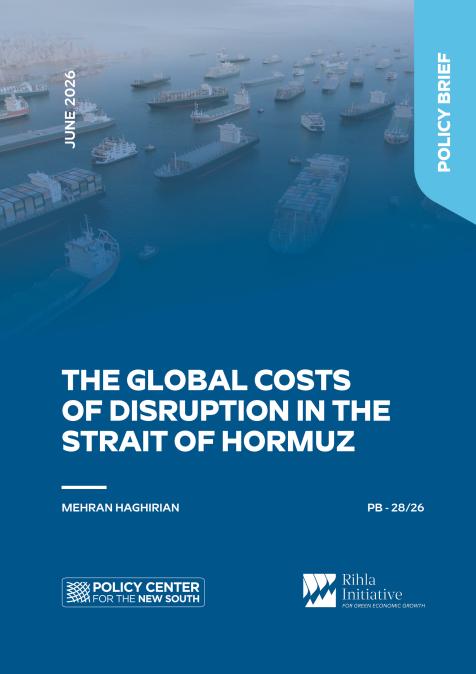
    This article draws in part on perspectives shared by members of the Rihla Initiative for Green Economic Growth, whose regional insights helped inform the sections on how the costs of the war are being felt across the Global South. The war on Iran and in the Gulf has made it impossible to treat the Strait of Hormuz as a regional issue. The disruption around the Strait has moved through the world economy in concrete ways, from higher fuel bills and pressure on food and fertilizer ...
  • Authors
    June 12, 2026
    This essay argues that the current debate about the future of the international monetary system is not really about Gulf currencies, oil pricing, or de-dollarization in the narrow technical sense. It is about something deeper and more important: whether institutional trust can survive when geopolitical certainty is eroding.The Gulf monarchies—Saudi Arabia, the United Arab Emirates, Qatar, Kuwait, Bahrain, and Oman—increasingly exist in a world where the United States no longer looks ...
  • June 11, 2026
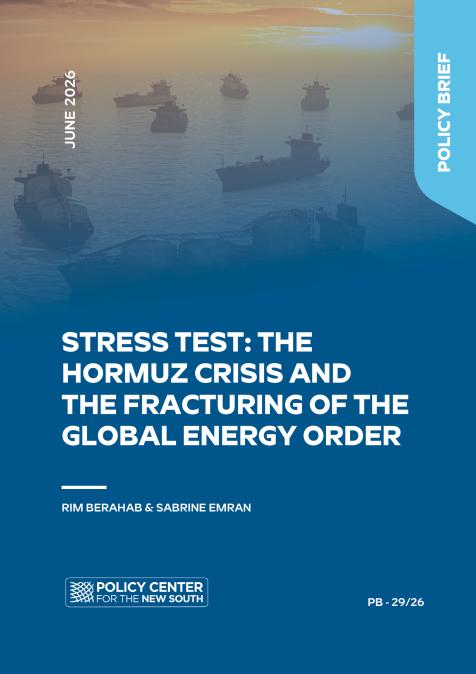
    The global energy system has entered a period of acute structural stress following the strikes by the United States and Israel on Iran in late February 2026, and the subsequent disruption of flows through the Strait of Hormuz. According to the International Energy Agency, the resulting shock marks the most severe disruption to global energy markets since the 1970s oil crises, with systemic characteristics comparable to the combined effects of those crises and the 2022 Russia-Ukraine ...
  • Authors
    Karim El Mokri
    Idriss El Abbassi
    June 8, 2026
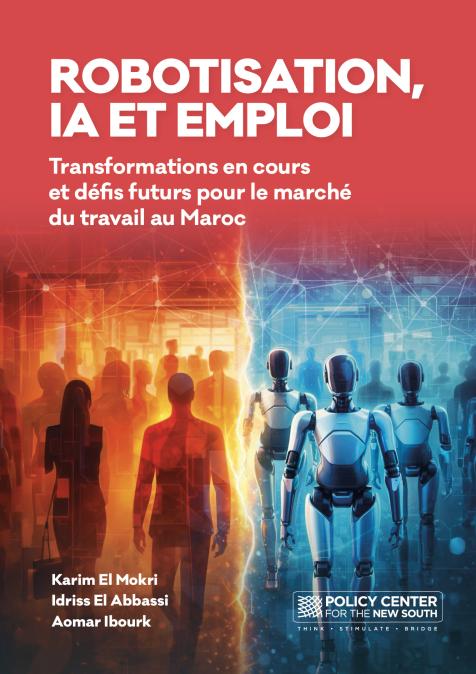
    Le monde du travail est engagé dans un processus de mutation sans précédent. La quatrième révolution industrielle, portée par l’intelligence artificielle (IA) et la robotisation, a été le point de commencement d’une ère nouvelle où les repères économiques et sociaux se redéfinissent à une vitesse inédite. Ces technologies suscitent un engouement légitime et offrent des perspectives prometteuses, mais requièrent une vigilance accrue face aux incertitudes qui les entourent.Bien que, à ...
  • June 5, 2026
    Driven by its mission to reflect on and analyze the major geopolitical, economic, and societal transformations shaping the contemporary world, and with a view to contributing to knowledge-sharing and disseminating the main outcomes of its research program, the Policy Center for the New South regularly publishes collective volumes addressing issues of particular importance to Morocco, Africa, and the broader Global/New South. In this spirit, the Center has recently released two volum ...
  • June 4, 2026
    Cet épisode revient sur les principaux enseignements du chapitre consacré au secteur extérieur marocain, en mettant en lumière le paradoxe d’un déficit commercial structurel persistant combiné à une forte résilience des équilibres externes. Badr Mandry explique comment les transferts de...
  • June 1, 2026
    Cette interview met en lumière le rôle central du secteur textile et de l’habillement dans l’économie marocaine, tant en matière d’emploi que d’exportations. Notre économiste, Mr. Fahd Azeroual revient sur son évolution historique, ses principaux défis, notamment la dépendance aux impor...
  • Authors
    May 22, 2026
    This paper, the fourth in a research series on services-led growth in the Global South, examines Egypt’s potential for growth and economic transformation through the integration of services into Global Value Chains (GVCs). It employs a new taxonomy that classifies services into Knowledge Services (KS), Enabling Services (ES), and Local Services (LS) and applies OECD 2025 Trade in Value-Added (TiVA), Trade in Employment (TiM), and input-output databases to benchmark Egypt against Mor ...