Podcasts

Back

Des émergents au défi du « retour de la géopolitique »

22
May 2015
TV Program, Policy Center for the New South

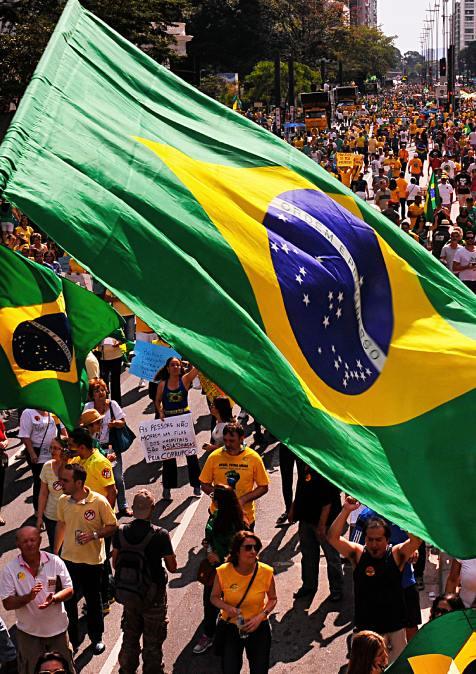
Cette deuxième émission de la série Ifri-Policy Center for the New South Roundtables sur "les défis de l'émergence et le retour de la géopolitique" porte sur les défis de l’émergence auxquels sont confrontés des pays comme le Brésil, l’Indonésie, le Nigéria et la Côte d’Ivoire. Acteur économique et politique incontournable des relations internationales depuis le début des années 2000, le Brésil connaît une croissance ralentie depuis 2011. Compte tenu du manque d’investissement dans les secteurs innovants et performants et de la persistance de très fortes inégalités sociales, le questionnement sur la trajectoire d’émergence brésilienne reste entier.
Avec ses caractéristiques géopolitiques, culturelles et politiques, l’Indonésie possède de tous les atouts d’une puissance en devenir. Néanmoins, les nombreuses crises internes et le faible niveau d’industrialisation freinent encore le retour de la confiance des investisseurs et remettent en question le modèle de croissance.
Devenu première puissance économique africaine en 2014, le Nigeria a fini par trouver sa place dans le cercle des pays émergents. Cependant, les inégalités fortes qui y persistent ainsi que la faible diversification de son économie dépendant très largement d’un secteur pétrolier en difficulté sont tant de freins à une croissance solide. Un climat sécuritaire extrêmement délicat fragilise d’autant plus ce géant aux pieds d’argile.
Disposant d’un fort potentiel en ressources naturelles et humaines, d’infrastructures relativement performantes et d’une croissance soutenue depuis l’adoption en 2011 de politiques de grands travaux, la Côte d’Ivoire semble destinée à un avenir économique florissant. Néanmoins, les défis économiques et sociaux que connaît le pays liés à l’existence de fortes inégalités entre espaces ruraux et urbains et à un climat politique tendu pourraient entraver son développement futur.

RELATED CONTENT

  • February 13, 2026
    There is a story told by Václav Havel, the Czech dissident writer who later became president after the fall of communism. In his essay The Power of the Powerless, Havel describes a shopkeeper who, every morning, places a sign in his window reading: “Workers of the world, unite!” He does not believe in it. Nor do the people around him. Yet the sign remains. ...
  • Authors
    February 12, 2026
    Divergent regulatory regimes for data, driven by different motivations, ranging from privacy protection in the European Union to information control in China, could eventually produce distinctively different, and possibly contradictory, bodies of data. Artificial-intelligence models trained on those datasets could produce differing and possibly even conflicting outputs. To the extent that AI outputs start to shape human perception and to influence decisions, in governments and ...
  • Authors
    February 11, 2026
    The U.S.–China technological rivalry has become a central axis of global economic and geopolitical competition. While the United States continues to lead in frontier innovation—most notably in advanced semiconductors and artificial intelligence (AI)—China has consolidated strengths in large-scale implementation, manufacturing capacity, and control over critical segments of global supply chains. These advantages are especially visible in clean energy technologies and in the processin ...
  • Authors
    Amine Ghoulidi
    February 5, 2026
    This Paper was originally published on orient-online.com  The Western Mediterranean’s exposure to the Sahel is usually framed in terms of security spillovers and crisis management. This paper argues that this framing misreads how Sahelian access conditions now shape Mediterranean integration. Morocco’s Atlantic Initiative is a state-led corridor strategy combining Atlantic port infrastructure, inland transit routes, and energy systems to connect landlocked Sahelian economi ...
  • February 4, 2026
    This article examines the quiet but profound implications of the erosion of U.S.-led hegemony for small and vulnerable states of the New South. While the post-1945 international order was never egalitarian, it offered predictability: power was organized through law, and sovereignty for weaker states rested less on justice than on procedural stability. Davos 2026 marked a turning point in the public acknowledgment of that system’s unraveling. Statements by leading Western figures rev ...
  • Authors
    February 3, 2026
    From the use of tariffs as a foreign policy instrument, to the weaponization of critical resources, and from targeted sanctions to attacks on critical infrastructure, economic security is at the forefront of international debates. The aggressive use of economic instruments for strategic purposes has become an explicit feature of international affairs, in a way not seen since the interwar period[1]. Beyond the weaponization of resources of all kinds, an increasing ‘monetization’ is u ...
  • January 30, 2026
    En 2019, Donald Trump a proposé d’acheter le Groenland, déclenchant un refus catégorique du Danemark et une tension diplomatique transatlantique. Cette initiative reflétait l’intérêt stratégique et économique des États-Unis pour l’Arctique et ses ressources. L’épisode a mis en lumière l...
  • Authors
    January 30, 2026
    The 2026 World Economic Forum (WEF) Annual Meeting took place in an environment of elevated economic uncertainty and structural risk repricing. According to the Global Risks Report (GRR) 2026, geoeconomic confrontation and economic downturn rank among the most severe near-term risks, while inflation-related risks and economic volatility have risen sharply in perceived severity compared with the previous edition. Notably, 50% of respondents to the Global Risks Perception Survey ...
  • January 29, 2026
    Le Mali, le Burkina Faso et le Niger, réunis au sein de l’Alliance des États du Sahel (AES), affirment l’ambition de bâtir une souveraineté nationale qui leur permettrait de s’émanciper de la domination et des influences extérieures et de se doter d’une liberté d’action dans les choix de développement politique et économique. Cependant, cette ambition se heurte à de nombreuses contraintes économiques et sécuritaires.La souveraineté ne peut se construire sans une base économique soli ...