Publications /
Policy Paper

Back
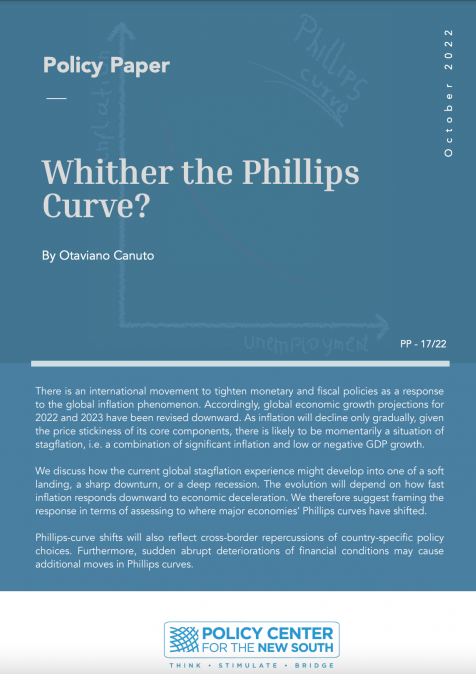
Whither the Phillips Curve?
Authors
October 12, 2022

There is an international movement to tighten monetary and fiscal policies as a response to the global inflation phenomenon. Accordingly, global economic growth projections for 2022 and 2023 have been revised downward. As inflation will decline only gradually, given the price stickiness of its core components, there is likely to be momentarily a situation of stagflation, i.e. a combination of significant inflation and low or negative GDP growth.

We discuss how the current global stagflation experience might develop into one of a soft landing, a sharp downturn, or a deep recession. The evolution will depend on how fast inflation responds downward to economic deceleration. We therefore suggest framing the response in terms of assessing to where major economies’ Phillips curves have shifted.

Phillips-curve shifts will also reflect cross-border repercussions of country-specific policy choices. Furthermore, sudden abrupt deteriorations of financial conditions may cause additional moves in Phillips curves.
RELATED CONTENT

  • Authors
    Russel Dinh
    January 27, 2016
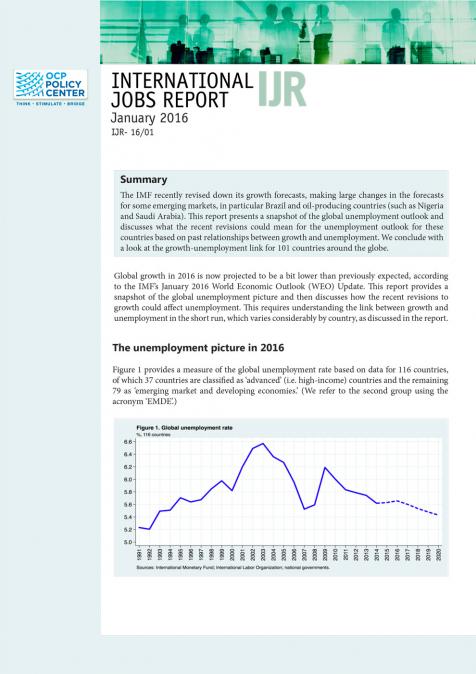
    The IMF recently revised down its growth forecasts, making large changes in the forecasts for some emerging markets, in particular Brazil and oil-producing countries (such as Nigeria and Saudi Arabia). This report presents a snapshot of the global unemployment outlook and discusses what the recent revisions could mean for the unemployment outlook for these countries based on past relationships between growth and unemployment. We conclude with a look at the growth-unemployment link f ...
  • November 5, 2015
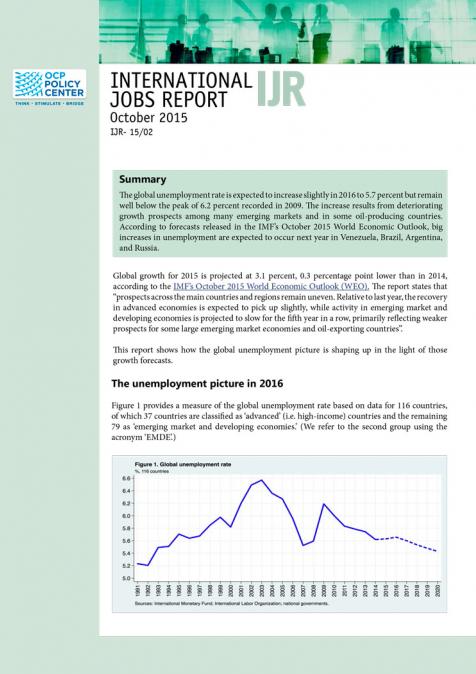
    The global unemployment rate is expected to increase slightly in 2016 to 5.7 percent but remain well below the peak of 6.2 percent recorded in 2009. The increase results from deteriorating growth prospects among many emerging markets and in some oil-producing countries. According to forecasts released in the IMF’s October 2015 World Economic Outlook, big increases in unemployment are expected to occur next year in Venezuela, Brazil, Argentina, and Russia. ...
  • Authors
    July 10, 2015
    Greek Prime Minister Alexis Tsipras has already completed two notable labors. First, he led his radical left-wing Syriza party to an improbable election victory in January 2015. Then, also improbably, he won a resounding no vote in a referendum on July 5 on accepting the terms of Greece’s international creditors for a new bailout package. According to Greek mythology, there are ten more labors to go, and indeed, it will probably take that many to redeem the Greek eco ...
  • Authors
    Pierre-Richard Agénor
    January 24, 2015
    OCP Policy Center est ravi de recueillir vos commentaires et d’engager la discussion autour de la publication de son dernier livre sur la stratégie de croissance du Maroc à l’horizon 2025 dans un environnement international en mutation, co-écrit par Pierre Richard Agénor et Karim El Aynaoui. L’économie marocaine fait actuellement face au risque de se retrouver « prise en tenaille », entre, d’un côté les pays à faible revenu en croissance rapide, bénéficiant d’une main-d’œuvre abond ...
  • Authors
    Pierre-Richard Agénor
    January 24, 2015
    L’économie marocaine fait actuellement face au risque de se retrouver « prise en tenaille », entre, d’un côté les pays à faible revenu en croissance rapide, bénéficiant d’une main-d’oeuvre abondante et bon marché, et, de l’autre, les pays à moyen revenu, capables d’innover rapidement. De plus, les investissements massifs de la Chine en Afrique subsaharienne ont contribué à accélérer la participation de certains pays de cette région à la nouvelle division internationale du travail, p ...
  • Authors
    Prakash Loungani
    January 24, 2015
    Seven years after the onset of the Great Recession, the global unemployment rate has returned to its pre-crisis level: the jobless rate fell to 5.6% in 2014; essentially the same as in 2007, the year before the recession. Chart 1: Global Unemployment Back to Pre-Crisis Level but Remains High in OECD (Average of unemployment rates for 105 countries, percent) Sources: IMF, and Economist intelligence Unit Calculations.   Note: Based on data for 105 countries that publi ...