Publications /
Policy Paper

Back
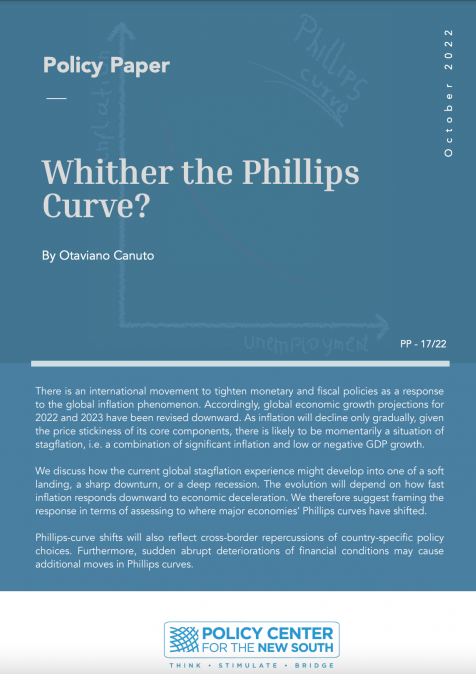
Whither the Phillips Curve?
Authors
October 12, 2022

There is an international movement to tighten monetary and fiscal policies as a response to the global inflation phenomenon. Accordingly, global economic growth projections for 2022 and 2023 have been revised downward. As inflation will decline only gradually, given the price stickiness of its core components, there is likely to be momentarily a situation of stagflation, i.e. a combination of significant inflation and low or negative GDP growth.

We discuss how the current global stagflation experience might develop into one of a soft landing, a sharp downturn, or a deep recession. The evolution will depend on how fast inflation responds downward to economic deceleration. We therefore suggest framing the response in terms of assessing to where major economies’ Phillips curves have shifted.

Phillips-curve shifts will also reflect cross-border repercussions of country-specific policy choices. Furthermore, sudden abrupt deteriorations of financial conditions may cause additional moves in Phillips curves.

RELATED CONTENT

  • November 10, 2026
    يناقش هذا الحوار أبرز التوجهات الاقتصادية والاجتماعية لمشروع قانون المالية لسنة 2027 في المغرب، في ظل الحاجة إلى التوفيق بين دعم النمو والاستثمار وخلق فرص الشغل، وتعزيز الحماية الاجتماعية، والحفاظ على التوازنات المالية. كما يتناول شروط فعالية المجهود الاستثماري، وسبل تمويل الأولويات الا...
  • Authors
    Patrick Kabanda
    November 10, 2026
    Cultural trade is a dynamic engine for economic diversification in the New South. Despite decades of diversification rhetoric, however, this sector remains underrealized. Thus, many countries across Africa, Latin America and the Caribbean, Asia, and the Middle East are still commodity-dependent, even though the global creative economy has grown roughly eightfold since 2002, to surpass $2 trillion—that figure, moreover, does not even account for the nonmonetary benefits that merit co ...
  • August 31, 2026
    Selon la dernière enquête nationale disponible, 57 % des femmes marocaines âgées de 15 à 74 ans, soit environ 7,6 millions de personnes, ont déclaré avoir subi au moins un acte de violence au cours des douze mois précédant l'enquête (HCP, 2019). Cette prévalence s'accompagne d'un coût économique direct et indirect estimé, pour la même période, à 2,85 milliards de dirhams (HCP, 2019). Ces deux ordres de grandeur — humain et économique — trouvent un écho dans les indicateurs du marché ...
  • Authors
    August 5, 2026
    This paper addresses the persistent challenge of resource dependence in the world's poorest countries, focusing on the ten poorest African nations where natural- resource rents average 14% of income. It argues that four decades of conventional policy advice, which treated resource dependence primarily as a revenue management problem, have failed to help these countries. While stabilization funds and permanent-income frameworks aim to smooth consumption, they do not answer the fundam ...
  • Authors
    July 28, 2026
    The term “K-shaped recovery” was introduced to describe the economic recovery from the recession triggered by the Covid-19 pandemic. It refers to the uneven and divergent growth pattern between leading industries or sectors (the upper arm of the letter K—mainly the high-technology sector) and laggards, or the rest of the economy (the lower arm—the traditional industries). Since then the term has become popular in portraying divergent growth patterns within and between countries, esp ...
  • Authors
    July 13, 2026
    This paper provides a structural assessment of India’s services-led development trajectory, and its integration into global value chains (GVCs) between 2012 and 2022. Applying an analytical framework that categorizes services into knowledge (KS), enabling (ES), and local (LS) sectors, the study utilizes sixteen OECD indicators to move beyond the narrative of India as a ‘services champion’ and reveal a more complex economic reality. The analysis identifies three central structur ...
  • Authors
    July 13, 2026
    This paper examines the evolution of China’s services sector between 2012 and 2022, analyzing the country’s structural transformation based on a novel three-tier taxonomy: knowledge services (KS), enabling services (ES), and local services (LS). Using sixteen quantitative indicators from OECD databases, the study evaluates China’s transition in comparison to the EU15 benchmark, highlighting three core challenges: manufacturing rebalancing, labor absorption, and global integration.Th ...
  • Authors
    Edited by
    July 13, 2026
    Available soon on livremoi. The 2026 edition of the Annual Report on the African Economy examines the issue of the valorization of Africa’s natural resources, particularly its mineral wealth. While the continent holds some of the world’s largest known reserves of a wide range of minerals and metals, the objective is not merely to catalogue these resources, but rather to explore the conditions under which natural resource endowments can be transformed into drivers of Africa’s in ...