Publications /
Policy Brief
Recent crises in the Middle East, particularly attacks targeting commercial vessels in the Red Sea and tensions surrounding the Strait of Hormuz, have highlighted the vulnerability of the main strategic corridors of global trade. Rather than fundamentally disrupting the organization of trade flows, these crises are accelerating an ongoing transformation driven by the search for more resilient connectivity chains, the diversification of trade routes, and the development of logistics infrastructure capable of better withstanding shocks.
In this context, corridors are no longer merely transport routes but also instruments of economic security and competitiveness.
This shift opens up new prospects for Africa’s Atlantic façade. Thanks to its geographical position, the gradual modernization of its port infrastructure, and the development of regional cooperation initiatives, Africa’s Atlantic façade has several assets that could strengthen its role within international trade networks.
However, this opportunity will depend on states’ ability to improve connectivity between existing infrastructure, deepen cooperation, and build more integrated logistics networks. Africa’s Atlantic façade could thus emerge as an area that contributes to strengthening the resilience of global connectivity chains.
Introduction
Since the end of 2023, tensions in the Middle East have extended beyond the political and security consequences of conflicts. Attacks on vessels in the Red Sea, tensions surrounding the Strait of Hormuz, and disruptions affecting several strategic maritime routes have underscored how regional crises can have repercussions far beyond their immediate geographical area. The security of strategic corridors has become a major concern for states, businesses, and international organizations seeking to mitigate risks to global trade[1].
While the COVID-19 pandemic had already exposed the fragility of global supply chains, current geopolitical crises are accelerating an ongoing shift toward more resilient connectivity chains, greater diversification of trade routes, and the development of new infrastructure capable of better withstanding shocks. The question is no longer simply how to transport goods at the lowest possible cost, but also how to ensure the continuity of trade when certain strategic corridors become vulnerable.
These transformations concern not only the countries directly affected by conflict. They are also prompting other states to rethink their position within international trade networks and consolidate their role along major trade routes. In this context, port infrastructure, logistics platforms, and multimodal corridors are becoming increasingly important, as they help diversify routes and reduce dependence on a limited number of strategic chokepoints[2]. Corridors are therefore no longer merely transport infrastructure; they have also become genuine instruments of competitiveness, resilience, and economic security.
This dynamic is particularly significant for Africa’s Atlantic façade. Long regarded primarily as a transit area or a maritime gateway, it is now emerging as a space that could play a growing role amid the diversification of trade routes. Investments made in recent years in port infrastructure, transport corridors, and logistics platforms reflect this trend. However, the growing importance of this façade does not depend solely on the quality of its infrastructure. It also relies on the ability of coastal states to develop more integrated connectivity networks and strengthen cooperation in order to better respond to the changing requirements of international trade.
This Policy Brief seeks to address a twofold question: to what extent are recent conflicts in the Middle East accelerating the reconfiguration of strategic corridors connecting Asia, the Middle East, Africa, and Europe, and how is this evolution opening up new prospects for Africa’s Atlantic façade? The central argument is that these conflicts are not creating a new structure of international trade, but rather accelerating transformations already underway, characterized by the search for more resilient connectivity chains, the diversification of trade routes, and the development of new logistics infrastructure.
The analysis adopts a qualitative approach based on reports from international organizations, among other sources. It also draws on recent data on maritime trade, strategic corridors, and supply chains to assess the implications of these transformations for Africa’s Atlantic façade and the prospects they create for the region.
To address this question, the Policy Brief is structured in two parts. The first examines how recent conflicts in the Middle East are accelerating the search for more resilient corridors and gradually reshaping the logic of international connectivity. The second explores the new prospects these developments create for Africa’s Atlantic façade, while highlighting the conditions required to strengthen its role within regional and international connectivity networks.
I. Conflicts in the Middle East Are Accelerating the Search for More Resilient Connectivity Chains
A. Strategic Corridors Are Increasingly Vulnerable to Regional Crises
Strategic corridors play a central role in the functioning of the global economy. They are not limited to maritime, land, or rail routes, but form connectivity networks that ensure the continuous movement of goods, raw materials, energy, and industrial components between the world’s major regions[3]. They also constitute critical infrastructure on which the stability of international trade largely depends. For several decades, international trade has been organized around these routes, with priority given to the fastest and least costly options. While this approach has improved supply chain efficiency and reduced transport costs, it has also increased global trade’s dependence on a limited number of strategic corridors and chokepoints, including the Strait of Hormuz and Bab el-Mandeb, the Suez Canal, and the Strait of Malacca[4]. In other words, a significant share of global trade relies on a small number of chokepoints whose proper functioning is essential to the smooth and secure flow of international trade.
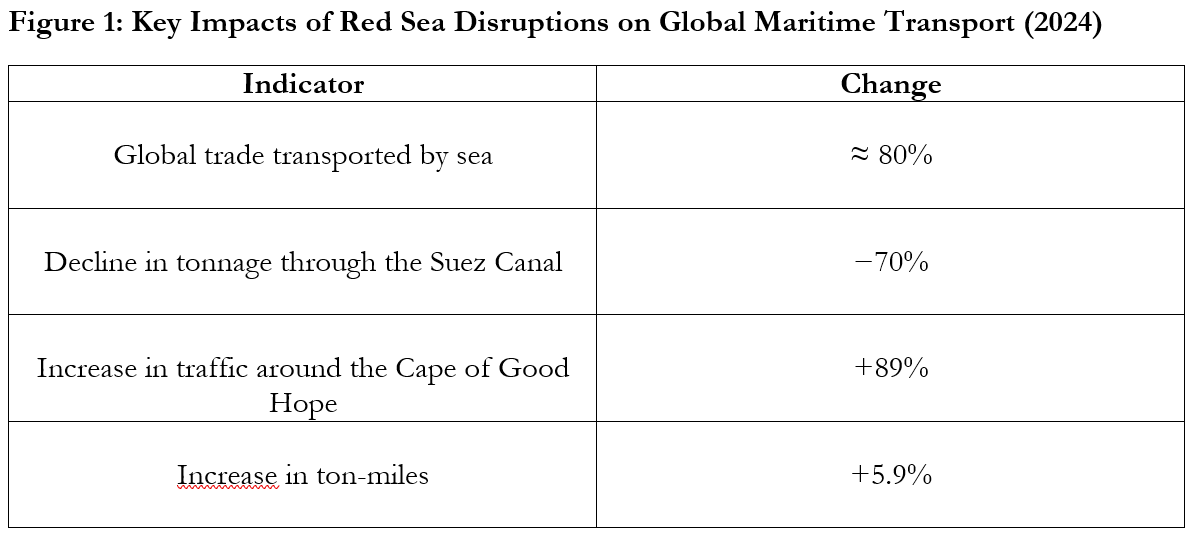
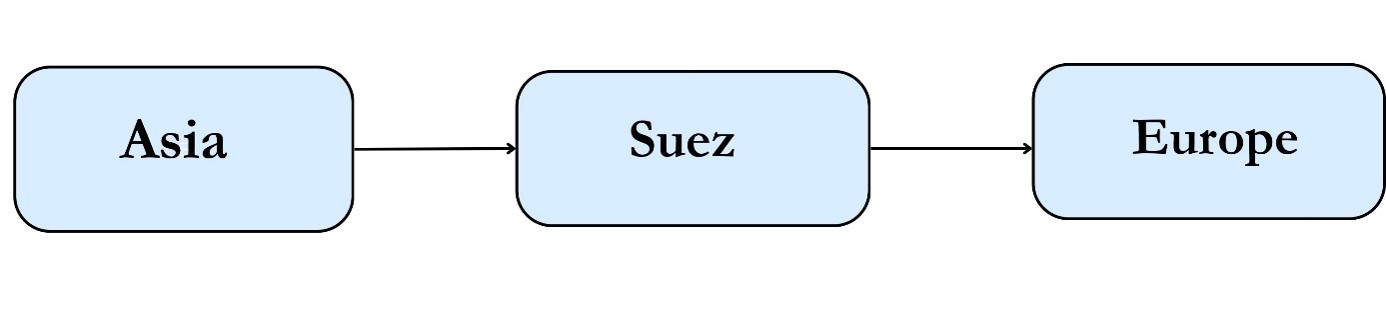
This dependence becomes particularly evident when traffic along one of these corridors is disrupted. Since the end of 2023, attacks in the Red Sea have prompted many shipping companies to avoid the Suez Canal and reroute their vessels around Africa via the Cape of Good Hope. This shift has had consequences far beyond the region. According to the United Nations Conference on Trade and Development (UNCTAD), tonnage transiting through the Suez Canal had fallen by around 70% by mid-2024, while traffic around the Cape of Good Hope had increased by nearly 89%[5]. At the same time, vessels have had to travel longer distances, leading to higher transport costs, longer delivery times, and increased CO₂ emissions[6]. These disruptions have therefore not only affected the countries bordering the Red Sea but also highlighted the strong dependence of global supply chains on a limited number of chokepoints, whose closure or slowdown can rapidly affect international trade.
Recent developments surrounding the Strait of Hormuz illustrate another dimension of this vulnerability. Beyond the risk of a closure of the strait to maritime traffic, discussions over the possibility of imposing transit fees on vessels have highlighted how strategic corridors can also become instruments of economic and geopolitical pressure. Although this possibility did not materialize, it reflects an important shift: the cost of and access to major maritime routes can increasingly be influenced by political considerations, creating greater uncertainty for international trade actors and encouraging the search for safer alternative routes.
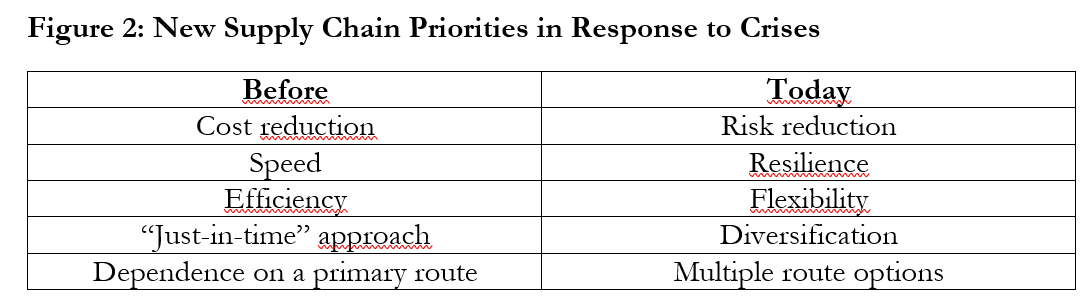
Recent disruptions ultimately show that the issue is no longer limited to the performance of strategic corridors, but also concerns their ability to continue operating in times of crisis. For a long time, supply chains were organized around key objectives: reducing costs, shortening transport times, and improving logistics efficiency.
However, this approach is shifting toward a greater focus on resilience. States, businesses, and maritime transport actors are placing greater emphasis on the continuity of trade by developing connectivity chains capable of absorbing shocks and adapting rapidly to disruptions. Recent OECD analyses confirm this shift, highlighting that supply chain resilience has become a strategic objective amid the growing number of crises[7].
The obstruction of the Suez Canal by the Ever Given container ship in March 2021 served as an early warning. Traffic was disrupted for nearly six days, leaving more than 400 vessels stranded[8]. Attacks on vessels in the Red Sea have further confirmed this vulnerability, leading hundreds of container ships to reroute around the Cape of Good Hope. According to UNCTAD, 586 container ships had already been rerouted via this route by February 2024[9].
Against this backdrop, the heavy concentration of trade flows along a limited number of corridors represents a growing risk. Recent crises in the Middle East did not create this vulnerability, but they have intensified it by demonstrating that the continuity of trade is just as important as the economic efficiency of corridors.
B. Accelerating Corridor Diversification and Logistics Investment
The disruptions observed in recent years have changed the way states, businesses, and major international transport actors approach connectivity chains. For a long time, logistics decisions were primarily based on cost, speed, and efficiency. Today, these criteria remain essential, but they are no longer sufficient on their own to guide strategic choices. The growing number of health, climate, and geopolitical crises has shown that even an efficient supply chain can quickly become vulnerable when it depends on a limited number of routes or suppliers[10].
Resilience has therefore emerged as a new decision-making criterion. The objective is no longer simply to optimize trade flows, but also to ensure that they can continue to function despite disruptions, whether temporary or prolonged. This shift is reflected in a growing effort to diversify trade routes, develop multiple transport options, and invest in infrastructure capable of providing greater flexibility in times of crisis[11]. Ensuring complementarity between corridors is therefore becoming a strategic objective of connectivity policies.
This new approach is reflected in the investments made by many states. Across several regions of the world, economic, port, and multimodal corridor projects are expanding, not to replace existing routes, but to provide complementary options when some of them become more exposed to risks. The India-Middle East-Europe Economic Corridor (IMEC) project illustrates this trend. It aims to connect India to Europe through the Middle East and to diversify trade routes in order to make supply chains more resilient[12]. In a context marked by geopolitical tensions, it reflects a growing effort to secure international trade by providing an alternative to traditional routes. Beyond its economic dimension, the project also reflects geoeconomic competition for control over major connectivity routes.
Figure 3. Main Connectivity Options between Asia and Europe amid Disruptions to Trade Routes
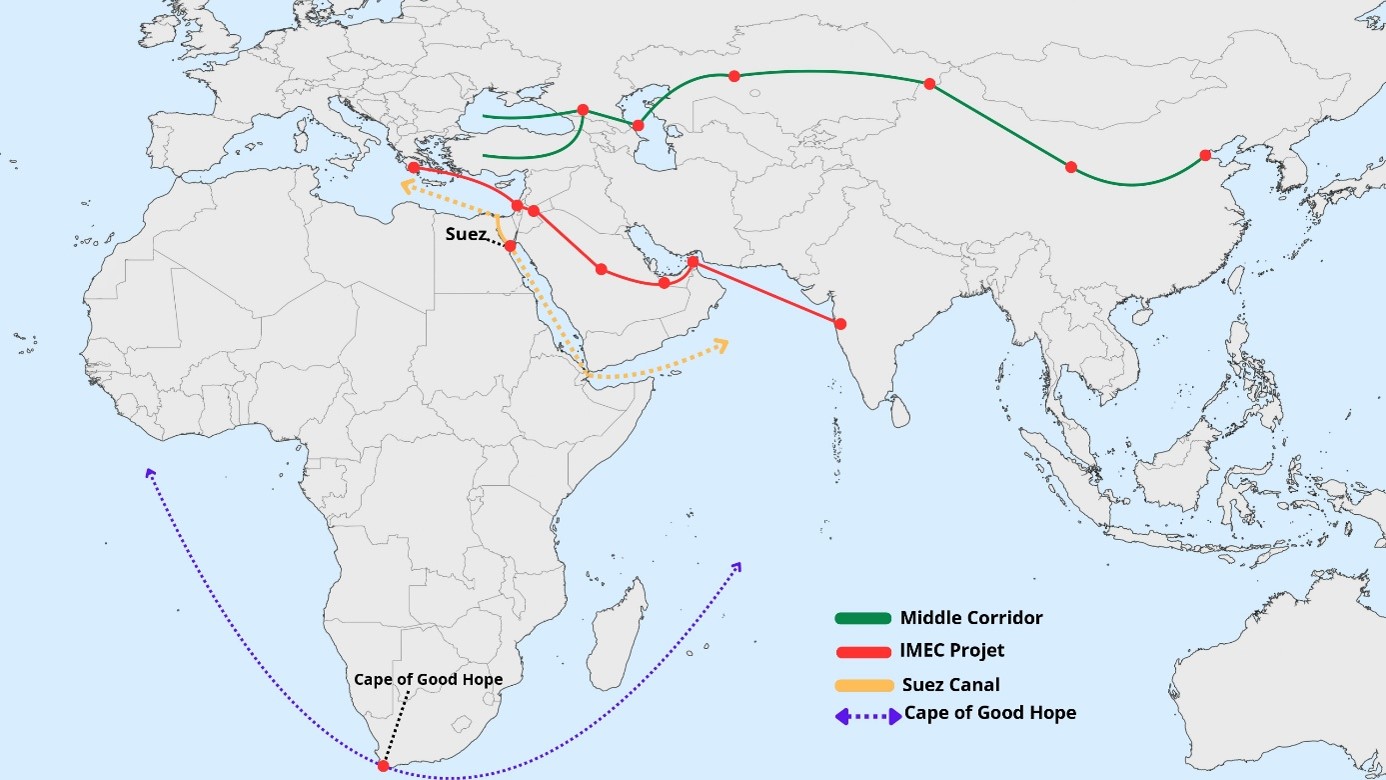
Source: Created by the author using QGIS.
However, this trend does not mean that established corridors will lose their importance or be replaced in the short term. The Suez Canal, the Strait of Hormuz, and the Strait of Malacca will continue to play an essential role in global trade because of their geographical position and the volumes of trade they handle.
Nevertheless, recent crises, such as the COVID-19 pandemic, the blockage of the Suez Canal by the Ever Given in 2021, and attacks on vessels in the Red Sea since the end of 2023, have shown that relying on a single route can become risky when it is affected by major disruptions. Current strategies therefore increasingly emphasize complementarity between corridors rather than their substitution.
The objective is no longer to identify a single route capable of replacing all others, but rather to have several routes available to maintain trade flows in times of crisis. This diversification increases the flexibility of connectivity chains and helps reduce the risks associated with an excessive concentration of trade flows[13]. It is also leading states to view logistics infrastructure not simply as a means of transport, but as a strategic asset capable of supporting the continuity of trade in an increasingly uncertain international environment. Corridors are thus becoming instruments of economic competitiveness, security of supply, and geopolitical influence.
Figure 4: Evolution of the Main Connectivity Corridors between Asia and Europe
Before
After
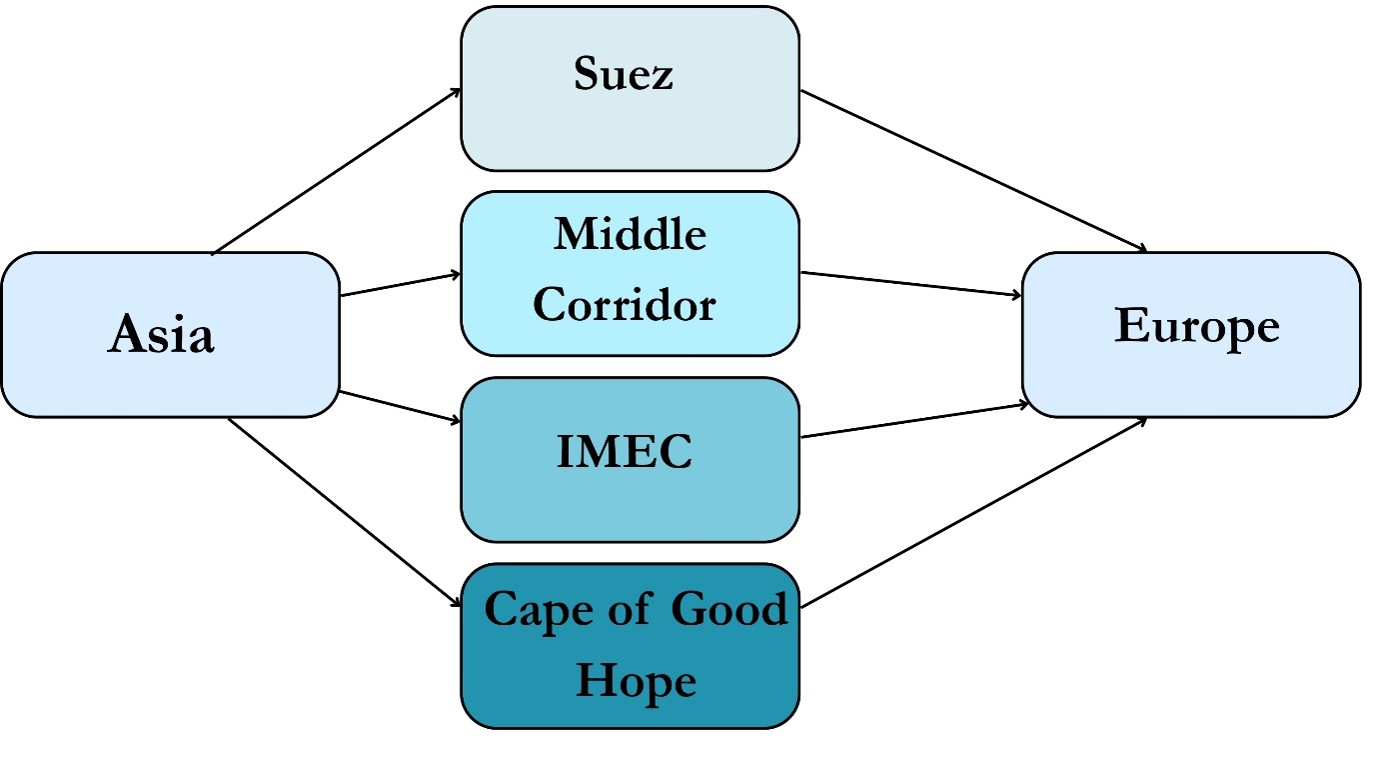
Beyond recent initiatives aimed at developing or strengthening strategic corridors, such as the IMEC project, the Middle Corridor, or the Lobito Corridor, developments observed in recent years primarily show that the way international connectivity is conceived is changing. While a country’s geographical position remains an important asset, it is no longer sufficient on its own to strengthen its role in international trade.
States are now seeking to improve their port and logistics infrastructure, strengthen their transport networks, and modernize customs procedures in order to make their territories more attractive, competitive, and resilient[14]. The strategic value of a territory increasingly depends on its ability to provide reliable and diversified connections that can continue to operate even in times of crisis.
As a result, some regions that had previously occupied a less central position within major trade networks are attracting greater attention. This is particularly the case for Africa’s Atlantic façade, whose geographical position, investments undertaken in recent years, and ongoing cooperation initiatives are opening up new prospects amid the reconfiguration of international connectivity. This shift therefore raises the question of the opportunities that this reconfiguration could create for the region in terms of trade, logistics, and regional integration.
II. The Reconfiguration of Connectivity Opens New Prospects for Africa’s Atlantic Façade
A. Growing Assets
The transformations observed over the past decade are not only changing the routes used by international trade. They are also leading states, businesses, and investors to view certain geographical areas differently, as their importance is no longer measured solely by their proximity to major markets, but also by their ability to provide more diversified and resilient connectivity and to secure trade flows in an increasingly uncertain international environment.
Africa’s Atlantic façade is attracting growing interest, not because it represents an alternative to the major existing corridors, but because it brings together several features that have become particularly valuable in the current context: access to the wider Atlantic space, a position at the crossroads of Europe, Africa, and the Americas, as well as a range of rapidly evolving port and logistics infrastructure. Thus, while the geography of this façade has not changed, its strategic value has increased as resilience becomes a criterion as important as the speed or cost of trade.
This dynamic can also be explained by the fact that economic actors are no longer seeking only efficient transit points, but also networks capable of ensuring a certain degree of continuity in trade when disruptions occur. In this context, major ports are no longer regarded simply as transit points. Their value increasingly depends on their ability to integrate into a broader system comprising logistics zones, road and rail corridors, industrial platforms, as well as more streamlined customs procedures[15].
The stability of maritime areas is becoming an increasingly important factor in investment decisions and the development of connectivity corridors. The Atlantic façade is part of this trend, offering an environment that is generally favorable to the development of port infrastructure and logistics connections, thereby enhancing its attractiveness to international trade actors.
Several countries along Africa’s Atlantic façade have made significant investments in recent years to modernize their port infrastructure and strengthen their integration into international trade networks. Tanger Med and the Port of Casablanca in Morocco, the Port of Abidjan in Côte d’Ivoire, the Port of Dakar in Senegal, and the Port of Tema in Ghana illustrate this trend. In Angola, the Port of Lobito is also gaining importance through its connection to the Lobito Corridor, which improves links between the Atlantic façade and the interior of the continent.
In addition to these facilities, the Dakhla Atlantic Port project is intended to strengthen Morocco’s Atlantic façade by providing a new gateway to West Africa and the Sahel countries, while supporting the Kingdom’s ambition to establish itself as a major logistics and maritime hub on the Atlantic[16].
Taken together, these infrastructures do not challenge the position of the world’s major hubs, but contribute to the diversification of logistics gateways and the emergence of new connectivity options along Africa’s Atlantic façade.
Figure 5: Main Operational Ports along Africa’s Atlantic Façade
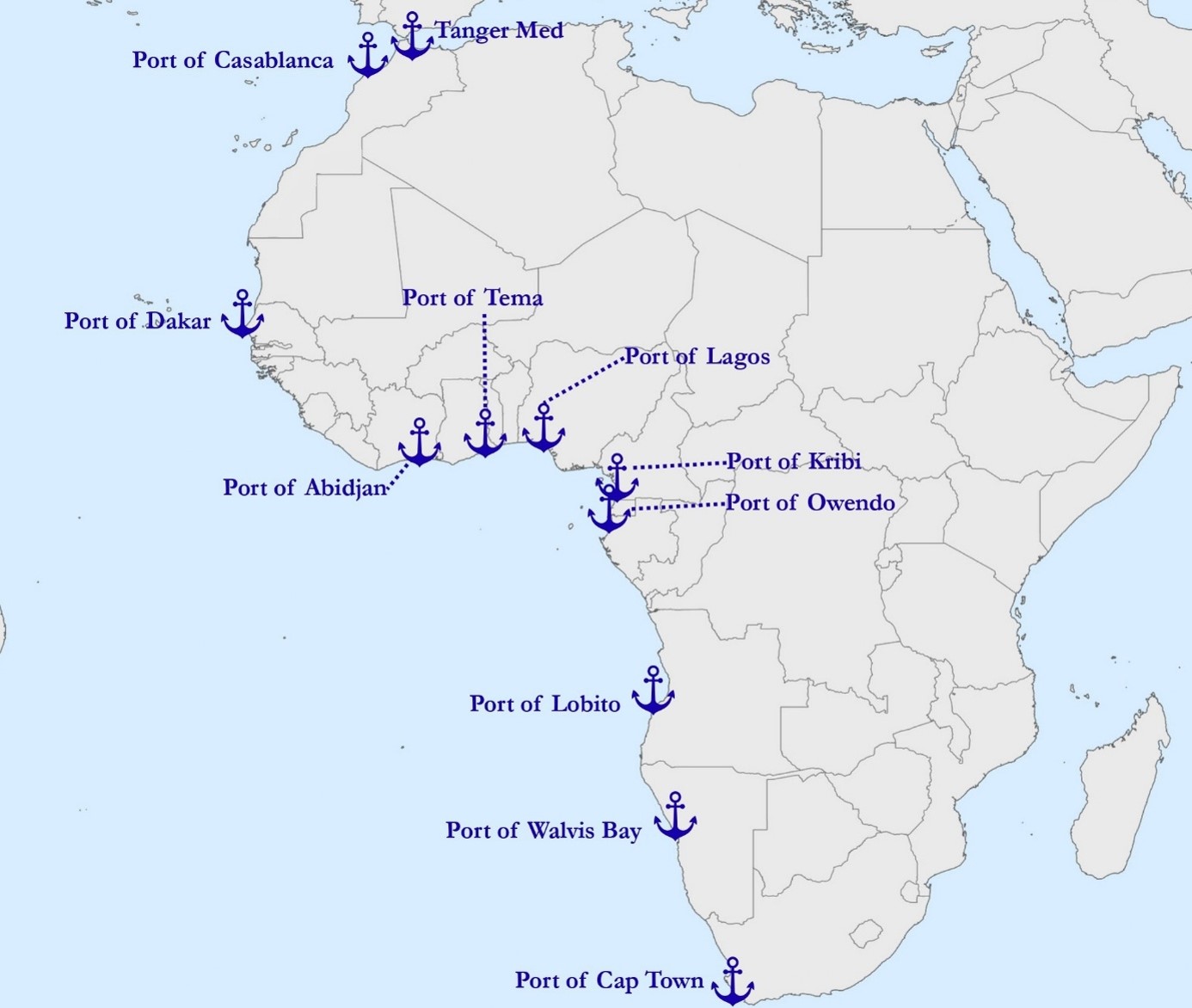
Source: Created by the author using QGIS.
This dynamic is also reflected in the development of several ports along Africa’s Atlantic façade. Although these infrastructures do not occupy the same position within international maritime networks, they are part of a common dynamic aimed at strengthening their logistics capacities in order to improve their connections to regional and global markets.
Tanger Med is a prominent example of this trend. In 2024, the port handled more than 10.2 million TEUs[17], confirming its position among the leading transshipment hubs in the Mediterranean and on the African continent[18].
However, infrastructure development alone is not enough to make Africa’s Atlantic façade a fully integrated connectivity space. Ports are certainly essential gateways for international trade, but their effectiveness also depends on their ability to connect to efficient inland corridors and logistics networks supported by cooperation policies among the countries concerned. Resilience is not built solely at the level of an individual port, but across an entire network.
Several regional initiatives, such as His Majesty King Mohammed VI’s Atlantic Initiative and the Abidjan-Lagos Corridor, supported by ECOWAS[19] and the Programme for Infrastructure Development in Africa (PIDA), seek to strengthen links among countries along the Atlantic façade and facilitate the integration of Sahel countries into regional connectivity networks, including ports, road and rail corridors, logistics platforms, border crossings, customs procedures, industrial zones, and digital infrastructure.
The Atlantic Initiative launched in 2023 follows this approach by seeking to facilitate access to the Atlantic Ocean for Sahel countries and strengthen economic and logistics complementarities among countries in the region[20]. This initiative reflects a broader shift: in an increasingly uncertain international environment, the competitiveness of a territory depends less and less on infrastructure alone and increasingly on its ability to integrate into coherent and resilient regional connectivity networks.
B. Strategic Priorities
Africa’s Atlantic façade now has a significant opportunity. However, this opportunity will not automatically translate into an economic advantage. Ports may be efficient and infrastructure modern, but this alone is not enough. If trade between countries remains difficult, procedures are lengthy, or corridors are not sufficiently interconnected, part of the region’s potential may remain untapped.
The challenge is therefore to ensure that the different infrastructure projects work together and form part of a common connectivity framework. This is also why cooperation among countries along the Atlantic façade is becoming increasingly important, as it can help build more efficient and resilient networks rather than projects that operate in isolation.
In this context, new connectivity chains no longer depend solely on the quality of a port or a road. They also depend on how the different networks are connected to one another. A modern port loses some of its value if it is not connected to efficient corridors, if border crossings remain slow, or if regulations vary from one country to another. Conversely, when infrastructure is supported by better coordination among states, it can facilitate trade, reduce transport times, and make routes more reliable. In the current context, as businesses seek to diversify their trade routes, the ability to provide seamless connectivity can become a genuine advantage for Africa’s Atlantic façade[21].
Beyond its diplomatic dimension, the Atlantic Initiative launched by the Moroccan Sovereign also responds to an economic reality: Sahel countries need to diversify their access to international markets, while countries along the Atlantic façade have an interest in strengthening their role in regional and international trade. The objective is not only to develop new infrastructure, but also to build more integrated connectivity chains that are better able to withstand the crises and disruptions currently affecting global trade.
The ongoing transformations show that competition is no longer limited to major ports or the main maritime routes. It also depends on the ability of regions to build coherent connectivity networks capable of functioning even when certain routes become more vulnerable. Africa’s Atlantic façade has assets that could enable it to play a greater role in international trade.
However, this evolution will require continued efforts to develop infrastructure, strengthen regional cooperation, and improve connections between existing projects. If these conditions are met, the Atlantic façade could gradually establish itself not as an alternative to traditional corridors, but as a space capable of contributing to greater resilience in global connectivity chains.
Conclusion
Recent developments in the Middle East show that the security of strategic corridors has become a major issue for international trade. The disruptions observed in the Red Sea, as well as tensions around the Strait of Hormuz, highlight the consequences that dependence on a limited number of maritime routes can have for global connectivity chains. States and businesses are increasingly seeking to diversify their routes and build networks that are better able to withstand crises.
This evolution creates new prospects for countries along Africa’s Atlantic façade. Thanks to its geographical position, the progressive development of its port infrastructure, and the cooperation initiatives emerging across the region, the Atlantic façade now has several assets that can help strengthen the role of these countries in regional and international trade. However, this opportunity can only be fully exploited if the different projects are better interconnected and integrated into a common vision of connectivity.
The analysis conducted in this Policy Brief leads to the conclusion that current crises are not only changing the routes used by global trade. They are also leading states to rethink the way corridors are organized and connected. Within this new dynamic, Africa’s Atlantic façade can establish itself as a strategic connectivity space, not by replacing the major existing corridors, but by contributing to more diversified and resilient international trade.
Bibliography:
Reports and Publications by International Organizations
African Development Fund (ADF), Study on the Abidjan-Lagos Corridor Highway Development Project, September 2016.
Organisation for Economic Co-operation and Development (OECD), OECD Supply Chain Resilience Review, Paris, OECD Publishing, 2025.
Organisation for Economic Co-operation and Development (OECD), “Regional Economic Corridors,” Policy issue, OECD.
United Nations Conference on Trade and Development (UNCTAD), Navigating Troubled Waters: Impact to Global Trade of Disruption of Shipping Routes in the Red Sea, Black Sea and Panama Canal, UNCTAD Rapid Assessment, Geneva, February 2024.
United Nations Conference on Trade and Development (UNCTAD), Review of Maritime Transport 2024: Navigating Maritime Chokepoints, Geneva, United Nations, 2024.
United Nations Conference on Trade and Development (UNCTAD), Review of Maritime Transport 2025: Staying the Course in Turbulent Waters, Geneva, United Nations, 2025.
Academic Articles
Liu, Jiaguo, Juanjuan Wu and Yu Gong, “Maritime Supply Chain Resilience: From Concept to Practice,” Computers & Industrial Engineering, vol. 186, 2023.
Think Tanks and Research Centers
Hussain, Afaq and Nicholas Shafer, The India-Middle East-Europe Economic Corridor: Connectivity in an Era of Geopolitical Uncertainty, Atlantic Council, 2025.
Runde, Daniel F. and Sundar R. Ramanujam, Recovery with Resilience: Diversifying Supply Chains to Reduce Risk in the Global Economy, Center for Strategic and International Studies (CSIS), 2020.
Audiovisual Sources
- Policy Center for the New South, « حديث الثلاثاء: المنظومة المينائية في المغرب: بوابة نحو قيادة الاقتصاد الأزرق في أفريقيا », interview with Sanae El Amrani, hosted by Redouan Najah, May 20, 2026.
Institutional and Official Sources
Speech by His Majesty King Mohammed VI on the occasion of the 48th anniversary of the Green March, November 6, 2023, reproduced in Speeches and Messages of His Majesty King Mohammed VI (July 2023-June 2024).
Tanger Med Port Authority, Port Activity Report 2024, press release, January 22, 2025.
Specialized Press
Lloyd’s List, “Erratic actions of Suez Canal pilots cited as major contribution to Ever Given grounding,” July 13, 2023.
[1] UNCTAD, Review of Maritime Transport 2025, United Nations Conference on Trade and Development, 2025. p.3
[2] Organisation for Economic Co-operation and Development (OECD), Regional Economic Corridors, OECD, https://www.oecd.org/en/topics/policy-issues/regional-economic-corridors.html
[3] Organisation for Economic Co-operation and Development (OECD), Regional Economic Corridors,
https://www.oecd.org/en/topics/policy-issues/regional-economic-corridors.html
[4] United Nations Conference on Trade and Development (UNCTAD), Review of Maritime Transport 2025, Geneva, Nations Unies, 2025, p 7-8.
[5] United Nations Conference on Trade and Development (UNCTAD), Review of Maritime Transport 2024: Navigating Maritime Chokepoints, Genève, Nations Unies, 2024, p.34.
[6] United Nations Conference on Trade and Development (UNCTAD), Review of Maritime Transport 2025: Staying the Course in Turbulent Waters, Geneva, United Nations, 2025, p.62.
[7] Organisation for Economic Co-operation and Development (OECD), OECD Supply Chain Resilience Review, Paris, OECD Publishing, 2025, chap. 2, p.100.
[8] Lloyd's List, Erratic actions of Suez Canal pilots cited as major contribution to Ever Given grounding, 13 July 2023, p.1.
[9] United Nations Conference on Trade and Development (UNCTAD), Navigating Troubled Waters: Impact to Global Trade of Disruption of Shipping Routes in the Red Sea, Black Sea and Panama Canal, UNCTAD Rapid Assessment, Geneva, February 2024, p. 11.
[10] Organisation for Economic Co-operation and Development (OECD), OECD Supply Chain Resilience Review, Paris, OECD Publishing, 2025
[11] Daniel F. Runde et Sundar R. Ramanujam, Recovery with Resilience: Diversifying Supply Chains to Reduce Risk in the Global Economy, Center for Strategic and International Studies (CSIS), 2020, p.7-9.
[12] Afaq Hussain et Nicholas Shafer, The India-Middle East-Europe Economic Corridor: Connectivity in an Era of Geopolitical Uncertainty, Atlantic Council, 2025, pp 8-13.
[13] Jiaguo Liu, Juanjuan Wu et Yu Gong, Maritime Supply Chain Resilience: From Concept to Practice, Computers & Industrial Engineering, vol. 186, 2023, p.8.
[14]Organisation for Economic Co-operation and Development (OECD), Regional Economic Corridors,
https://www.oecd.org/en/topics/policy-issues/regional-economic-corridors.html
[15] Organisation for Economic Co-operation and Development (OECD), Regional Economic Corridors, https://www.oecd.org/en/topics/policy-issues/regional-economic-corridors.html
[16] Policy Center for the New South, « حديث الثلاثاء: المنظومة المينائية في المغرب: بوابة نحو قيادة الاقتصاد الأزرق في أفريقيا », interview with Sanae El Amrani, hosted by Redouan Najah, May 20, 2026, available at:
[17] TEU (Twenty-foot Equivalent Unit): a standard unit of measurement used in maritime transport to measure container traffic.
[18] Tanger Med Port Authority, Port Activity Report 2024, press release, January 22, 2025, p. 1.
[19] African Development Fund (ADF), Study on the Abidjan–Lagos Corridor Highway Development Project, September 2016.
[20] Speech by His Majesty King Mohammed VI on the occasion of the 48th anniversary of the Green March, November 6, 2023, reproduced in Speeches and Messages of His Majesty King Mohammed VI (July 2023–June 2024), pp. 57–67.
[21] Organisation for Economic Co-operation and Development (OECD), Regional Economic Corridors, https://www.oecd.org/en/topics/policy-issues/regional-economic-corridors.html