Publications /
Policy Paper

Back
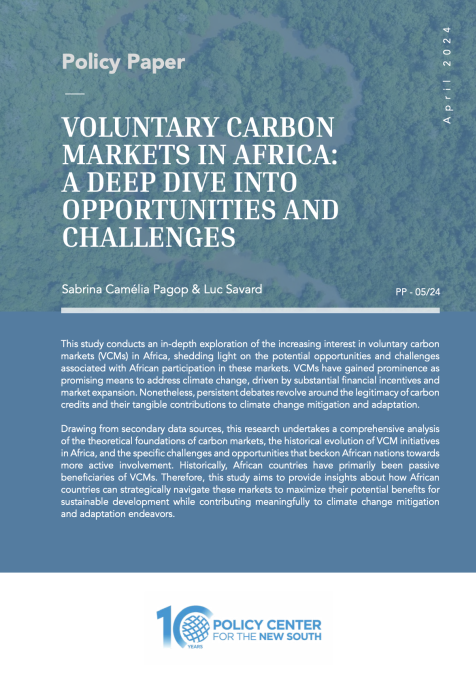
Voluntary Carbon Markets in Africa: A Deep Dive Into Opportunities and Challenges
Authors
Sabrina Camélia Pagop
Luc Savard
April 29, 2024

This study conducts an in-depth exploration of the increasing interest in voluntary carbon markets (VCMs) in Africa, shedding light on the potential opportunities and challenges associated with African participation in these markets. VCMs have gained prominence as promising means to address climate change, driven by substantial financial incentives and market expansion. Nonetheless, persistent debates revolve around the legitimacy of carbon credits and their tangible contributions to climate change mitigation and adaptation.

Drawing from secondary data sources, this research undertakes a comprehensive analysis of the theoretical foundations of carbon markets, the historical evolution of VCM initiatives in Africa, and the specific challenges and opportunities that beckon African nations towards more active involvement. Historically, African countries have primarily been passive beneficiaries of VCMs. Therefore, this study aims to provide insights about how African countries can strategically navigate these markets to maximize their potential benefits for sustainable development while contributing meaningfully to climate change mitigation and adaptation endeavors.
RELATED CONTENT

  • April 25, 2017
    Chinese investors are increasingly interested in Africa. Some criticize them for privileging mining investments. A 2017 analysis of these investments shows that investments in mining have not been the only ones privileged by the Chinese operators. Many other sectors such as transport and energy have benefited from Chinese investments, much more so than the mining sector, for example. ...
  • Authors
    April 12, 2017
    We argue in this paper that electricity production needs to be multiplied by a large factor in the coming years for East Africa to reach the economic growth rate it deserves after the improvement of its socio-political situation. The rural electrification rate in North Africa as represented for instance by Morocco was higher than 99.50% in the first quarter of 2017 while it was barely 10% in some parts of Western Kenya. We also make the case for hydroelectricity as the adequate ren ...
  • Authors
    Youssef El Hayani
    November 11, 2016
    Africa is endowed with an abundance of renewable (forestry, water, wind, solar) and non-renewable (extractives, oil, gas, minerals) natural resources. It is estimated that the continent accounts for about 7% of global oil reserves, 7% of natural gas, 20% of land area, 9% of renewable water resources and 17% of forests. The continent is also home to the largest or second largest world reserves of bauxite, cobalt, industrial diamonds, manganese, phosphate rock and platinum group ...
  • Authors
    Under the Supervision of
    Philippe Chalmin
    July 4, 2016
    Guinea’s bauxite, Moroccan phosphates, Nigerian Bonny Light, Zambian copper, Côte d'Ivoire’s cocoa, Ethiopian coffee or Madagascar’s vanilla: all are examples demonstrating that raw materials have a dimension that is as global as it is local. Global by the markets on which they are traded, local by their quality, a key element of their price, and their macroeconomic impact, particularly for Africa. In line with the 2016 CyclOpe report, which celebrates three decades of existence thi ...
  • Authors
    June 10, 2016
    Après avoir enregistré des baisses considérables au cours de l'année 2015, les prix des matières premières non renouvelables ont repris de la vigueur sur les quatre premiers mois de l'année 2016 avec, à la clé, une question essentielle pour nombre de pays et d'acteurs économiques : novembre 2015 peut-il être considéré comme le point bas du cycle permettant de croire à une reprise, sinon soutenue, du moins durable des marchés ? L'hypothèse semble raisonnable, mais les développements ...
  • Authors
    Silvia Colombo
    Mohamed El Harrak
    Nicolò Sartori
    May 27, 2016
    Energy is at the core of the remarkable current transitions in the global economy and geopolitics, and natural gas plays a crucial role in these processes. In this context of rapidly evolving trends at the market level and developing dynamics between regional and global actors, The Future of Natural Gas aims at analysing the role of natural gas in the future energy mix by considering several key factors: the ambitious climate policies agreed by the international community, cost issu ...