Publications /
Research Paper

Back
Vers l’adhésion du Maroc à l’OCDE : enjeux, réformes et perspectives
Authors
Eugène Berg
May 19, 2026

L’Organisation pour la coopération et le développement économiques (OCDE), forte de 38 membres, a longtemps fait figure d’Organisation regroupant les « démocraties industrielles développées ». Cette image n’est plus vraie, du fait de l’adhésion en son sein de pays, qualifiés jadis en développement, et que l’on considère souvent comme faisant partie du « Sud global ». C’est ainsi que l’ont intégrée : le Mexique (1994), qui lui a donné un Secrétaire général, Angel Gurria, la Corée du Sud (1996), le Chili (2010), la Colombie (2020) et le Costa Rica (2021). 

Le Maroc est le seul État dont le programme de coopération avec l’OCDE est passé au stade deux. Ceci lui a permis de prendre une avance sur beaucoup d’autres pays. En envisageant d’entamer la procédure d’adhésion, le Maroc serait face à une décision politique majeure. Laquelle décision pourrait mettre le Royaume en piste pour devenir membre de l’OCDE à l’horizon 2040, en accédant à la catégorie des pays à revenu intermédiaire de rang élevé. Dans cette perspective, le dépôt d’une candidature pourrait être envisagé entre la fin 2030 et le printemps 2031, à l’issue de la Coupe du monde de football 2030, afin de tirer parti de l’effet d’image et de l’attention internationale accrue autour du Royaume. 

L’intégration à l’OCDE s’inscrit, en effet, dans une procédure de transformation qui aide le pays candidat à s’aligner sur les normes et les meilleures pratiques de l’Organisation et, ainsi, à améliorer ses résultats économiques et sociaux. Le processus d’adhésion, constitué de huit étapes, s’étale sur plusieurs années au cours desquelles le pays candidat doit s’adapter aux critères et valeurs de l’Organisation qui, pour ce faire, lui apporte son soutien et son expertise.

RELATED CONTENT

  • Authors
    Arkebe Oqubay
    November 17, 2025
    Morocco has emerged as one of Africa's success stories, achieving significant progress in economic transformation and the green transition over the past 25 years. Continuing and deepening this transformation is essential to reach the country’s goal of becoming a high-income economy in the coming decades. Significant challenges include managing the risk of the middle-income trap, addressing demographic pressures, promoting inclusive growth, ensuring environmental sustainability, and ...
  • Authors
    Elhoussaine Wahyana
    January 12, 2024
    The debate on global value chains (GVCs) has emphasized countries’ contributions to value-added creation. From an intercountry perspective, a new body of research is addingto this debate by studying how subnational regions contribute to the indicators in specific countries. Proper assessment of economic contributions is essential for designing incentive policies. This paper analyzes the role played by the main trading partners of Moroccan regi ...
  • December 26, 2023
    في ختام هذا العام، يُخصص مركز السياسات من أجل الجنوب الجديد حلقة خاصة من برنامجه الأسبوعي"حديث الثلاثاء"، لاستعراض أبرز تطورات الاقتصادية خلال عام 2023. هذا العام شهد تحولات عديدة وتحديات غير اعتيادية ، فكيف أثرت هذه التغيرات على الاقتصادات العالمية؟ وما هو الدور الذي أضافته الجغرافيا ا...
  • December 5, 2023
    في حلقة هذا الأسبوع سنحاول مناقشة موضوع القطاع غير المُهيكَل في المغرب، أبرز التحديات وأفاق المستقبل. حيث أن ظاهرة العمالة غير الرسمية أصبحت تأخذ حيزا كبيرا في مختلف النقاشات العالمية الدائرة حول مسألة التنمية، والمغرب يعد من بين الدول التي تبقى فيها الظاهرة عند مستويات مرتفعة كون منظو...
  • Authors
    Ali Elguellab
    Elhadj Ezzahid
    November 1, 2023
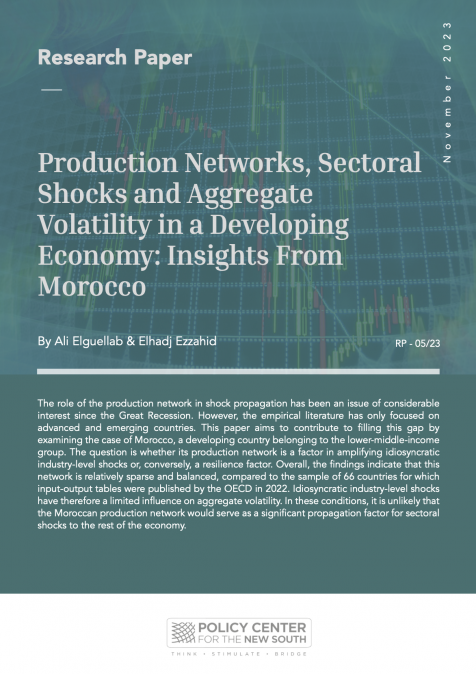
    The role of the production network in shock propagation has been an issue of considerable interest since the Great Recession. However, the empirical literature has only focused on advanced and emerging countries. This paper aims to contribute to filling this gap by examining the case of Morocco, a developing country belonging to the lower-middle-income group. The question is whether its production network is a factor in amplifying idiosyncratic industry-level shocks or, conversely, ...
  • Authors
    April 5, 2023
    The Policy Center for the New South and the Economic Research Forum held on March 20 a workshop titled ‘Stabilization and adjustment towards inclusive and sustainable policies in MENA: The Moroccan case study’. The event took place at the PCNS headquarters in Rabat, Morocco. It brought together renowned Moroccan economists and scholars to discuss the issue of public debt sustainability in the context of the Moroccan economy. It was an occasion to revisit the main features of the Mor ...
  • Authors
    Inácio F. Araújo
    Fatna El Hattab
    Soulaimane Anis
    June 30, 2022
    Depuis l’année 2015, le Maroc a fait de la régionalisation avancée un choix stratégique pour concrétiser sa volonté politique de mettre en œuvre une approche de développement territorial plus intégrée. Cette initiative vise à assurer un développement territorial durable, robuste et inclusif mais aussi à capitaliser sur les potentialités de chaque région en termes de ressources. Ainsi, de nouvelles structures ont été mises en place pour moderniser les services publics et améliorer le ...
  • June 7, 2022
    يعتبر التضخم مقياسا اقتصاديا يعنى بتطور الأسعار في أسواق السلع والخدمات كما انه يرصد القدرة الشرائيّة. وقد شهد معدل التضخم مؤخرا ارتفاعات غير مسبوقة في بقاع عدة، قارن بعض الخبراء الاقتصاديين بينها وبين مرحلة الركود التضخمي في سبعينيات القرن الماضي، اخذين كمنطلق مجموعة من ...
  • Authors
    December 21, 2021
    The Policy Center for The New South (PCNS) joined an inter-institutional effort between the Ibero-American General Secretariat (SEGIB), the United Nations Development Program (UNDP) and the International Development Research Centre (IDRC) in an international research project called ‘’Purpose-driven companies and the regulation of the Fourth Sector in Ibero-America’’. As this project grew to cover countries outside of Ibero-America, the PCNS was invited to write a chapter about ...