Publications /
Policy Paper

Back
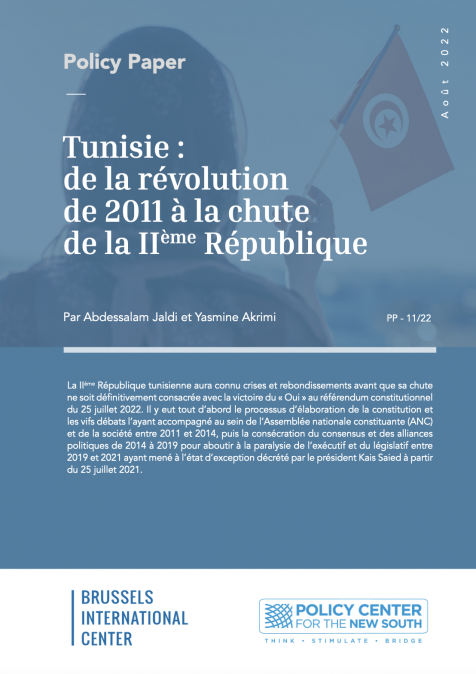
Tunisie : de la révolution de 2011 à la chute de la IIème République
Authors
Yasmine Akrimi
August 3, 2022

La IIème République tunisienne aura connu crises et rebondissements avant que sa chute ne soit définitivement consacrée avec la victoire du « Oui » au référendum constitutionnel du 25 juillet 2022. Il y eut tout d’abord le processus d’élaboration de la constitution et les vifs débats l’ayant accompagné au sein de l’Assemblée nationale constituante (ANC) et de la société entre 2011 et 2014, puis la consécration du consensus et des alliances politiques de 2014 à 2019 pour aboutir à la paralysie de l’exécutif et du législatif entre 2019 et 2021 ayant mené à l’état d’exception décrété par le président Kais Saied à partir du 25 juillet 2021.

RELATED CONTENT

  • Authors
    Fatima Ezzahra Mengoub
    February 20, 2026
    After more than seven years of drought, Morocco experienced exceptionally abundant rainfall during the winter of 2025-2026, reflecting increasingly marked water variability. This rapid alternation between chronic deficits and occasional excesses reveals the country's water paradox: a system historically centered on scarcity must now manage concentrated and intense extreme episodes.Hydraulic infrastructures helped limit human and economic impacts and ensured significant replenishment ...
  • Authors
    Fatima Ezzahra Mengoub
    February 20, 2026
    Après plus de sept années de sécheresse, le Maroc a connu durant l’hiver 2025–2026 des précipitations exceptionnellement abondantes, témoignant d’une variabilité hydrique de plus en plus marquée. Cette alternance rapide entre déficit chronique et excès ponctuels révèle le paradoxe hydrique national : un système historiquement centré sur la rareté doit désormais gérer des épisodes extrêmes concentrés et intenses.Les infrastructures hydrauliques ont limité les impacts humains et écono ...
  • February 17, 2026
    في هذه الحلقة، نناقش كيف ينسجم مسار إزالة الكربون من الصناعة المغربية مع التزامات المملكة المناخية، ومدى واقعية الأهداف المعلنة في ظل البنية الصناعية الحالية، كما نتناول آليات التمويل والحوافز الاقتصادية الممكنة لتسريع التحول دون التأثير على تنافسية المقاولات، خاصة في سياق تطبيق آلية تع...
  • Authors
    February 17, 2026
    La Marche Verte fait partie de ces moments féconds qui n’ont pas cessé d’influer sur le cours des événements politiques du Maroc, par la place qu’elle a prise, dès le départ, dans la longue durée, le contexte dans lequel elle s’est déployée, la logique des interactions dans laquelle elle s’est inscrite par ses causes et ses effets, et comme une des figures éclatantes du récit national. ...
  • Authors
    January 13, 2026
    This policy brief was originally published on : euromesco.net This paper examines the nexus between governance structures, digital transformation, sustainability, and port service efficiency through an international comparative lens, with a specific focus on the Tanger Med–Algeciras corridor in the strait of Gibraltar. Using global best practices—from Singapore to Busan and Kaohsiung—it explores how public-private coordination, digital innovation, and green transition policies ...
  • January 5, 2026
    This Paper was originally published on sciencedirect.com This study provides an original and significant contribution to evaluating educational service quality in Morocco by leveraging, for the first time, microdata from the Service Delivery Indicators (SDI) survey. The survey covers a nationally representative sample of 300 public and private primary schools across rural and urban areas. The use of SDI data represents a major methodological advancement, shifting away from perc ...
  • December 22, 2025
    This paper presents the theoretical specification and current developments of a Spatial (Interprovincial) Computable General Equilibrium (SCGE) model for Morocco. The model is formulated as a Johansen-type CGE system, solved in linearized form, and is designed to analyze the regional and national impacts of policy shocks within an integrated interregional economic framework. The Moroccan economy is disaggregated into 72 provinces, 20 production sectors, multiple institutional agents ...
  • Authors
    Ahmed Ouhnini
    December 5, 2025
    “Uberization,” a term derived from the American company Uber in the early 2010s, initially refers to an economic model based on directly matching supply and demand through digital platforms. Rapidly popularized, the concept has expanded with Airbnb in accommodation, and then to a wide range of other sectors: food delivery, home services, e-commerce, and even traditionally regulated or corporatist professions. This neologism thus reflects a transformation of economic and social relat ...