Publications /
Book / Report

Back
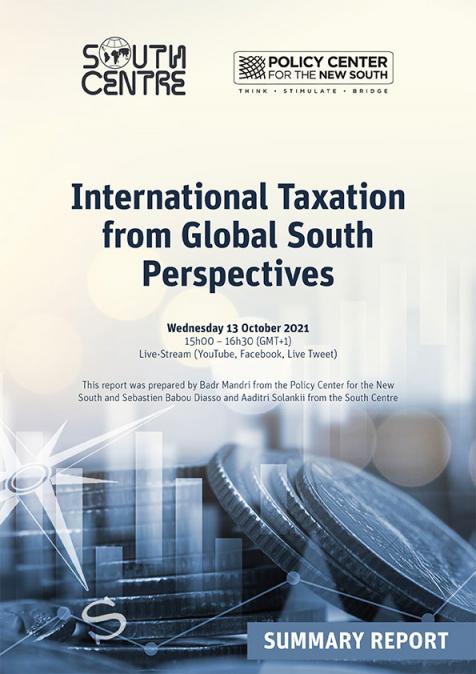
Summary Report - International Taxation from Global South Perspectives
Authors
Babou Diasso
Aaditri Solankii
November 4, 2021

South Centre (SC) in collaboration with the Policy Center for the New South (PCNS) organized on October 13, 2021, a webinar on the issue of International Taxation from the Global South perspectives.
Tax revenue mobilization plays a key role in financing the economic and social development of countries. When well designed and implemented, tax policy can help developing countries raise revenue and increase their spending, especially in the social sector. Indeed, tax revenue as a share of GDP represent only 15% to 20% in low and middle-income countries, because of obstacles such as the imbalanced and complex international standards designed for developed countries, and the difficulties in collecting taxes in developing countries.
This webinar addressed keys questions such as:
• What reforms to international standards are needed that can strengthen the capacities of governments to raise revenue from multinational enterprises (MNEs) without discouraging economic activity?
• What is the cost of tax havens for developing countries and what role can international cooperation play in dealing with this issue?
• What might the future of tax reform look like in the post-COVID-19 era, given the growing digitalization of the economy?


RELATED CONTENT

  • June 3, 2026
    Cet épisode met en lumière les défis et perspectives du secteur halieutique marocain à travers l’analyse du Pr. Abdelkabir Kamili. Il souligne que la durabilité des ressources marines n’est pas un frein à la croissance économique, mais une condition essentielle pour garantir la performa...
  • June 1, 2026
    Cette interview met en lumière le rôle central du secteur textile et de l’habillement dans l’économie marocaine, tant en matière d’emploi que d’exportations. Notre économiste, Mr. Fahd Azeroual revient sur son évolution historique, ses principaux défis, notamment la dépendance aux impor...
  • May 29, 2026
    This Paper was originally published on tandfonline.com This paper examines how reductions in transportation costs reshape regional economic and environmental outcomes in Morocco. We simulate a reduction in delivered (purchasers’) costs via a transport-margin efficiency improvement – implemented as a margin-saving technical change in the transport sector – within a province-level Spatial Computable General Equilibrium (SCGE) framework. Simulating a 1% decline in transport costs, ...
  • Authors
    May 22, 2026
    This paper, the fourth in a research series on services-led growth in the Global South, examines Egypt’s potential for growth and economic transformation through the integration of services into Global Value Chains (GVCs). It employs a new taxonomy that classifies services into Knowledge Services (KS), Enabling Services (ES), and Local Services (LS) and applies OECD 2025 Trade in Value-Added (TiVA), Trade in Employment (TiM), and input-output databases to benchmark Egypt against Mor ...
  • Authors
    May 15, 2026
    This paper is the third in a series of country and comparative studies that together comprise a research program on services as drivers of economic growth and structural transformation in the Global South. The paper analyzes the pattern of Tunisia's services-led economic growth from 2012- 2022 using a specialized three-category framework: knowledge services (KS), enabling services (ES), and local services (LS). Using data from the OECD Trade in Value Added (TiVA), Trade in Employmen ...
  • May 15, 2026
    In this podcast recorded during the Growth Summit, Naomi Kengurungu, Director of Marketing and Communication at the African Management Institute, discusses the key conditions needed for h ...
  • Authors
    Jorge Arbache
    May 14, 2026
    Decarbonization is reconfiguring global relative prices. As clean energy, natural capital, and location-specific assets become dominant industrial inputs, the relative cost of producing low-carbon goods is increasingly determined by geography. Two systematic distortions explain why the expected reallocation of investment toward renewable-rich economies remains incomplete. First, industrial policy interventions, including subsidies, trade barriers, and certification systems, disconne ...
  • May 14, 2026
    In this episode of Africafé, Neema CHUSSI discusses the opportunities and challenges artificial intelligence presents for Africa. She highlights the need for the continent to develop its own AI governance approach, rooted in African democratic values, while addressing critical issues su...
  • May 12, 2026
    Cet épisode analyse le poids du secteur informel dans l’économie marocaine et ses principaux défis. Les intervenants expliquent que l’informel constitue à la fois un mécanisme de survie pour une grande partie de la population et un frein à la productivité, à la fiscalité et à la protect...