Publications /
Policy Brief
Strategic hedging is rational when it preserves a worthwhile choice at a tolerable cost while respecting existing commitments. Drawing on the literature on hedging and Latin American autonomy, this Policy Brief examines contrasting illustrations of that proposition. It distinguishes ambiguity about future alignment from uncertainty about existing obligations and explains how clearly bounded commitments can reconcile autonomy with credibility. The cases reveal different vulnerabilities across energy, security, technology, export concentration and regulatory discretion. Policy recommendations link diplomatic options to productive capabilities, institutional safeguards, and the administrative resources required to implement them. Hedging succeeds when governments can exercise the alternatives they retain and recognise when maintaining them no longer serves a defensible purpose.
Introduction
A country may have a flag, a seat at the United Nations, and an impressive list of foreign partners, yet at the first serious disagreement, it may discover that someone else decides whether its economy functions. The gap between formal sovereignty and the capacity to act has long troubled governments emerging from colonial rule. At Bandung in 1955, they challenged the assumption that independence required supervision by one of the great powers. Their circumstances differed, but their claim mattered: a country should be able to judge its own interests, even when that judgement displeased a stronger state.
Globalisation widened access to markets, capital and technology without resolving this difficulty. China's rise created opportunities alongside established American security and financial relationships. These connections overlap across projects: a port may be financed by one partner, insured through another's financial system and protected through cooperation with a third. Governments must understand who could disrupt each connection and which choices would then become unavailable before committing funds and authority.
Amitav Acharya's description of a multiplex order helps explain how different centres of authority coexist. Institutional variety, however, can coexist with concentrated economic power. Farrell and Newman show how governments that control central financial and information nodes can use those networks coercively. Dependence on an export market or a proprietary technical standard creates related but distinct vulnerabilities. Joining more organisations does not necessarily reduce any of them. What matters is whether participation changes the choices available when access, finance or cooperation is threatened. Strategic hedging addresses this problem, but applying the term to every government with several partners empties it of analytical value. In Southeast Asian debates, it often describes efforts to pursue economic opportunities with China while retaining security options with the United States. Here, it refers to a deliberate combination of engagement and precaution towards competing powers under uncertainty, intended to preserve a consequential national choice. Diversification becomes part of hedging when a country maintains an alternative to protect against political pressure, rather than simply because another supplier offers a competitive price.
The distinction remains contested. Balancing commits a country to oppose a perceived threat, whereas bandwagoning entails accommodating a stronger power. Lim and Cooper emphasise uncertainty about security alignment and question classifications that overlook the significance of alliances or territorial disputes. Kuik gives greater weight to insurance through countervailing policies under uncertainty. This brief adopts the latter approach when examining relationships and policy areas. India may balance against China while preserving options elsewhere; calling the country a hedger in every relationship would obscure precisely the differences that require explanation.
Research recognises that hedging is costly and may fail when protective options are unavailable. The test asks whether an alternative can be used under pressure, at a tolerable cost, without undermining obligations. India, Saudi Arabia and Brazil illustrate exposures; they neither constitute a representative sample nor establish causation.
Rationality, in this account, concerns judgement given the information available at the time. It neither assumes perfect calculation nor guarantees success. Keeping an alternative may be worthwhile even if it is never used, because its availability alters what another power can demand. That benefit must,nevertheless, justify the expense, administrative effort and distrust associated with maintaining it. The central distinction is between leaving future alignment open and making existing commitments uncertain. The first can preserve negotiating space; the second can destroy the confidence on which useful cooperation depends.
The Rationality and Costs of Keeping Options Open
Uncertainty gives governments a reason to retain options, but it cannot justify indefinite retention. Rivalry may diminish, a supplier may become unreliable, or the costs of maintaining incompatible systems may outweigh their protective value. Different commitments also mature at different rates. A security arrangement can endure for decades, while dependence on a digital system may become difficult to reverse within a few years. Governments therefore need to see how today's contracts shape tomorrow's choices, rather than treating an agreement's survival as proof of its continuing value.
Costs are spread across institutions and constituencies. Multiple suppliers complicate maintenance and training, while new export markets may require sacrificing short-term profits. Officials mustcompare contracts against political expectations; otherwise, the government may buy insurance that offers little protection. Assessment should identify the decision at risk, the alternative that protects it, and the circumstances warranting alignment, withdrawal or managed dependence. The threshold should concern an essential national function, rather than a partner's displeasure.
Reconsider an option when its provider cannot deliver, restrictions prevent its use during the relevant crisis, or maintaining it consumes resources needed for a better response. Notice periods and transition arrangements can preserve credibility while allowing withdrawal. Conversely, a temporary cost increase may justify retention if rebuilding the option would take years. The calculation must include the lost opportunity, rather than treating current expenditure as the entire strategic cost.
India makes the asymmetry in these calculations visible. Cooperation with Australia, Japan and the United States through the Quad addresses Indo-Pacific concerns without establishing a mutual defence treaty. Defence and energy ties with Russia serve different purposes. While the territorial dispute with China creates a distinct security problem, the relevant hedging question is therefore narrower than whether India stands between rival camps. It concerns how far engagement with Washington can coexist with maintaining Russian supply relationships, and whether those relationships preserve useful choices once the costs imposed by other partners are considered.
The episode from August 2025 to March 2026 illustrates that difficulty. Washington imposed an additional 25 per cent duty on covered Indian goods in response to Russian oil purchases. In February 2026, it removed the penalty, stating that India had committed to stop those imports. The bilateral trade statement issued that day contained no such undertaking: the oil commitment was Washington's account. In March, the US Office of Foreign Assets Control temporarily authorised specified transactions involving Russian oil already loaded onto vessels bound for India. This was limited relief for specific transactions, not an unrestricted permission to import Russian oil. The sequence shows shifting constraints on India's options without permanently abandoning Russian supplies.
For New Delhi, the calculation therefore extends beyond the oil purchase price. Retaining an energy source may protect against supply disruption but could expose exporters to retaliation elsewhere. The gains and losses must be assessed together, including their distribution across the economy. When transactions require relief from American restrictions, the option's usability depends partly on decisions made in Washington. That does not necessarily make it worthless, but it limits the autonomy it provides. The episode constrains hedging; demonstrating its net benefit would require evidence on supply security, export losses, and available substitutes.
Saudi Arabia faces a distinct mix of opportunities and obligations. Xi Jinping's December 2022 visit linked cooperation with China to Vision 2030, including energy and infrastructure. In March 2023, Saudi and Iranian representatives agreed in Beijing to restore diplomatic relations, following earlier talks hosted by Iraq and Oman. These developments broadened Riyadh's economic and diplomatic options without establishing that China had replaced the United States as Riyadh's security partner. The precautionary logic is to reduce dependence on a single relationship while retaining forms of cooperation that other partners cannot readily provide.
That logic encounters practical limits in sensitive technology. In November 2025, Washington and Riyadh signed a Strategic Defence Agreement, along with arrangements covering nuclear cooperation, critical minerals, and artificial intelligence. The AI memorandum was a separate instrument, providing access to American systems while protecting US technology from foreign influence. The public fact sheet did not specify which Chinese suppliers would be excluded. Inferring a comprehensive exclusion from that document would therefore go beyond the evidence. Riyadh needs to establish the restrictions applicable to each procurement before selecting systems whose incompatibility could make an apparent economic opening costly to reverse.
Riyadh also broadened its formal security relationships. The August 2026 Makkah agreement with Pakistan and Türkiye declared that an armed attack on one would be regarded as an attack on all; subsequent ministerial discussions outlined a joint secretariat and further defence cooperation.
These statements record commitments and institutional plans, not an already integrated defence system. Their contribution to Saudi autonomy depends on implementation and on whether the participants share an understanding of the circumstances that require assistance. Additional promises can expand support while creating obligations that restrict freedom elsewhere.
The Saudi case requires separating functions that announcements conflate. Chinese commerce creates interests in stability without a duty to defend Saudi territory. American military cooperation provides conditional capabilities, while the Makkah arrangements add obligations that require reconciliation. Hedging is rational only if the combination preserves usable options once these limits are acknowledged. The number of partners says little about what each can deliver in a crisis.
Brazil's problem is less centred on military protection. Its relationships with China, BRICS and Western institutions align with a longstanding Latin American discussion of relational autonomy, diversification and active non-alignment. In 2025, China received 28.7 per cent of Brazilian exports, with soybeans, crude oil, and iron ore accounting for roughly three-quarters of that share; the United States received 10.8 per cent. These figures indicate concentration rather than automatic political subordination. They also suggest that diplomatic choices cannot be understood as if powers wereequally distant when their economic roles differ substantially.
Pressure from Washington shows that exposure cannot be inferred from market size alone. The Section 301 investigation, opened in 2025, covered electronic payment services and raised concerns about Pix, which Brazil's central bank operates and regulates. In July 2026, Washington imposed a 25 per cent duty on covered Brazilian products. Brazil challenged that measure and a separate 12.5 per cent duty through WTO consultations.
The Pix controversy concerns pressure on domestic regulatory discretion, rather than dependence on an imported payment system. Finding additional buyers and defending the authority to regulate therefore address distinct sources of vulnerability.
These developments do not, by themselves, prove that Brazil has implemented a coherent hedging strategy. The classification would require evidence that Brazil deliberately combines engagement with competing partners with precautions to protect those choices. For Brazil, those choices could include maintaining domestic payment rules while preserving access to external markets and investment. Alternative buyers, financing relationships and institutional recourse would need to support that objective in practice. This distinction matters because a strategy cannot be inferred simply from BRICS membership, extensive trade with China or resistance to an American demand.
Brazil's industrial opportunity becomes clearer when linked to a production chain. The 2025 BNDES–Finep call envisaged up to R$5 billion for transforming strategic minerals, including lithium, graphite, and rare earths; its stated objectives include producing purified graphite for batteries. Consider a hypothetical Brazilian project that takes graphite concentrate, purifies it to buyers' specifications and sells qualified material to several battery manufacturers. A domestic processor would operate a pilot plant in partnership with a technology partner and a Brazilian research institution. Finance for commercial expansion would follow, contingent on independently verified product quality, environmental performance and purchase commitments. Training and licensed operating rights would enable Brazilian personnel to run the process, while maintenance contracts would provide access to essential parts. The resulting alternative to raw mineral exports is a domestic processing capability with several customers. Its viability would still depend on costs, reliable demand and access to technology; public support should stop if pilot results fail those tests. This is a proposed investment pathway, not an accomplished case of independence.
BRICS also has a concrete financial channel through the New Development Bank. Its BNDES sustainable infrastructure project has a financing ceiling of US$1.2 billion, with renewed board approval in November 2023. For Brazil, the task is to link such infrastructure finance to supplier development and maintenance expertise where project rules permit. Credit availability creates an opportunity; procurement, implementation and evaluation determine whether it strengthens productive capacity.
The three cases illuminate different tests of rationality. India's energy options face trade pressure; Saudi Arabia must reconcile technological constraints with several security relationships; Brazil needs to align regulatory discretion with productive diversification. None establishes that maintaining alternatives always improves outcomes. Defiance alone tells us little about whether a strategy has protected a consequential choice at a sustainable cost. Assessment should instead examine how quickly essential supplies can be replaced, whether services continue during disruption, and how long the country can sustain its policy without intolerable domestic losses. Those measures connect diplomatic ambition to observable capabilities.
Evaluation needs a baseline. Improved continuity might reflect favourable prices or reduced external pressure rather than diversification. Officials should compare outcomes with the alternatives available when decisions were made, documenting assumptions and disagreements. This makes claims of success open to scrutiny and helps distinguish prudent preparation from favourable coincidence.
The Credibility of an Independent Choice
Preserving a choice becomes more difficult when another government must rely on a promise. A lender expects repayment, a technology partner requires protection for sensitive systems, and a military ally needs reliable arrangements for access or logistics. The obligations differ, yet each relationship depends on an intelligible commitment. A state cannot invite common defence planning while leaving its own participation indefinitely uncertain. Autonomy entails responsibility for freely assumed undertakings, including the discipline to explain their limits before others base their policies on mistaken expectations.
A country can leave future partnerships open while specifying what it promises today. For example, it might authorise logistical support for agreed maritime operations without granting automatic access for an unrelated war. This hypothetical agreement would specify the covered activities, the authority granting access and the grounds for suspension. The partner could plan around a defined service and assess its reliability through performance. Credibility would depend on honouring that undertaking, rather than implying that limited cooperation entails an allegiance extending to every future dispute.
The harder case is a government that cannot afford another security provider. Consider a small coastal state facing an immediate threat, whose sole effective protector demands that it exclude a rival's telecommunications equipment. Refusal could leave the state exposed, while replacement equipment may be unaffordable. No diplomatic formula eliminates that constraint. The government should first test whether the protector will accept restrictions confined to sensitive networks, a transition period, or financial assistance for replacement. If bargaining fails and the threat remains overriding, accepting exclusivity may be the least damaging choice. Officials should acknowledge the autonomy surrendered, set the agreement's duration, review its terms, and, where possible,preserve unrelated commercial relationships. Hedging in the restricted sector would then give way to alignment. Its rationality lies in recognising that limit, rather than presenting dependence as freedom; future investment can still aim to improve the terms available at renewal.
The same tension arises where commercial and security systems intersect. Telecommunications infrastructure may compromise intelligence protection; sanctions can disrupt defence supplies; and a port developed for trade may acquire military significance. Sending each contract to a different ministry does not resolve these conflicts. A joint review should determine which systems can coexist and which obligations take priority. If a government postpones the discussion until equipment isinstalled, the cost of replacement may decide a question that ministers should have settled politically. Technical compatibility thus becomes part of diplomatic credibility.
Consultation helps when it exposes incompatible assumptions early enough to adjust plans. Hotlines can clarify a military move, while exercises can reveal whether logistical promises are feasible. Neither substitutes for political authority or adequate resources. Partners need to know who can approve assistance, under what conditions and within what timeframe. A bounded commitment that can be implemented promptly may offer more dependable cooperation than a sweeping declaration whose constitutional or operational requirements remain unresolved. That is how clarity can preserve room for independent choices without signalling indifference to a partner's legitimate concerns.
Domestic credibility is equally consequential. Citizens encounter foreign policy through employment, imported competition, land disputes, and surveillance concerns. An industrial ministry may welcome a supplier that defence officials distrust, while exporters may resist moving away from a profitable market. Governments need to explain which choices are being protected and how their costs are distributed. Parliamentary scrutiny of significant undertakings and coordinated review of investments can help, provided confidentiality protects genuinely sensitive information rather than shielding decisions from accountability.
The American Market Facilitation Programs demonstrate why compensation design matters. Following retaliatory agricultural tariffs, the US Department of Agriculture provided US$23 billion through its 2018 and 2019 programmes. The US Government Accountability Office later found that unrepresentative baselines inflated the 2019 trade-damage estimates and that producers of the same crop received different payment rates across counties. This was an adjustment programme rather than a hedging strategy, but its distributional problems are directly relevant to governments seeking to sustain a contested diplomatic choice.
Exporters can lose orders immediately, whereas alternative markets take years to develop. Assistance therefore needs published loss estimates, clear eligibility criteria and periodic review. Support should finance a defined adjustment with an end date and measurable progress towards alternative markets or production. Workers cannot live on promises of eventual bargaining power, but emergency relief should not become an entitlement detached from demonstrable losses.
Major powers also have responsibilities. Washington may interpret commerce with China as a sign of wavering loyalty, while Beijing may regard American security cooperation as containment. Governments should explain their commitments without acceding to every demand for exclusivity. During crises, requests for access or for sanctions compliance may arrive within hours. Tested procedures and prior domestic authorisation enable deliberate decisions under pressure.
Institutions for Disagreement
The photograph at a signing ceremony is usually the easiest part of cooperation. Implementation raises questions about who pays for overruns, who interprets disputed standards, and whether withheld information breaches an obligation. Without agreed procedures, flexibility tends to favour the participant who can afford to walk away. An effective strategy therefore requires institutions at two levels: arrangements for managing disagreement among states and national agencies capable of using them. Their purpose is to make cooperation dependable enough that a dispute does not immediately become a test of geopolitical loyalty.
Consider a regional energy corridor in which one government prioritises speed, another prioritises domestic procurement, and a third prioritises environmental safeguards. Rules for disclosure, the allocation of delay costs, and dispute settlement would help distinguish ordinary disagreement from a breach. The appropriate degree of legalisation will vary with the project and the participating states. Even a modest arrangement should specify whose interpretation governs a contested decision and what smaller participants can do when they disagree.
Technical agencies give these rules practical effect. They should publish requirements, specify testing procedures and explain exclusions so suppliers understand the conditions of entry. Buying from several countries offers limited protection if their systems cannot communicate or rely on the same indispensable component. Contract review should scrutinise documentation, portability and access to maintenance as carefully as the initial price. This also makes security exceptions more credible: an exclusion linked to a defined risk is easier to defend than a discretionary veto against an unwelcome bidder.
Brazil's fertiliser exposure illustrates why this institutional work should be part of a development strategy. A 2025 National Fertiliser Council document reported that about 85 per cent of consumption was imported, while the agriculture ministry identified Russia as the principal supplier. A response should compare the contributions of reserves, additional suppliers, domestic production and more efficient use. The Brazilian Development Bank and relevant ministries could assess these options alongside investment terms, including the time required to bring new capacity online. Immediate continuity and long-term learning require different instruments and should be budgeted accordingly.
Industrial cooperation would become strategically useful if it enabled Brazilian personnel and firms to perform functions previously reliant on external decisions. Contracts could specify training, access to technical documentation and support for qualifying local suppliers, with progress assessed against operational milestones. Domestic production would still require scrutiny of costs, environmental requirements and reliance on imported inputs. The objective should be to reduce a defined vulnerability at an acceptable public cost. Subsidising an inefficient plant indefinitely, or assembling imported components without acquiring relevant expertise, would not establish the independence invoked to justify the expenditure.
Smaller governments may lack the staff to conduct comparable assessments independently. Regional cooperation can make contract analysis, technical testing and specialised training affordable while strengthening negotiating capacity. It also requires safeguards to prevent replacing external dependence with dependence on the largest regional member. Participating governments should agree on how shared services are financed, who controls confidential information and which decisions remain national. Cooperation can then support distinct diplomatic choices without requiring agreement on every geopolitical dispute. Its durability will depend on visible benefits and procedures for revising the bargain when costs or needs change.
An autonomous foreign policy requires sustained funding and expertise. Agencies must monitor agreements after delegations depart and retain knowledge despite personnel changes. Judgeinstitutional participation by the rules a country helps shape and the resources it can mobilise. A small diplomatic service may gain more from one consequential negotiation than from attending every forum.
Policy Recommendations
The Global South does not occupy a single strategic position. Some governments negotiate from large markets and with capable institutions; others depend heavily on a single export, creditor or security provider and have few officials available to review complex agreements. Policy should begin by aligning the seriousness of an exposure with the capacity to respond. Otherwise, recommendations for comprehensive diversification may consume scarce resources while leaving the most consequential vulnerability untouched. Governments with stronger institutions also have responsibilities, particularly where their expertise can support affordable regional arrangements.
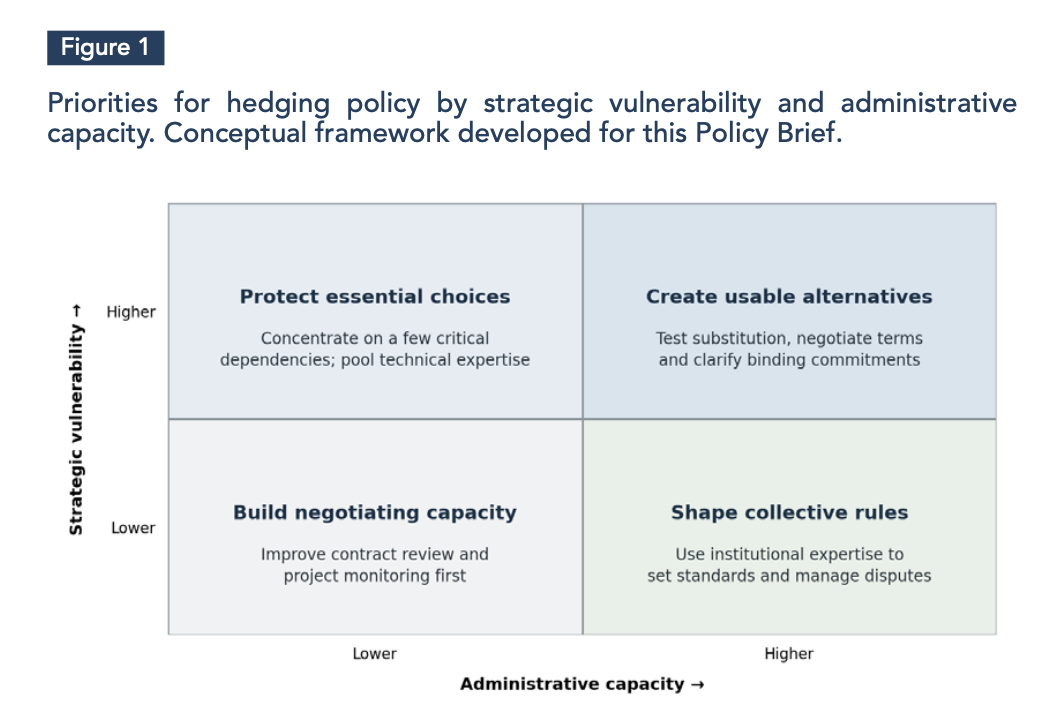
Figure 1 identifies priorities, not a sequence or ranking of countries. Strategic vulnerability describes the severity and speed of disruption to an essential choice before a response is undertaken. Administrative capacity concerns the ability to assess contracts, coordinate agencies, and implement decisions. A country may occupy different quadrants across sectors, and its position can change as capabilities develop. The recommendations below apply across the matrix, with priorities reflecting those differences. They are intended to organise judgement rather than produce a numerical score that obscures contested political assumptions.
Audit dependencies that could force a political choice
Governments should identify which connections could enable another state to compel a concession, who could interrupt them and how quickly. A designated agency should assess minimum service requirements, replacement costs and the availability of substitutes. In the matrix's “Protect essential choices” quadrant, this audit takes priority because resources must reach the most consequential exposure first. Simulations can reveal that apparently separate suppliers share a payment provider, shipping route or component. Broad findings should be made public, with sensitive details protected and the uncertainty underlying disruption estimates made explicit.
The audit should distinguish emergency protection from longer-term adjustment. A reserve that sustains essential services for several weeks serves a different purpose from an investment that takes years to deliver alternative capacity. For each exposure, officials should identify who authorises action, which resources are available, and what disruption remains unavoidable. Reviewing those assumptions after exercises or actual interruptions makes the assessment useful. However, even acomprehensive static inventory of foreign connections cannot tell ministers whether an alternative will work when political pressure arrives.
Judge partnerships by domestic capabilities
A partnership should leave behind capabilities that remain useful after the contractor's departure. Include training, maintenance arrangements, and opportunities for domestic suppliers as enforceable obligations, and monitor progress after signature. This supports “Build negotiating capacity” where institutions are weaker and “Create usable alternatives” where they can implement more demanding agreements. Where appropriate, final payment could depend on local personnel demonstrating operational competence. Development banks could similarly require evidence of acquired skills before extending support, while avoiding conditions too elaborate for the institutions responsible for enforcing them.
Local content requirements deserve the same scrutiny as imported systems. They can raise costs without transferring knowledge or reducing dependence. Ministers should compare the resulting capability with its public cost and ask whether essential inputs remain vulnerable to disruption. Partnerships with every major power should undergo this assessment. The relevant benefit may be a domestic maintenance team, an additional export destination, or the ability to redesign a component; it need not involve reproducing an entire industry. Clear objectives make selective industrial policy more defensible and easier to revise.
Separate binding commitments from open choices
Before signing an agreement, governments should assess whether it conflicts with an existing undertaking and specify the activities it covers. Defence partners need assurances to plan; trading partners need predictable rules without necessarily requiring exclusive political allegiance. In “Create usable alternatives”, this review is particularly important because an additional agreement can introduce incompatible expectations. Where obligations cannot be reconciled, ministers must choose, renegotiate, or withdraw under the applicable procedures. Leaving the conflict unresolved until a crisis allows accumulated contracts and sunk costs to determine policy.
Build institutions that withstand disagreement
Joint projects should specify who pays when costs change, who assesses compliance, and where disputes can be heard. Smaller participants need affordable access to these procedures. In “Shape collective rules”, governments with stronger institutions can help design arrangements that others could not negotiate alone. Emergency channels should be tested before confrontation, when mistaken assumptions are easier to correct. These mechanisms cannot guarantee military assistance or political agreement, but they can contain a disagreement over one undertaking before it places the entire relationship in question.
Cabinets should review the portfolio annually, resolve conflicts between ministries, and withdraw support for alternatives that no longer serve a worthwhile purpose. The review should also be triggered by a supplier's exit, new restrictions, or an obligation that alters the terms of cooperation. Parliament should examine adjustment costs while safeguarding sensitive information. Sometimes the sensible decision will be to accept a manageable dependence or to abandon a celebrated initiative. Rational diplomacy requires that possibility: the prestige invested in an agreement cannot outweigh its purpose.
Conclusion
Strategic hedging derives its value from the choices it enables, and the three cases of India, Saudi Arabia and Brazil show why development is central to that judgement. For India, an energy relationship preserves autonomy only to the extent that supply arrangements and domestic adjustment capacity allow the country to absorb pressure on its exporters. For Saudi Arabia, acquiring technology strengthens choice when local capabilities and compatible systems reduce the cost of changing partners without compromising security commitments. For Brazil, processing strategic minerals and building expertise can broaden the range of products and markets available, provided finance produces commercially viable capabilities rather than another protected dependence. In each case, diplomacy must leave the country better equipped to act after signing the agreement.
Major powers should recognise that reliable, bounded commitments can sustain cooperation better than demands for allegiance that their partners cannot fulfil. Smaller and middle powers must honour their undertakings and clarify who bears the adjustment costs. Keeping options open is rational when their protective value justifies those costs and when governments know what warrants a change of course. Some decisions can remain open for years; others arrive without warning. A state unable to choose has little autonomy. A state that keeps its options open must also know when and on what terms to exercise them.
Bibliography
Abbott, Kenneth W., Robert O. Keohane, Andrew Moravcsik, Anne-Marie Slaughter, and Duncan Snidal. “The Concept of Legalization.” International Organization 54, no. 3 (2000): 401–19. https://doi.org/10.1162/002081800551271.
Acharya, Amitav. “After Liberal Hegemony: The Advent of a Multiplex World Order.” Ethics & International Affairs 31, no. 3 (2017): 271–85. https://doi.org/10.1017/S089267941700020X.
Australian Department of Foreign Affairs and Trade. “Quad Foreign Ministers’ Meeting Joint Statement.” May 26, 2026. https://www.foreignminister.gov.au/minister/penny-wong/media-release/quad-foreign-ministers-meeting-joint-statement.
Brazil. Brazilian Development Bank (BNDES). “Chamada Pública de Planos de Negócios para Investimentos em Transformação de Minerais Estratégicos.” 2025. https://www.bndes.gov.br/wps/portal/site/home/desenvolvimento-sustentavel/parcerias/chamada-publica-transformacao-minerais-estrategicos.
———. “Com R$ 5 bi, BNDES e Finep apoiarão projetos para transformação de minerais estratégicos.” January 7, 2025. https://agenciadenoticias.bndes.gov.br/cultura/Com-R%24-5-bi-BNDES-e-Finep-apoiarao-projetos-para-transformacao-de-minerais-estrategicos/.
Brazil. Ministry of Development, Industry, Trade, and Services. “Alcance das Medidas Tarifárias dos Estados Unidos sobre Exportações Brasileiras.” July 24, 2026. https://www.gov.br/mdic/pt-br/assuntos/noticias/2026-periodo-eleitoral/julho/alcance-das-medidas-tarifarias-dos-estados-unidos-sobre-exportacoes-brasileiras/.
Ciorciari, John D. “The Variable Effectiveness of Hedging Strategies.” International Relations of the Asia-Pacific 19, no. 3 (2019): 523–55. https://doi.org/10.1093/irap/lcz007.
Congressional Research Service. “Section 301 Investigation into Brazil’s Acts, Policies, and Practices.” IN12613. September 29, 2025. https://www.everycrsreport.com/reports/IN12613.html.
Conselho Empresarial Brasil-China (CEBC). “Comércio Brasil-China atinge recorde de US$ 171 bilhões em 2025.” CEBC Alerta, January 13, 2026. https://static.poder360.com.br/2026/01/Comercio-Brasil-China-atinge-recorde-de-US-171-bilhoes-em-2025-CEBC-Alerta.pdf.
Conselho Nacional de Fertilizantes e Nutrição de Plantas (CONFERT). “Moção nº 01/2025 – Apoio à Criação do Centro de Excelência em Fertilizantes e Nutrição de Plantas (CEFENP).” August 25, 2025. https://www.gov.br/mdic/pt-br/assuntos/sdic/confert/atos-normativos/sei_53225191_mocao_1.pdf.
Farrell, Henry, and Abraham L. Newman. “Weaponized Interdependence: How Global Economic Networks Shape State Coercion.” International Security 44, no. 1 (2019): 42–79. https://doi.org/10.1162/ISEC_a_00351.
Fortin, Carlos, Jorge Heine, and Carlos Ominami, eds. Latin American Foreign Policies in the New World Order: The Active Non-Alignment Option. London: Anthem Press, 2023. https://anthempress.com/latin-american-foreign-policies-in-the-new-world-order-hb.
Goh, Evelyn. Meeting the China Challenge: The U.S. in Southeast Asian Regional Security Strategies. Policy Studies 16. Washington, DC: East-West Center Washington, 2005. https://www.files.ethz.ch/isn/26086/PS016.pdf.
Haacke, Jürgen. “The Concept of Hedging and Its Application to Southeast Asia: A Critique and a Proposal for a Modified Conceptual and Methodological Framework.” International Relations of the Asia-Pacific 19, no. 3 (2019): 375–417. https://doi.org/10.1093/irap/lcz010.
Kuik, Cheng-Chwee. “The Essence of Hedging: Malaysia and Singapore’s Response to a Rising China.” Contemporary Southeast Asia 30, no. 2 (2008): 159–85. https://doi.org/10.1355/CS30-2A.
———. “Getting Hedging Right: A Small-State Perspective.” China International Strategy Review 3, no. 2 (2021): 300–15. https://doi.org/10.1007/s42533-021-00089-5.
Kuik, Cheng-Chwee, and Yew Meng Lai. “Deference and Defiance in Malaysia’s China Policy: Determinants of a Dualistic Diplomacy.” International Journal of Asian Studies 22, no. 1 (2025): 5–24. https://doi.org/10.1017/S1479591423000104.
Lim, Darren J., and Zack Cooper. “Reassessing Hedging: The Logic of Alignment in East Asia.” Security Studies 24, no. 4 (2015): 696–727. https://doi.org/10.1080/09636412.2015.1103130.
Ministry of Foreign Affairs of the People’s Republic of China. “Joint Trilateral Statement by the People’s Republic of China, the Kingdom of Saudi Arabia, and the Islamic Republic of Iran.” March 10, 2023. https://www.mfa.gov.cn/eng/gjhdq_665435/2675_665437/2818_663626/2819_663628/202303/t20230311_11039241.html.
———. “President Xi Jinping Holds Talks with Crown Prince and Prime Minister Mohammed bin Salman of Saudi Arabia.” December 9, 2022. https://www.mfa.gov.cn/eng/zy/jj/2022/xjpcxfh/202212/t20221209_10987728.html.
———. “Wang Yi Chairs Closing Meeting of Talks between Saudi Arabia and Iran in Beijing.” March 10, 2023. https://www.mfa.gov.cn/eng/gjhdq_665435/2675_665437/2878_663746/2880_663750/202303/t20230312_11039412.html.
New Development Bank. “BNDES–NDB Sustainable Infrastructure Project.” Project summary. https://www.ndb.int/project/brazil-bndes-ndb-sustainable-infrastructure-project/.
Office of Foreign Assets Control, U.S. Department of the Treasury. “Russia-related General License 133: Authorizing the Delivery and Sale of Crude Oil and Petroleum Products of Russian Federation Origin Loaded on Vessels as of March 5, 2026, to India.” March 5, 2026. https://ofac.treasury.gov/media/935101/download?inline=.
Office of the United States Trade Representative. “USTR Section 301 Action on Brazil’s Unreasonable Acts, Policies, and Practices.” July 15, 2026. https://www.ustr.gov/about/policy-offices/press-office/press-releases/2026/july/ustr-section-301-action-brazils-unreasonable-acts-policies-and-practices.
Pakistan. Ministry of Foreign Affairs. “Makkah Al-Mukarramah Summit for Joint Defence.” August 7, 2026. https://mofa.gov.pk/press-releases/makkah-al-mukarramah-summit-for-joint-defence.
———. “Strategic Political and Defence Committee of the Makkah Agreement for Joint Defence – Joint Statement.” August 31, 2026. https://mofa.gov.pk/press-releases/strategic-political-and-defence-committee-of-the-makkah-agreement-for-joint-defence-joint-statement.
Prime Minister’s Office of India. “Joint Statement Following the 23rd India–Russia Annual Summit.” December 5, 2025. https://www.pmindia.gov.in/en/news_updates/joint-statement-following-the-23rd-india-russia-annual-summit/.
Russell, Roberto, and Juan Gabriel Tokatlian. “From Antagonistic Autonomy to Relational Autonomy: A Theoretical Reflection from the Southern Cone.” Latin American Politics and Society 45, no. 1 (2003): 1–24. https://doi.org/10.1111/j.1548-2456.2003.tb00230.x.
U.S. Government Accountability Office. USDA Market Facilitation Program: Stronger Adherence to Quality Guidelines Would Improve Future Economic Analyses. GAO-22-468. November 18, 2021. https://www.gao.gov/products/gao-22-468.
Vigevani, Tullo, and Gabriel Cepaluni. “Lula’s Foreign Policy and the Quest for Autonomy through Diversification.” Third World Quarterly 28, no. 7 (2007): 1309–26. https://doi.org/10.1080/01436590701547095.
White House. “Executive Order 14329: Addressing Threats to the United States by the Government of the Russian Federation.” August 6, 2025. https://www.govinfo.gov/content/pkg/DCPD-202500829/html/DCPD-202500829.htm.
———. “Executive Order 14384: Modifying Duties to Address Threats to the United States by the Government of the Russian Federation.” February 6, 2026. https://www.whitehouse.gov/presidential-actions/2026/02/modifying-duties-to-address-threats-to-the-united-states-by-the-government-of-the-russian-federation-04b2/.
———. “Fact Sheet: President Donald J. Trump Solidifies Economic and Defense Partnership with the Kingdom of Saudi Arabia.” November 18, 2025. https://www.whitehouse.gov/fact-sheets/2025/11/fact-sheet-president-donald-j-trump-solidifies-economic-and-defense-partnership-with-the-kingdom-of-saudi-arabia/.
———. “United States–India Joint Statement.” February 6, 2026. https://www.whitehouse.gov/briefings-statements/2026/02/united-states-india-joint-statement/.
World Trade Organization. “DS646: United States—Additional Duties on Certain Products from Brazil.” Consultations requested July 27, 2026. https://www.wto.org/english/tratop_e/dispu_e/cases_e/ds646_e.htm.