Publications /
Policy Brief

Back
Separatism in Africa - A Fundamental Problem -
Authors
December 25, 2019

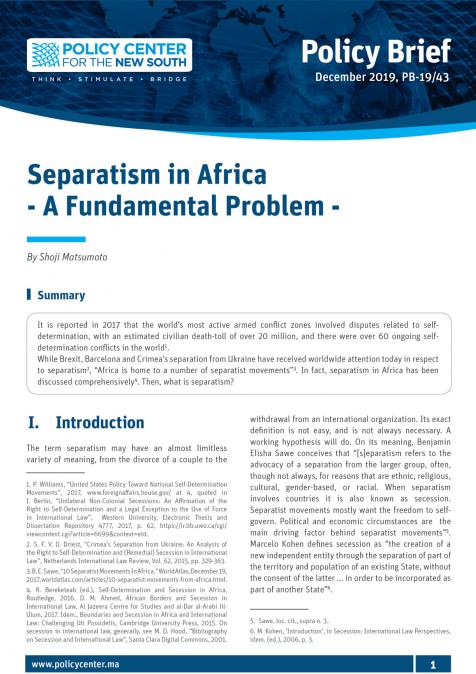
It is reported in 2017 that the world’s most active armed conflict zones involved disputes related to selfdetermination, with an estimated civilian death-toll of over 20 million, and there were over 60 ongoing selfdetermination conflicts in the world. While Brexit, Barcelona and Crimea’s separation from Ukraine have received worldwide attention today in respect to separatism, “Africa is home to a number of separatist movements”. In fact, separatism in Africa has been discussed comprehensively. Then, what is separatism?

The term separatism may have an almost limitless variety of meaning, from the divorce of a couple to the withdrawal from an international organization. Its exact definition is not easy, and is not always necessary. A working hypothesis will do. On its meaning, Benjamin Elisha Sawe conceives that “[s]eparatism refers to the advocacy of a separation from the larger group, often, though not always, for reasons that are ethnic, religious, cultural, gender-based, or racial. When separatism involves countries it is also known as secession. Separatist movements mostly want the freedom to selfgovern. Political and economic circumstances are the main driving factor behind separatist movements”5. Marcelo Kohen defines secession as “the creation of a new independent entity through the separation of part of the territory and population of an existing State, without the consent of the latter ... in order to be incorporated as part of another State”.

RELATED CONTENT

  • Authors
    Lina Jaoid
    October 8, 2026
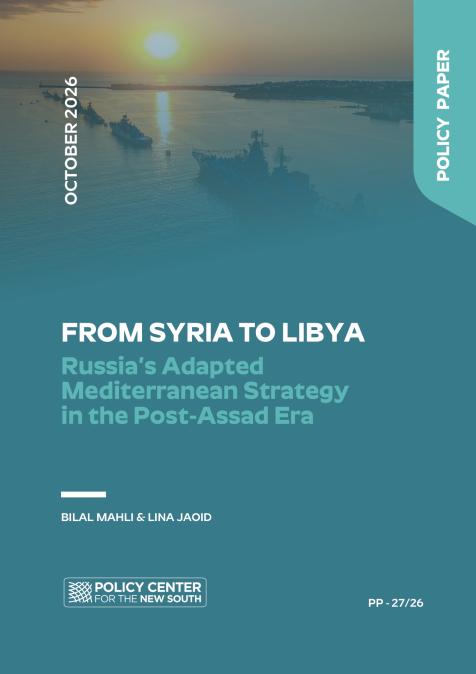
    In the two years since the fall of Bashar al-Assad in Syria, Russia has restructured its Mediterranean presence. Although Russia’s limited and increasingly conditional access to the Khmeimim and Tartus facilities in Syria has been preserved, its presence in the country has morphed from Assad’s ‘patron-client’ configuration to a more negotiated engagement. Simultaneously, Russia has upgraded its force-projection and logistical infrastructure in eastern Libya, giving it an access path ...
  • July 24, 2026
    Dans cet épisode d’Africafé, les échanges portent sur la situation sécuritaire au Sahel et le rôle de la CEDEAO face aux défis régionaux. À travers le cas du Mali, la discussion revient sur les recompositions en cours, le retrait des partenaires internationaux, la montée en puissance de...
  • Authors
    Niccola Milnes
    July 21, 2026
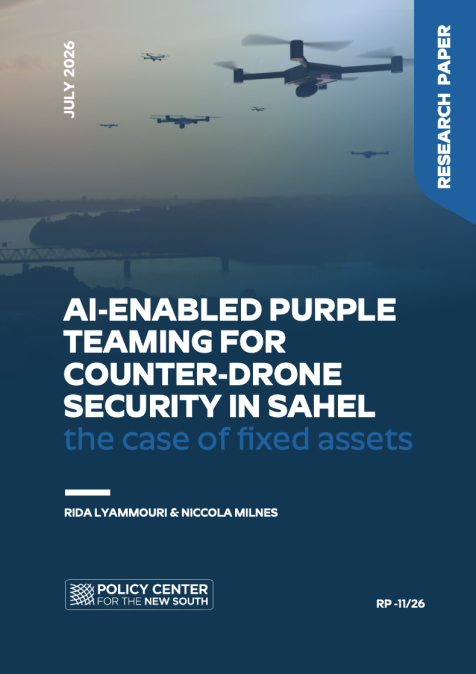
    Armed-group drone use in the Sahel and Lake Chad Basin has scaled from rudimentary commercial-quadcopter Improvised Explosive Device (IED) drops in 2023 to a capability set that now includes First-Person View (FPV) strikes with shapedcharge anti-armor warheads, fiber-optic FPVs that defeat radio-frequency jamming, coordinated drone-and-ground assaults on hardened airfields, and a 25-drone non-state swarm. Four groups—Jama'at Nusrat al-Islam wal-Muslimin (JNIM), the Azawad Liberation ...
  • July 3, 2026
    This episode explores Russia’s growing influence in Africa through media, information warfare, and anti-Western narratives. It examines how Moscow uses historical ties, social media, local influencers, and security partnerships to shape perceptions, while questioning the real scope and ...
  • June 10, 2026
    L’édition 2026 du Rapport annuel sur la Géopolitique de l’Afrique (RAGA) du Policy Center for the New South analyse un continent africain saisi par une double transformation : celle du système international, plus fragmenté, plus conflictuel et plus transactionnel ; et celle des environn...