Publications /
Opinion

Back
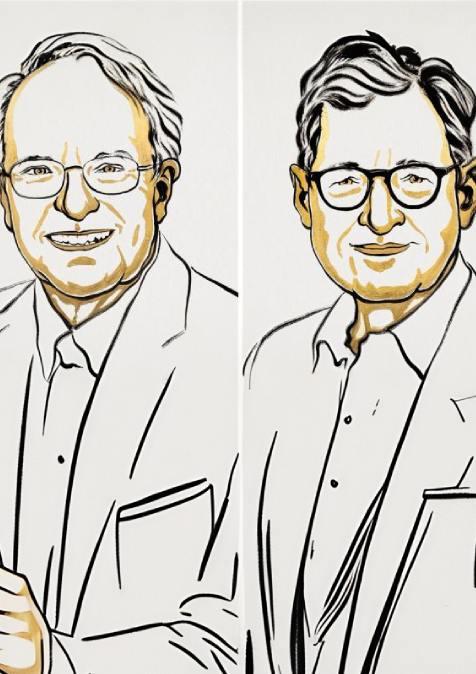
Robert E .Hall et Michael Woodford, Prix Nobel d’Économie 2026
October 26, 2026

Depuis que l’économie a été reconnue par les Nobel en 1969, il revient à cette discipline de clore les cérémonies annuelles d’attribution des Prix aux lauréats. C’est le 12 octobre 2026 que le jury du prix de la Banque de Suède, en sciences économiques en mémoire d’Alfred Nobel, a consacré deux Américains Prix Nobel de l’économie : Robert E. Hall et MichaelWoodford, pour leur contribution aux « fondements microéconomiques de la stabilisation macroéconomique de la stabilisation ».

Le choc pétrolier de 1973, aboutissant à la stagflation, va mettre à mal les recettes keynésiennes de l’après-guerre. Mais, à la différence de nombreux   Keynésiens qui désiraient tourner la page du Maitre de Cambridge, nos deux lauréats vont chercher à donner une nouvelle dimension à son analyse, à partir d’une approche micro économique comportementale des individus et des entreprises. Et ils vont agir en complémentarité, Robert E .Hall, en privilégiant la demande, Michael Wood, l’offre.

Robert E .Hall enseigne toujours à l’université de Stanford (Californie), aux États-Unis, après avoir soutenu sa thèse de doctorat, sous la direction de Robert Solow, Prix   Nobel d’Économie en 1987. Ses travaux vont porter principalement sur la prise en compte des anticipations dans la décision   de consommer ou de ne pas consommer. Avant sa contribution, on considérait que la consommation dépendait du revenu disponible et de lui seul. Hall va montrer qu’on ne peut comprendre l’évolution de la consommation sans prendre en compte les anticipations individuelles du consommateur, par exemple celle qui concerne son salaire ou son pouvoir d’achat. Dans un article fondateur de 1978, il montre que le changement de consommation est imprévisible, ce qui le conduit à conclure que la meilleure prédiction de la consommation ne peut se fonder que sur la consommation du moment, à une variation imprévisible près. (Son ouvrage de   référence : ‘’The 

Rational Consumer :Theory  and Evidence ‘’, MIT Press /Cambridge, Massachusetts 1990)

Michael Woodford enseigne à l’université de Columbia (New York). Ses travaux concernent la version offre de la problématique. Et ce, en analysant la fixation des prix par les entreprises, et plus particulièrement les raisons pour lesquelles , en cas de choc, les prix ne s’ajustaient pas rapidement. Il va montrer que si ces prix pouvaient baisser, cela ne pouvait être que très lentement, leur adaptation au choc nécessitant de multiples, et parfois couteuses, micro-décisions. À partir de ce constat, il va développer, en y intégrant, les travaux de Hall sur la consommation, un modèle macroéconomique beaucoup plus efficace, montrant, par exemple, que l’inflation globale est fonction des anticipations et du niveau actuel de la production, qu’il va intégrer à celui de Hall. Woodford va ainsi influencer les politiques économiques et monétaires du monde entier. Ce qui lui vaudra d’être qualifié par certains du « plus grand économiste monétaire de son temps ». ( Son ouvrage de référence : ‘’ Interest   and Prices :Foundations  of a Theory of Monetary Policy ‘’ Princeton University Press   2003 )

En distinguant un champ de recherche, celui de la nouvelle économie keynésienne, le jury ne pouvait en ignorer le pionner :Robert E .Hall , et celui qui va le plus contribuer à la faire progresser, allant jusqu’à la modéliser avec des applications concrètes : Michael Woodford.



RELATED CONTENT

  • Authors
    Hala Boumaiz
    November 15, 2019
    The effects of new technologies on the ways in which we think, govern, work and socialize are already posing complex problems for decision-makers, citizens and corporates, leading to reactions of rejection that reflect fear or lack of preparation in coping with digital transformations. Due to these changes, the classical patterns shaping our society - be it within the political, economic, or social spheres - have been rapidly altered. With this fast-paced transformation, the general ...
  • Authors
    Pedro da Motta Veiga
    November 14, 2019
    Created as a State-owned company in the late 1960s, Embraer was privatized in the mid- 1990s and became the main Brazilian company producing and exporting high-technology goods. The company diversified its operations within the aircraft business and added to its portfolio goods and services associated to its core activities. ...
  • Authors
    November 13, 2019
    The growth slowdown became evident in late 2017. World GDP at market exchange rates slowed from a seasonally adjusted annual rate of between 4 and 5% in the second half of 2017 to between 1.5% to 2% in the first half of 2019. The slowdown came as a big surprise and led to continuous revisions downwards of growth forecasts as shown yet again by the IMF’s World Economic Outlook issued last week. Nearly all observers and experts had expected the expansion of 2016/2017 to con ...
  • November 13, 2019
    La décennie 2009-2019 a vu se développer les crypto-monnaies. Ce que certains appellent des unités de compte cryptées. Cette étude est consacrée à deux d’entre elles : le Bitcoin, créé en 2009, et la Libra, dont les premières devraient apparaître en 2020. Deux crypto-monnaies qui peuvent s’opposer ou se compléter. Unité de compte reconnue, le Bitcoin va vite apparaître aussi spéculatif, l’éloignant du caractère monétaire que certains veulent lui attribuer. A l’inverse, la Libra, mon ...
  • Authors
    November 8, 2019
    The Trump government has been imposing restrictions on access to technologies by Chinese telecommunications firms. Why and what are the consequences? The Federal Communications Commission is about to ban carriers from using government funds to buy equipment from Huawei and ZTE. Other government agencies are expected to take similar measures. This is just the latest episode of a gradual squeeze that the Trump government has been giving over China's telecommunications giant Huawei, ...
  • November 5, 2019
    In this brief, we review the evidence on Morocco’s export concentration, discuss its causes, and then draw some policy implications. The main message is that Morocco needs to raise its game in some less familiar markets and move outside its comfort zone. This implies not only investments by private firms, greater efforts on export promotion by the government and professional associations, but also deeper changes within Morocco, including in its educational system. Over the past two ...
  • Authors
    November 5, 2019
    Since 2013, armed conflict has raged in the Central African Republic, between the largely Muslim Seleka rebels and the predominantly Christian militias (known as the anti-Balaka). Rebel groups are controlling broad swathes of the country, exploiting mineral wealth, and levying taxes on cattle migration. Non-state actors such as the Popular Front for the Governance of the Central African Republic (FPRC), which claims to “govern” the country’s northeast, have severely tested the autho ...
  • Authors
    Morten Seja
    November 1, 2019
    The author is an alumnus of the Atlantic Dialogues Emeging Leaders Program 2014. The discussion on industry 4.0 (also often referred to as smart manufacturing or industrial internet of things – which is the term mostly used in the United States of America) has graduated from being a niche topic discussed (and implemented) by engineers in the world’s richest economies. If industry 4.0 has not physically arrived everywhere, it is at least in the minds of some: industry 4.0 in&nb ...
  • Authors
    Samuel Arnaud
    October 28, 2019
    Africa, as a continent of economic opportunities, is attracting foreign players. In this context, India is emerging as an important partner, especially for Eastern and Southern Africa. The complexity of its geopolitical environment combined with internal specificities motivated the revival of interest for the continent. This paper draws on historical developments between India and African countries to provide the state of play of recent linkages. Those trends are better perceived th ...