Publications /
Policy Brief

Back
Reviving Multilateral Security Dialogue in the MENA: Finding the Hard, but Possible, Compromise
Authors
Emilliano Alessandri
April 7, 2017

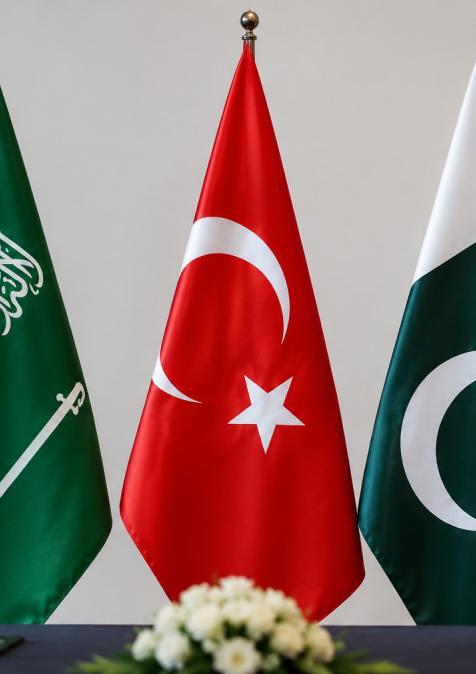
While possible, prospects for repairing existing fractures through multilateral dialogue and compromise have become elusive as crises in the region persist. There are quite a few unfavorable conditions hindering the emergence of some form of multilateral security process: areas of hot conflict have widened in recent years making violence almost endemic in the region, in countries like Syria, Iraq, Yemen and Libya. The Middle East peace process is in a stalemate and already thin trust between the Israeli and Palestinian leaderships is all but gone as both have become more contested among respective constituencies and less respected abroad In some countries, the social contract seems to be breaking after a failed Arab Spring, challenging government authority even in places like Tunisia where a fragile democratic transition audaciously continues despite growing socio-economic discontent and a deteriorating security situation. Some other MENA states have become weaker as a result of chronic violence and dysfunctional governance; while non-Arab states, from Turkey to Iran, have seen an opportunity to expand their clout in a Middle East in flux, even if themselves under great pressure, extra-regional actors have never appeared more divided about the course to follow, or more distracted by other priorities.
RELATED CONTENT

  • Authors
    June 19, 2026
    Fin mai 2026, des frappes israéliennes ont visé les abords du château de Beaufort (Qalaat al-Chaqif), près de Nabatiyeh, avant que l'armée israélienne n'en annonce la prise. Ce fait soulève une question centrale : pourquoi une hauteur fortifiée au Moyen Âge conserve-t-elle une valeur militaire à l'ère des satellites, des drones et des missiles de croisière ?Le présent Policy Brief tente de démontrer que la valeur de Beaufort est géographique avant d'être idéologique ou technologique ...
  • Authors
    June 12, 2026
    This essay argues that the current debate about the future of the international monetary system is not really about Gulf currencies, oil pricing, or de-dollarization in the narrow technical sense. It is about something deeper and more important: whether institutional trust can survive when geopolitical certainty is eroding.The Gulf monarchies—Saudi Arabia, the United Arab Emirates, Qatar, Kuwait, Bahrain, and Oman—increasingly exist in a world where the United States no longer looks ...
  • June 5, 2026
    Driven by its mission to reflect on and analyze the major geopolitical, economic, and societal transformations shaping the contemporary world, and with a view to contributing to knowledge-sharing and disseminating the main outcomes of its research program, the Policy Center for the New South regularly publishes collective volumes addressing issues of particular importance to Morocco, Africa, and the broader Global/New South. In this spirit, the Center has recently released two volum ...
  • Authors
    Liel Maghen
    May 11, 2026
    This Paper was originally published on mitvim.org.il This paper argues that the reconstruction of Gaza will depend not only on the amount of funding mobilized, but on how financing is structured, governed, and anchored within a broader politi`cal context. In a setting shaped by movement restrictions and weak institutions, financial design is not neutral but shapes priorities, distributes power, and determines what can be implemented on the ground. The paper examines the key cha ...
  • Authors
    April 1, 2026
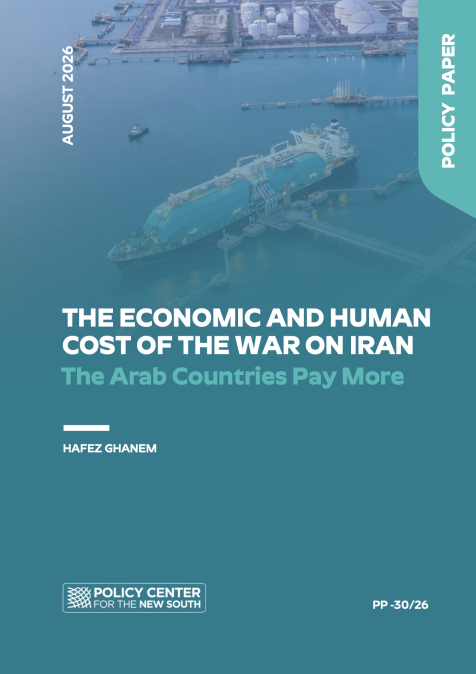
    We are now in the fifth week since the U.S. airstrike that killed top leaders of the Iranian regime, initiating a war involving the United States and Israel against the country. More than a month of mutual bombardments between Iran and Israel has ensued, extending to other Persian Gulf nations, U.S. military installations—and even Cyprus. From a global perspective, the impact has stemmed primarily from disruptions to regional production of goods and the blockade of the Strait of Hor ...
  • Authors
    December 18, 2025
    The return of President Donald Trump to the White House at the start of 2025 was expected to signal an American retreat from international engagement, especially in regions of traditional security interest, such as southern Europe, North Africa, and the Middle East. To the surprise of many observers around the Mediterranean, and perhaps to the dismay of some in the Trump administration’s ideological orbit, this has not happened. If anything, the second half of 2025 has seen a high d ...
  • Authors
    December 17, 2025
    I recently participated in a discussion between Israelis and Arabs, some living in the Middle East, some living abroad[1]. The discussion topic was ‘The Two State Solution’. This article presents my personal takeaways from the discussion. It does not try to describe the details, and other participants may have different takeaways.I joined the discussion thinking that the two-state solution was dead. Most of the other participants felt the same way—all very pessimistic. But I left fe ...
  • Authors
    December 16, 2025
    An unusual gesture indeed—the dictator, more often than not a recluse, withdrawn behind his fortress and protected by 1.2 million armed soldiers, finally admitted what had long been seen on the battlefield in Ukraine and by spy satellites far above. North Korean soldiers—possibly 12,000 of them—are fighting on front lines alongside Russian troops, and they are falling or being wounded; some 4,000 men so far, by current estimates.  ...
  • Authors
    December 1, 2025
    This Paper was originally published on transatlantic.org The contemporary maritime domain is increasingly recognized as a geopolitical and economic space, but also as an environment intertwined with human, social, ecological, and governance systems ashore. The United Nations Institute for Disarmament Research (UNIDIR 2024) report argues that maritime security has evolved from a narrow naval and state-centered concern into a multidimensional issue embedded in global human s ...
  • Authors
    November 28, 2025
    The adoption of United Nations Security Council Resolution 2803 on November 17, 2025, endorsing the “Comprehensive Plan to End the Gaza Conflict,” is a step in the right direction, but it must be accompanied by the implementation of a Gaza development and post-conflict reconstruction program. Paragraph 6 of Resolution 2803 “calls upon the World Bank and other financial institutions to facilitate and provide financial resources to support the reconstruction and development of Ga ...