Publications /
Paper in Academic Journals
Back
Remittances and women’s empowerment: empirical evidence from North African countries
Authors
Oussama Zennati
August 4, 2026

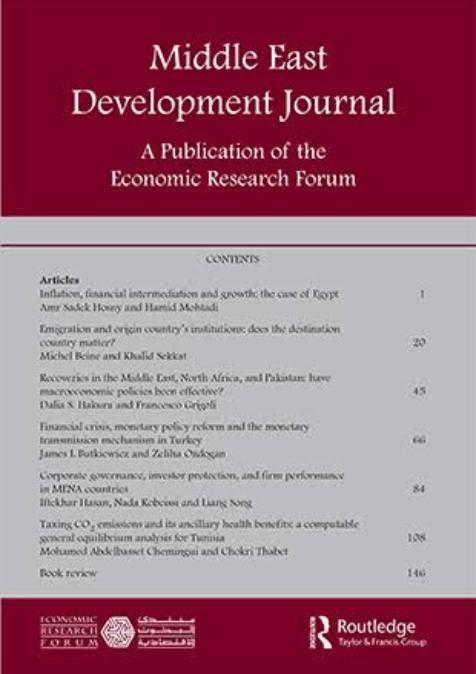
This paper was originaly published on Middle East Development Journal


This article examines the impact of remittances on human capital formation, living conditions, and economic participation of women in North African countries. While prior research has explored remittances’ effects on women’s access to fundamental rights, it has not fully captured the social and economic transformations induced by these funds. Our findings indicate that remittances significantly enhance women’s human capital in the region. Additionally, remittances contribute to increased life expectancy and a reduction in adult female mortality rates. However, they do not show a significant effect on women’s economic participation. A country-by-country analysis further reveals substantial heterogeneity in the effects of remittances across the sub-region, reflecting cross-country differences in migration patterns, the use of remittances by recipient households, as well as the relative importance of remittance as a share of GDP. While remittances increase women’s average years of schooling in Egypt, they are negatively associated with educational attainment in Morocco and Tunisia. Moreover, remittances are linked to improved living conditions for women across the sub-region, with the notable exception of Tunisia which suggests that remittances alone cannot fully compensate for the absence of migrant family members.
RELATED CONTENT

  • Authors
    March 29, 2023
    Le taux d’activité des femmes marocaines (*) affiche un déclin devenu structurel depuis une vingtaine d’années. Ce déclin est encore plus critique vu le faible niveau de ce taux, considéré parmi les plus bas à l’échelle mondiale. Pourtant, plusieurs réformes, programmes et actions ont été menés ou sont en cours de déploiement pour améliorer les conditions de la femme, aussi bien au niveau économique que social, et dans les milieux urbain et rural. Sommes-nous face a ...
  • Authors
    March 29, 2023
    يبين معدل نشاط المرأة المغربية1 انخفاضا أصبح هيكليا على مدى السنوات العشرين الماضية. وتزداد حدة هذا الانخفاض نظرا لضعف مستوى هذا المعدل، الذي يعتبر من بين أدنى المعدلات في العالم. ومع ذلك، تم تنفيذ العديد من الإصلاحات والبرامج والإجراأت أو يجري تنفيذها لتحسين ظروف المرأة، اقتصاديا واجتماعيا، وفي المناطق الحضرية والريفية. هل نواجه ظاهرة مجتمعية أم مجرد مشاكل تتعلق بالنمو الاقتصادي؟ ما هي الدروس التي يمكن استخلاصها من مختلف الدراسات والتحليلات التي أجريت في هذا الاتجاه وما هي الأدوات ...
  • Authors
    March 29, 2023
    The activity rate of Moroccan women (*) has been on a structural decline for some twenty years. This trend is all the more critical given its low level, regarded as one of the lowest in the world. And yet, a host of reforms, programs and actions have been implemented or are underway to improve the condition of women, both economically and socially, and in both urban and rural areas. Are we dealing with a societal phenomenon or simply with economic growth issues? What lessons can we ...
  • March 28, 2023
    كشفت دراسة نشرتها المنظمة الدولية للهجرة حول العاملات الموسميات بعد انتهاء مدة إقامتهن في إسبانيا والعودة إلى المغرب، أن أكثر من 83٪ من النساء يدعمن أسرة مالياً. وقد تم إجراء العديد من ال ...
  • Authors
    Zakaria Elouaourti
    March 15, 2023
    The aims of this article were twofold. First, to tackle the issue of convergence from an analytical point of view by presenting the mathematical developments of the main economic growth models, which emphasized that the convergence of African economies is conditional to the investment level in the early stages of physical capital accumulation. As the latter increases, the convergence of African economies is determined by other factors (investment in research and development (R&D ...
  • Authors
    February 28, 2023
    This publication was originally published on https://www.euromesco.net/   The Moroccan job market offers few opportunities for young non-educated Moroccans. With the rise of the internet, many Moroccans sought to find new ways to generate an income and find financial stability. During the COVID-19 pandemic, we have seen a rise of Moroccan entrepreneurs in e-commerce and dropshipping and a dramatic increase of motivational and educational content that aims at en ...