Publications /
Paper in Academic Journals
Back
Remittances and women’s empowerment: empirical evidence from North African countries
Authors
Oussama Zennati
August 4, 2026

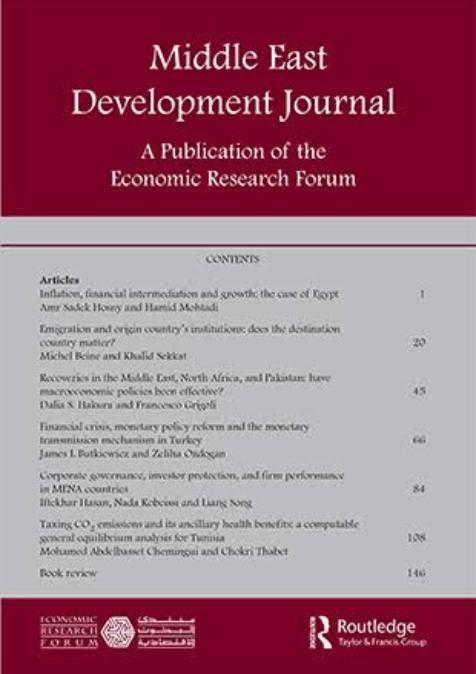
This paper was originaly published on Middle East Development Journal


This article examines the impact of remittances on human capital formation, living conditions, and economic participation of women in North African countries. While prior research has explored remittances’ effects on women’s access to fundamental rights, it has not fully captured the social and economic transformations induced by these funds. Our findings indicate that remittances significantly enhance women’s human capital in the region. Additionally, remittances contribute to increased life expectancy and a reduction in adult female mortality rates. However, they do not show a significant effect on women’s economic participation. A country-by-country analysis further reveals substantial heterogeneity in the effects of remittances across the sub-region, reflecting cross-country differences in migration patterns, the use of remittances by recipient households, as well as the relative importance of remittance as a share of GDP. While remittances increase women’s average years of schooling in Egypt, they are negatively associated with educational attainment in Morocco and Tunisia. Moreover, remittances are linked to improved living conditions for women across the sub-region, with the notable exception of Tunisia which suggests that remittances alone cannot fully compensate for the absence of migrant family members.
RELATED CONTENT

  • Authors
    March 12, 2026
    Historically, manufacturing has served as the primary pathway to economic development, offering strong scale economies, learning-by-doing effects, and the capacity to generate the foreign exchange necessary to import capital goods and technology. However, advances in robotization and artificial intelligence (AI) are fundamentally undermining manufacturing’s traditional role, making it increasingly skill- and capital-intensive while limiting its ability to absorb labor. Thi ...
  • March 10, 2026
    بمناسبة اليوم العالمي لحقوق المرأة في 8 مارس، يتناول هذا اللقاء وضعية المرأة القروية في المغرب والتحولات التي عرفها دورها في التنمية الاقتصادية والاجتماعية خلال السنوات الأخيرة. كما يسلط الضوء على مساهمتها الكبيرة في الأنشطة الفلاحية والأسرية، رغم أن جزءاً مهماً من عملها يظل غير مرئي أو...
  • January 5, 2026
    This Paper was originally published on sciencedirect.com This study provides an original and significant contribution to evaluating educational service quality in Morocco by leveraging, for the first time, microdata from the Service Delivery Indicators (SDI) survey. The survey covers a nationally representative sample of 300 public and private primary schools across rural and urban areas. The use of SDI data represents a major methodological advancement, shifting away from perc ...
  • Authors
    Ahmed Ouhnini
    December 5, 2025
    “Uberization,” a term derived from the American company Uber in the early 2010s, initially refers to an economic model based on directly matching supply and demand through digital platforms. Rapidly popularized, the concept has expanded with Airbnb in accommodation, and then to a wide range of other sectors: food delivery, home services, e-commerce, and even traditionally regulated or corporatist professions. This neologism thus reflects a transformation of economic and social relat ...
  • Authors
    Ahmed Ouhnini
    December 5, 2025
    L’« uberisation », terme né du nom de l’entreprise américaine Uber au début des années 2010, désigne initialement un modèle économique fondé sur la mise en relation directe entre offre et demande via des plateformes numériques. Rapidement popularisé, le concept s’est élargi, avec Airbnb dans l’hébergement, puis à une multitude d’autres secteurs : livraison de repas, services à domicile, commerce en ligne, voire des métiers traditionnellement régulés ou corporatistes. Ce néologisme t ...
  • Authors
    Arkebe Oqubay
    November 17, 2025
    Morocco has emerged as one of Africa's success stories, achieving significant progress in economic transformation and the green transition over the past 25 years. Continuing and deepening this transformation is essential to reach the country’s goal of becoming a high-income economy in the coming decades. Significant challenges include managing the risk of the middle-income trap, addressing demographic pressures, promoting inclusive growth, ensuring environmental sustainability, and ...
  • October 3, 2025
    In this episode, we explore Africa’s industrial challenges and opportunities, showing how AfCFTA-driven integration, green sectors, and inclusive policies for women, youth, and SMEs can foster sustainable growth, resilience, and domestic value capture. ...
  • September 19, 2025
    Pierre Nguimkeu, Director of the Africa Growth Initiative at Brookings, examines Africa’s digital transformation and its impact on work, education, and the economy. From mobile technology ...
  • Authors
    September 19, 2025
    Le constat est unanime et est constamment souligné : le modèle de développement en vigueur au Maroc a atteint ses limites. La Vision Royale, refusant « un Maroc à deux vitesses », vient formaliser au plus haut niveau cette préoccupation systémique, documentée par une décennie de rapports officiels. La  Vision de Sa Majesté le Roi Mohammed VI est un hymne à une dynamique de croissance dont les retombées doivent être plus équitablement réparties et à un développement te ...