Publications /
Research Paper

Back
RACE AGAINST THE CLOCK : Industrial Policy for Resource-Rich African Least Developed Economies-Transforming Wealth into Productive Capacity
Authors
August 5, 2026

This paper addresses the persistent challenge of resource dependence in the world's poorest countries, focusing on the ten poorest African nations where natural- resource rents average 14% of income. It argues that four decades of conventional policy advice, which treated resource dependence primarily as a revenue management problem, have failed to help these countries. While stabilization funds and permanent-income frameworks aim to smooth consumption, they do not answer the fundamental question of how to transform resource wealth into permanent productive capacity capable of generating income after rents decline. 

The paper identifies a critical research gap in industrial-policy literature: many African least developed countries (LDCs) occupy a unique position characterized by weak administrative capacity and small domestic markets, but possess temporarily large fiscal space created by resource rents. This combination creates a "race against the clock," as the global energy transition and rapid technological change are shortening the economic life of both hydrocarbons and critical minerals. The paper argues that the goal of resource policy must shift from "revenue smoothing" to "productive-capacity replacement" before this fiscal window closes. 

Empirical analysis reveals that the failure of resource booms did not result from a lack of investment, but an inability to convert capital into productivity. To assess this issue, the paper undertakes two complementary growth decompositions for eleven African economies, distinguishing resource-intensive countries from successful diversifiers. The results show that while many resource-intensive economies accumulated physical capital, their total factor productivity (TFP) was often negative, and labor productivity collapsed after commodity cycles peaked. In contrast, a group of "African diversifiers"—such as Ethiopia, Ghana, and Tanzania—achieved sustained gains by directing public investment toward labor-intensive manufacturing and tradable services, even without heavy resource endowments. 

To address these failures, the paper proposes a rent-financed "Big Push" framework. Unlike traditional models focused on domestic demand, this strategy is value-chain-oriented, emphasizing the connection of firms and workers to regional and global production systems. The framework prioritizes the creation of export platforms (special economic zones), trade-enabling infrastructure, and human capital for tradable production. It advocates for a strict fiscal hierarchy where resource revenues are treated as "transformation finance" rather than recurrent income, separating a dedicated "transformation window" from short- term stabilization needs. 

Ultimately, the paper warns that delayed transformation is, in practice, no transformation. As technological substitution and climate-consistent scenarios reduce the long-term value of resources, African LDCs must use their remaining rents to build competitive non-resource sectors. The "race against the clock" suggests that the greatest wealth of these nations is not the resources themselves, but the brief opportunity they provide to fund a permanent productive economy.
RELATED CONTENT

  • Authors
    August 5, 2026
    This paper addresses the persistent challenge of resource dependence in the world's poorest countries, focusing on the ten poorest African nations where natural- resource rents average 14% of income. It argues that four decades of conventional policy advice, which treated resource dependence primarily as a revenue management problem, have failed to help these countries. While stabilization funds and permanent-income frameworks aim to smooth consumption, they do not answer the fundam ...
  • February 16, 2023
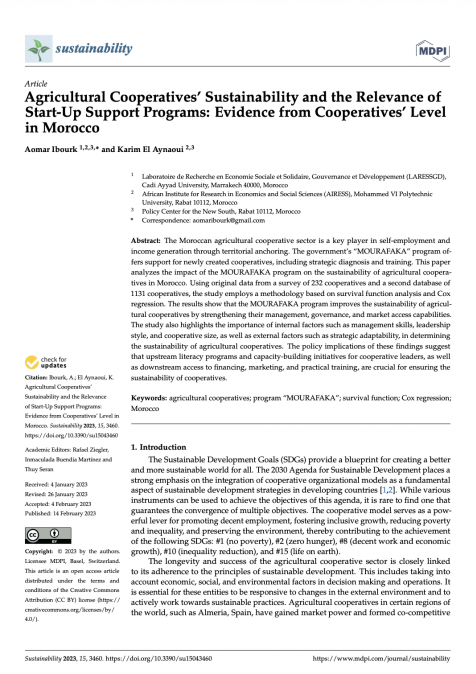
    This publication was originally published in https://www.mdpi.com/   The Moroccan agricultural cooperative sector is a key player in self-employment and income generation through territorial anchoring. The government’s “MOURAFAKA” program offers support for newly created cooperatives, including strategic diagnosis and training. This paper analyzes the impact of the MOURAFAKA program on the sustainability of agricultural cooperatives in Morocco. Using original data from a ...
  • March 1, 2022
    Known for being a climate change hotspot, Morocco is at the forefront of a climate disaster. Consequences are already being felt, whether in the form of increasing temperature or a downward trend in precipitations, which directly threaten the water security and, by extension, the social-ecological systems of the country. The systems by which food, energy, and water are produced, distributed, and consumed heavily depend on one another. Their implicit feedbacks and links are not linea ...
  • Authors
    Paola Maniga
    Yassine Moustanjidi
    February 15, 2021
    The COVID-19 pandemic has exposed new vulnerabilities in social, infrastructure, and governance systems. In the first months of the pandemic, there was a genuine concern about the capacity of the Global South to contain the spread of the virus. African cities were particularly vulnerable, with some experts1, including the head of WHO2, predicting a catastrophe for the continent. Despite the structural and chronic challenges that African cities face, including informality, poverty, a ...
  • Authors
    Mouhamadou Moustapha Ly
    Tharcisse Guedegbe
    September 19, 2018
    La ville de Kigali, au Rwanda, a accueilli du 5 au 8 septembre 2018 le forum de l’AGRA, devenant ainsi la capitale de l’agriculture africaine pendant ces quatre journées. Délégations gouvernementales, partenaires techniques et financiers, chercheurs, universitaires, investisseurs, producteurs, club de réflexion, entre autres, étaient en conclave pour faire l’état des lieux du secteur et mesurer les progrès accomplis sur la route de la transformation de l’agriculture africaine.  ...
  • August 1, 2018
    “This article has been originally published in 'Morocco in Focus 2018,' the magazine of the Moroccan Embassy in New Delhi, India on the occasion of the Morocco National Day 2018.” Introduction In an article published last year, the author stressed the role of partnership between Morocco and India for the inclusive growth of small farmers. There is no doubt that agriculture remains a major instrument for human development both in India and in Africa. Several international reports&n ...
  • Authors
    Edité par
    Idriss El Abbassi
    Lahcen Oulhaj
    Aziz Ragbi
    November 28, 2016
    Le présent ouvrage se propose d’apporter quelques éléments d’appui supplémentaires aux policy-makers pour une meilleure identification des défaillances des marchés au Maroc et une mise en place d’une stratégie de diversification et une politique industrielle efficientes, sans toutefois tomber dans la situation inverse où une stratégie mal définie et des outils mal choisis peuvent se traduire par une défaillance des politiques publiques. L’appréhension des difficultés qu’éprouve l’é ...
  • Authors
    Under the Supervision of
    Philippe Chalmin
    July 4, 2016
    Guinea’s bauxite, Moroccan phosphates, Nigerian Bonny Light, Zambian copper, Côte d'Ivoire’s cocoa, Ethiopian coffee or Madagascar’s vanilla: all are examples demonstrating that raw materials have a dimension that is as global as it is local. Global by the markets on which they are traded, local by their quality, a key element of their price, and their macroeconomic impact, particularly for Africa. In line with the 2016 CyclOpe report, which celebrates three decades of existence thi ...
  • July 21, 2015
    The 16th Annual Global Development Conference has been dedicated this year to the theme of ‘Agriculture for Sustainable Growth: Challenges and Opportunities for a New ‘Green Revolution’.  One of the sub-themes that has been addressed during this event is related to the design of the optimal agricultural policy supposed to lead towards development, especially in low-income countries. The objective of this blog is to cover the key elements that make an agricultural policy su ...
  • Authors
    Karim EL MOKRI
    July 6, 2015
    « Les asymétries et l’instabilité du marché des matières premières dans les pays en développement : politiques et impacts sur le développement », une problématique d’un intérêt particulier pour ces pays, a fait l’objet d’un séminaire de recherche organisé par la Fondation pour les Etudes et Recherches sur le Développement International (Ferdi), les 24 et 25 juin 2015 à Clermont-Ferrand. Cet évènement a été tenu la veille du workshop co-organisé par la Ferdi et OCP Policy Center ...