Publications /
Policy Brief

Back
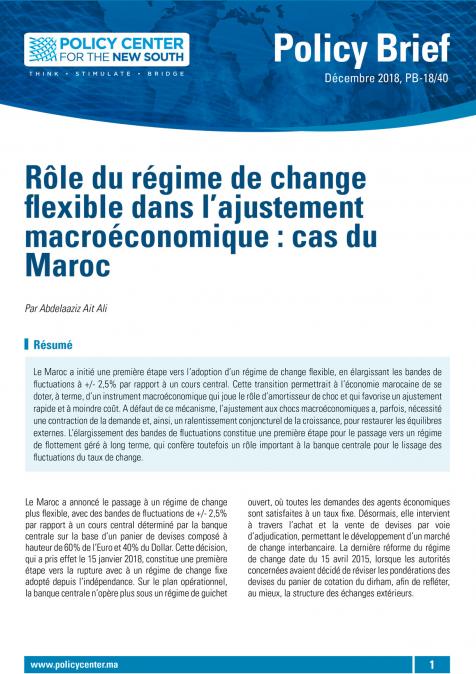
Rôle du régime de change flexible dans l’ajustement macroéconomique : cas du Maroc.
January 1, 2019

Le Maroc a initié une première étape vers l’adoption d’un régime de change flexible, en élargissant les bandes de fluctuations à +/- 2,5% par rapport à un cours central. Cette transition permettrait à l’économie marocaine de se doter, à terme, d’un instrument macroéconomique qui joue le rôle d’amortisseur de choc et qui favorise un ajustement rapide et à moindre coût. A défaut de ce mécanisme, l’ajustement aux chocs macroéconomiques a, parfois, nécessité une contraction de la demande et, ainsi, un ralentissement conjoncturel de la croissance, pour restaurer les équilibres externes. L’élargissement des bandes de fluctuations constitue une première étape pour le passage vers un régime de flottement géré à long terme, qui confère toutefois un rôle important à la banque centrale pour le lissage des fluctuations du taux de change.


RELATED CONTENT

  • August 3, 2026
    This Opinion was originally published in Project Syndicate Data from a period in which both China and India pursued deliberate industrial policies show that neither country's development route is accessible to other countries. At best, their experience can alert policymakers to structural limitations and coordination problems that will require their own homegrown solutions.RABAT—What is the most reliable development path for an increasingly fragmented global economy? China ...
  • Authors
    July 31, 2026
    Ethiopia continues to struggle to lay the economic foundations of food security for all, more than 30 years after first adopting the East Asian Developmental State Model (EADS) under Zenawi (1911-2012), continued under Hailemariam Desalegn (2012-April 2018), and later shifting toward a neo-liberal, Washington consensus-oriented approach under Abiy Ahmed (2018-present). The achievements recorded under the EADS approach—particularly double-digit annual growth, substantial poverty ...
  • July 29, 2026
    En un siècle, le cours de l’once d’or est passé de 20 dollars à 5 300 dollars au premier trimestre 2026. Cette étude, consacrée à l’analyse de cette envolée, comporte deux parties.La première privilégie une approche historique. Elle retrace tout d’abord le changement de statut du précieux métal jaune, monétisable jusqu’en 1971 puis démonétisé par la suite. Elle rappelle ensuite que cette évolution, loin d’être linéaire, est ponctuée de phases de forte hausse, de stagnation et d ...
  • Authors
    July 28, 2026
    The term “K-shaped recovery” was introduced to describe the economic recovery from the recession triggered by the Covid-19 pandemic. It refers to the uneven and divergent growth pattern between leading industries or sectors (the upper arm of the letter K—mainly the high-technology sector) and laggards, or the rest of the economy (the lower arm—the traditional industries). Since then the term has become popular in portraying divergent growth patterns within and between countries, esp ...
  • Authors
    July 16, 2026
    Thanks to the AI investment boom, the U.S. economy has performed well at the macroeconomic level. However, it is on an unsustainable fiscal and debt path. Mr. Trump’s fiscal policy in his second term has aggravated this trajectory. In turn, Mr. Trump’s tariff-based trade policy has failed to address what he sees as U.S. economic problems associated with the trade balance. Besides explaining why this has been the case, and what its implications are for the U.S. economy and the r ...
  • July 15, 2026
    تناقش هذه الحلقة واقع المنافسة في الأسواق المغربية وعلاقتها بتطور الأسعار والقدرة الشرائية للمواطنين. كما تسلط الضوء على أبرز العوامل المؤثرة في الأسعار، سواء المرتبطة بالمنافسة أو بتكاليف الإنتاج وسلاسل التوزيع. ويتناول الحوار دور مجلس المنافسة والسلطات العمومية والفاعلين الاقتصاديين ف...
  • Authors
    July 13, 2026
    This paper provides a structural assessment of India’s services-led development trajectory, and its integration into global value chains (GVCs) between 2012 and 2022. Applying an analytical framework that categorizes services into knowledge (KS), enabling (ES), and local (LS) sectors, the study utilizes sixteen OECD indicators to move beyond the narrative of India as a ‘services champion’ and reveal a more complex economic reality. The analysis identifies three central structur ...
  • Authors
    July 13, 2026
    This paper examines the evolution of China’s services sector between 2012 and 2022, analyzing the country’s structural transformation based on a novel three-tier taxonomy: knowledge services (KS), enabling services (ES), and local services (LS). Using sixteen quantitative indicators from OECD databases, the study evaluates China’s transition in comparison to the EU15 benchmark, highlighting three core challenges: manufacturing rebalancing, labor absorption, and global integration.Th ...
  • Authors
    Edited by
    July 13, 2026
    Available soon on livremoi. The 2026 edition of the Annual Report on the African Economy examines the issue of the valorization of Africa’s natural resources, particularly its mineral wealth. While the continent holds some of the world’s largest known reserves of a wide range of minerals and metals, the objective is not merely to catalogue these resources, but rather to explore the conditions under which natural resource endowments can be transformed into drivers of Africa’s in ...