Publications /
Opinion
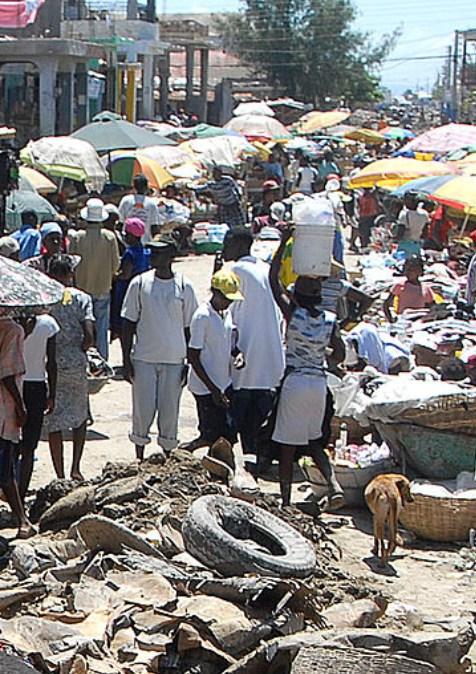
An estimated 600,000 Haitians live legally on US soil, most of them in New York City and Florida. Another 500,000 are waiting—certainly in vain—for entry papers. In September, the Trump government ended a special “Temporary Protected Status” for an estimated 300,000 Haitian migrants, and possibly another 500,000 migrants temporarily settled in the U.S., including Afghans, Cubans, Nicaraguans, and Venezuelans. The Trump regime is claiming that the violence-plagued Caribbean nation of eleven million is not, as New York Times reporter Tim Balk writes, “one of the most unstable and desperate places in the world,” but now, allegedly, safe enough for the return of desperate masses.
Not so, argues the International Organization for Migration, a UN related agency, in its Haiti Crisis Response Plan 2025: “Haiti faces a severe humanitarian crisis marked by escalating violence, forced displacement, irregular migration, and a lack of basic services. The country has long been grappling with overlapping crisis, including political instability, socioeconomic collapse, natural hazards, and rampant gang violence.” Human Rights Watch (January 16, 2025) confirmed: “Haiti’s crisis has reached catastrophic levels.” The nation now appears at risk of moving beyond criminal anarchy toward the full collapse of the state.
Dying for Napoleon
Thus, it is no surprise that, for the citizens of this nation, the U.S. must seem like paradise. To the desperate masses, it feels as if their homeland is bedeviled by an evil spirit—or rather, by a global conspiracy of dark forces forever—its history colorful, painful, and dramatic. This history includes slaves imported from Africa to work on sugarcane and coffee plantations, humans deprived of their dignity. And one day, these slaves said basta—they revolted against colonial oppression.
In 1803, they created the first nation ever to gain freedom through a slave revolt, and the first country in the Americas to abolish slavery. The first Europeans arrived on December 6, 1492, during Christopher Columbus’s first voyage to the region, establishing the first European settlement in the Americas, La Navidad, on what is now the northeastern coast of Haiti. Columbus claimed the island for the Crown of Castile, a former kingdom compromising most of modern Spain. The island remained part of the Spanish Empire until 1697, when the western portion was ceded to France and renamed Saint-Domingue.
Haiti was the tiny spot on the unexplored global map where Christopher Columbus landed and believed he had discovered the unending land that would one day be known as the USA. Since then, Haiti and its 6,000-year-old island have endured—and survived—disasters without end: hurricanes, tropical storms, earthquakes, Covid-19, yellow fever, cholera, American occupation, UN intervention, the assassination of President Jovenel Moise just four years ago; centuries earlier, a self-appointed monarch, Emperor Jacques I, ruled, followed later by a native family that provided two dictators in succession—the Papa Doc and the Baby Doc.
Centuries before these dictators rose, 50,000 of Napoleon’s soldiers died of yellow fever while attempting to crush a revolt of enslaved people—men and women who did not hesitate to slaughter white oppressors and their associates, who had amassed incredible wealth for themselves and for the kingdom of France, making this colony one of the world’s richest and drawing 25,000 whites to the promising island.
In 2010, an earthquake killed 200,000 citizens, destroyed the cathedral in the capital, Port-au-Prince, and the National Palace—events that strengthened both respect and fear of Voodoo power: invisible but potent, frightening at times, yet deeply reassuring for believers.
The people of the island of Hispaniola, shared with the Dominican Republic, are mainly Catholic, and all have their roots in Africa—except for the mulattos, who often felt superior because they did not see themselves as Black and were frequently wealthier than those crammed into dramatic dwellings like Cité Soleil, where hundreds of thousands do not live so much as fade away, without dreams or hope.
A resurgence of tuberculosis has been reported, and the health service is on the brink of collapse. Human Rights Watch stated that “international organizations estimate that 75 percent of the country’s health facilities have inadequate medical supplies and insufficient trained personnel.” Independent experts quoted by United Nations Human Rights (June 20, 2024) confirmed: “Violence, particularly in the capital Port-au-Prince, has reached alarming levels, with armed groups controlling large areas and complicating humanitarian access. Clashes between gangs and the Haitian National Police have created a pervasive environment of fear, restricting freedom of movement and access to basic services.”
Hell Touched by Cholera
UN agencies estimate that more than 300 criminal gangs control 80 to 90 percent of Haiti’s capital as of September last year. Many are alleged to have ties to political and economic elites, as well as police officers. The UN Office of the High Commissioner for Human Rights (OHCHR) recorded the killings of 3,150 people—including 36 police officers—and 1,284 kidnappings from January through September 2023.
In the first quarter of 2024 alone, 2,500 persons, including 82 children, were reportedly killed or injured in gang-related violence. More than half a million children in Haiti are living in neighborhoods controlled by armed gangs. Doctors without Borders reported that between January and May 2023, their staff assisted 1,005 sexual-violence survivors at its clinics in Port-au-Prince. Insecurity has triggered an exodus of health workers in recent years. In early August of this year, Haiti declared a three-month state of emergency (Al Jazeera, August 9, 2025) as gang violence surged. From October 2024 to June of this year, 4,804 people were killed.
Their paradise is hell, and no change is in sight. As of August 2023, the Pan American Health Organization reported 58,230 suspected cases of cholera, 3,696 confirmed cases, and 823 deaths since the beginning of the ongoing outbreak in October 2022. The Human Rights Watch notes in its World Report 2024, Haiti, Events of 2023: In 2023, Haiti’s security, justice, political, and humanitarian crises worsened. Killings, kidnapping, and sexual violence by criminal groups increased dramatically. More than 40 percent of Haiti’s population experiences acute food insecurity. Access to electricity, safe drinking water, sanitation, health care and education is severely limited.
UN experts warn that soaring numbers of displaced persons urgently need protection and aid. Haiti’s escalating gang violence and political instability have forced a record 578,074 internal displacements in 2024, including over 310,000 women and girls and 180,000 children—double the figure from 2022—making it the country with the largest number of global displacements due to crime-related violence.
Humanitarian Catastrophe
Yes, once upon a time Haiti was the “Pearl of the Antilles,” a tropical beauty of white beaches, green fields, majestic mountains, wealthy plantation owners, and winds flowing in from the ocean—Cuba just 80 km west of the northern peninsula, Jamaica 190 km west of the southern peninsula, the Bahamas somewhere nearby. Today, Haiti is a country in crisis, without structure or spirit, solidarity or stability.
There is no functioning government. Parliament has ceased to exist. Elections are planned for February 2026. A prime minister governs without ministers, pressured by gangs, political interests and neighboring governments that demand a halt to migration and violence. A president is selected from among the members of a so-called Transitional Presidential Council, its leadership rotating. On August 7, 2025, a wealthy businessman, Laurent Saint-Cyr, was chosen. Will he survive—physically, politically? Or be buried like democracy itself? No political party on the island dares to show its colors, because death may follow. There is no elected president, and no institution capable of proposing a candidate.
“Haitians flee a nation fearing collapse,” writes Emmanuela Douyon in a report for the Switzerland-based Migration Policy Institute (July 5, 2023), describing an “unfolding humanitarian catastrophe.” The situation is dire, and current migration will likely exacerbate the country’s brain drain, depriving it of the human resources, capital, and other capacities needed to rebuild.
“For the past two years, Haiti has experienced a reign of terror as rival outlaw bands battle in the streets of the capital with American assault rifles,” reported Jason Motlagh in “Rolling Stone” (November 26, 2023). According to the World Bank, notes Human Rights Watch, about 59 percent of Haiti’s population of 11.5 million lived on less than $3.65 per day in 2023; about 5.2 million needed food and shelter assistance—a 20 percent increase from 2022; and of these, 4.9 million were acutely food insecure.
The president of the Dominican Republic, Haiti’s direct neighbor, Luis Abinader, describes Haiti as being “in the midst of a low intensity civil war,” underscoring the unprecedented nature of the country’s implosion. Two years ago, the Dominican Republic closed its land borders with Haiti, as well as all sea and air connections, in a dispute over a waterway. The UN-designated expert on human rights in Haiti warned that this measure would exacerbate an already grave crisis, as the country relies on its neighbors for at least 25 percent of its food and medical supplies.
Since October 2024, the Dominican Republic has deported 150,000 Haitians across the border—an estimated thousand people per day—sending them from poverty back into misery. A tsunami of desperation could engulf Haiti if Washington begins deporting the first thousands of the 300,000 slated to follow, arriving in Port-au-Prince on U.S. Air Force transport planes.
Aaron Reichlin-Meiniek, a Senior Fellow at the American Immigration Council, warned, “This is not a safe place to send people. It is a death sentence.” Adding to the plight of Haiti’s desperate masses, the Dominican Republic plans to construct further fortifications along its 392-km border with Haiti.