Publications /
Paper in Academic Journals

Back
A new methodology to track the dynamics of structural transformation applied to the case of a developing country
Authors
Zakaria Elouaourti
May 6, 2025

This paper was originaly published on sciencedirect.com


This paper introduces a novel empirical approach, combining sigma convergence and sigma counterfactual statistics, to examine the dynamics of structural transformation in Morocco from 1990 to 2018. The findings reveal that Morocco experienced structural transformation driven by labor productivity reallocation across sectors during specific sub-periods (1991–1993, 1996–1997, and 1998–2003). However, this process came to an abrupt halt after 2004. Sectoral analysis highlights that the reallocation of labor from the primary and secondary sectors to the tertiary sector contributed to the observed changes, particularly during the early 2000s. By proposing this innovative methodology, the study makes a significant contribution to the literature on structural transformation, offering a replicable framework to analyze similar dynamics in diverse contexts and addressing a critical methodological gap.
RELATED CONTENT

  • September 24, 2019
    En pleine transition ordonnée de son régime de change, sous l'autorité bienveillante du Fonds monétaire international (FMI), le Royaume du Maroc est un exemple très concret des avantages et des inconvénients des deux régimes de change dominants ces dernières décennies/change fixe et change flottant /. L’objet de cette note est de rappeler, tout d'abord, les fondamentaux économiques des deux systèmes et leur environnement historique (I). Ensuite, à la lumière de ces fondamentaux, pré ...
  • Authors
    Afrique Contemporaine
    February 28, 2019
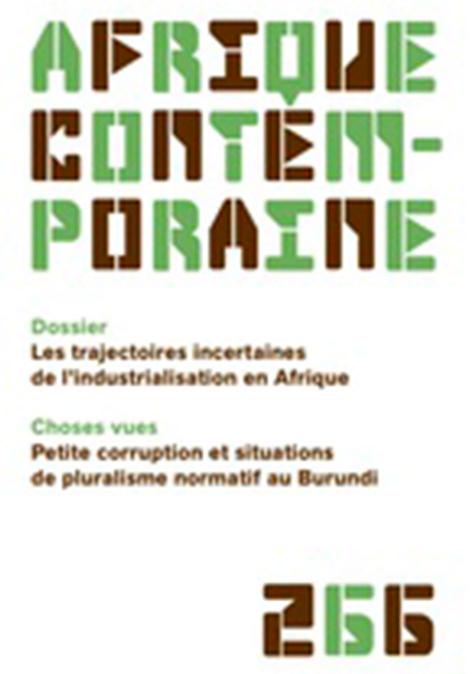
    Dans son édition n°266, la revue scientifique Afrique Contemporaine consacre son Dossier à la question de l’industrialisation en Afrique. D’après la Rédaction de la publication, le choix de la thématique s’imposait d’autant plus que « la recomposition de l’ordre mondial repose la question de la place du continent à l’échelle planétaire, en l’occurrence sur le plan économique, social et environnemental tout à la fois. » Outre la coordination du Dossier, Dr. Karim Et Aynaoui, Préside ...
  • Authors
    Yassine Msadfa
    February 25, 2019
    La transformation structurelle d’une économie demeure un point de passage nécessaire pour toute nation qui souhaite gravir les échelons du développement, cette transformation est souvent tributaire de la capacité d’une économie à s’ériger d’une société agraire de subsistance, dans son stade initial, vers une économie de productivité. Pour ce qui est du Maroc, le débat a pris de l’ampleur quant à la capacité des dynamiques actuelles à accélérer le rythme de l’activité économique au p ...
  • November 1, 2018
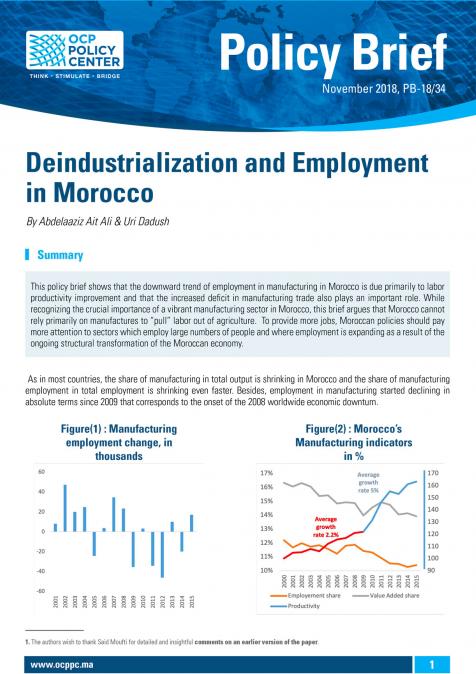
    This policy brief shows that the downward trend of employment in manufacturing in Morocco is due primarily to labor productivity improvement and that the increased deficit in manufacturing trade also plays an important role. While recognizing the crucial importance of a vibrant manufacturing sector in Morocco, this brief argues that Morocco cannot rely primarily on manufactures to “pull” labor out of agriculture. To provide more jobs, Moroccan policies should pay more attention to s ...
  • Authors
    September 21, 2018
    This blog is based on remarks delivered at the Think-Tank Summit in Buenos Aires on 18 September 2018 held under the G-20’s Argentine Presidency.  Africa has an enormous infrastructure gap that impedes its development. The Compact with Africa (CwA) is an international policy initiative sponsored under the German presidency of the G-20 in 2017 designed to bridge that gap. Intended to draw in the private sector in developing Africa’s infrastructure through a combination of Priva ...
  • Authors
    Yassine Msadfa
    September 21, 2017
    Les chaînes de valeur mondiales offrent de nouvelles opportunités de transformation structurelle pour les pays en développement. Aujourd’hui la vision des chaînes de valeur mondiales se limitant à l’analyse des flux commerciaux et des IDE à l’échelle globale n’est plus suffisante pour répondre aux questions clés du positionnement et de la remontée dans ces chaînes de valeur, de la dynamique de la capture de la valeur et de sa pérennisation. La réponse à ces questions appelle un écla ...
  • Authors
    August 9, 2017
    This paper reports on the recent developments in the construction of an interregional input-output matrix for Morocco (IIOM-MOR). As part of an ongoing project that aims to specify and calibrate an interregional CGE (ICGE) model for the country, a fully specified interregional input-output database was developed under conditions of limited information. Such database is needed for future calibration of the ICGE model. We conduct an analysis of the intraregional and interregional shar ...
  • Authors
    Taoufik Abbad
    July 5, 2017
    Le processus continu et renforcé de l’accumulation du capital physique, dans lequel s’est engagé le Maroc depuis le début des années 2000, a permis de préserver la stabilité des équilibres fondamentaux et d’amortir les différents chocs exogènes, aussi bien internes qu’externes. Cependant, cet effort d’accumulation n’a pas permis d’insuffler un accroissement significatif des gains de productivité et d’accélérer la transformation de la base productive. Ce Policy Brief propose de décri ...
  • Authors
    Taoufik Abbad
    July 5, 2017
    The continuous and reinforced process of accumulating physical capital, in which Morocco has embarked since the early 2000s, has helped to preserve the stability of the fundamental equilibrium and cushion the economy from various external and exogenous shocks. However, these accumulation efforts have not led to a significant increase in productivity gains or to an accelerated transformation of the productive base. This Policy Brief aims to describe the underpinnings of the capital a ...
  • Authors
    Edité par
    Idriss El Abbassi
    Lahcen Oulhaj
    Aziz Ragbi
    November 28, 2016
    Le présent ouvrage se propose d’apporter quelques éléments d’appui supplémentaires aux policy-makers pour une meilleure identification des défaillances des marchés au Maroc et une mise en place d’une stratégie de diversification et une politique industrielle efficientes, sans toutefois tomber dans la situation inverse où une stratégie mal définie et des outils mal choisis peuvent se traduire par une défaillance des politiques publiques. L’appréhension des difficultés qu’éprouve l’é ...