Publications /
Book / Report

Back
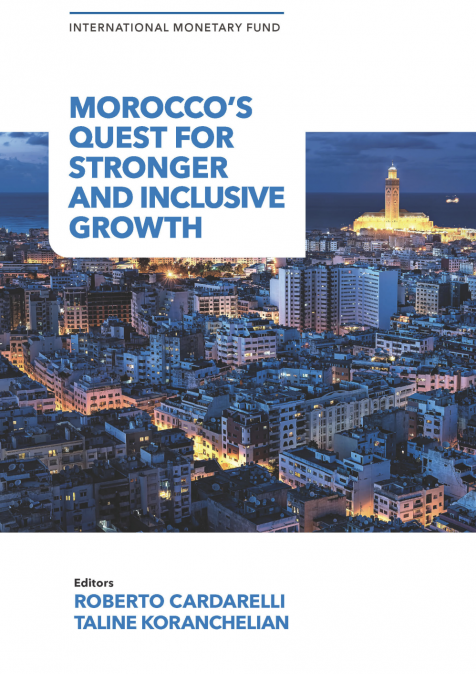
Morocco’s Quest for Stronger and Inclusive Growth
Authors
Edited by Roberto Cardarelli
Taline Koranchelian
October 9, 2023

This book was originally published on elibrary.imf.org


Throughout the past two decades, Morocco has faced several external and domestic shocks, including large swings in international oil prices, regional geopolitical tensions, severe droughts, and most recently the impact of the pandemic and the economic fallout from Russia’s invasion of Ukraine. Despite rough waters, the government stayed the course and remained focused not only on immediate stability, but also on the long-term needs of the Moroccan economy. This involved the adoption of a series of difficult measures, like the elimination of energy subsidies, and a strategy aimed at improving the country’s infrastructure, diversifying the production and export bases by attracting foreign investment, and modernizing the governance structure of the public administration. The road to higher and more inclusive growth, however, remains steep. Despite gains in poverty reduction, literacy and lifespans, Morocco economy continues to face a high share of inactive youth, large gaps in economic opportunities for women, a fragmented social protection system, and remaining barriers to private sector development. An ambitious reform agenda is needed to better meet the aspirations of Moroccans, by making economic growth stronger, more resilient and more inclusive, particularly to provide greater opportunities for young, women, and entrepreneurs. Morocco appears well positioned to address these challenges, and indeed, the country has recently sought to define and pursue a new “model of development”, through national debates and a more inclusive approach to reform. Significant reforms have been announced recently that revamp both the social protection system and the SOEs business model. This book draws lessons from the reforms Morocco has implemented in the past few decades and charts a course for Morocco by addressing key areas for reform.

RELATED CONTENT

  • December 26, 2023
    في ختام هذا العام، يُخصص مركز السياسات من أجل الجنوب الجديد حلقة خاصة من برنامجه الأسبوعي"حديث الثلاثاء"، لاستعراض أبرز تطورات الاقتصادية خلال عام 2023. هذا العام شهد تحولات عديدة وتحديات غير اعتيادية ، فكيف أثرت هذه التغيرات على الاقتصادات العالمية؟ وما هو الدور الذي أضافته الجغرافيا ا...
  • December 5, 2023
    في حلقة هذا الأسبوع سنحاول مناقشة موضوع القطاع غير المُهيكَل في المغرب، أبرز التحديات وأفاق المستقبل. حيث أن ظاهرة العمالة غير الرسمية أصبحت تأخذ حيزا كبيرا في مختلف النقاشات العالمية الدائرة حول مسألة التنمية، والمغرب يعد من بين الدول التي تبقى فيها الظاهرة عند مستويات مرتفعة كون منظو...
  • November 28, 2023
    This Working Paper was originally published on erf.org.eg Like many developing countries, Morocco faced a significant increase in public debt following the COVID-19 pandemic. In 2022, Central government debt reached 69.6% of GDP, up from 60.3% in 2019, highlighting the need for a thorough analysis of debt sustainability. This paper examines the main trends in the Moroccan economy over the past two decades, including growth performance, monetary policy and financial condit ...
  • November 14, 2023
    This Policy brief was originally published on erf.org.eg Like many emerging and developing economies, Morocco has experienced a significant increase in public debt since the COVID-19 pandemic. Central government debt reached 69.6 percent of GDP in 2022, up from 60.3 percent in 2019, and overall public debt increased to 82.5 percent of GDP in 2022, well above the presumed critical threshold of 60 percent. Therefore, it becomes crucial to conduct a comprehensive debt sustainabil ...
  • Authors
    Touhami Abdelkhalek
    Dorothee Boccanfuso
    November 8, 2023
    Public policies, particularly those related to taxes and subsidies, should help to reduce poverty and inequality. However, the combination of components of these two systems, as implemented, leads sometimes to an increase in poverty and or inequality without being necessarily anticipated. In this policy brief, based on data from the 2019 wave of the Enquête Panel de Ménage from the Observatoire National du Développement Human from Morocco, we first highlight the influence of taxes ...
  • Authors
    Ali Elguellab
    Elhadj Ezzahid
    November 1, 2023
    The role of the production network in shock propagation has been an issue of considerable interest since the Great Recession. However, the empirical literature has only focused on advanced and emerging countries. This paper aims to contribute to filling this gap by examining the case of Morocco, a developing country belonging to the lower-middle-income group. The question is whether its production network is a factor in amplifying idiosyncratic industry-level shocks or, conversely, ...
  • October 9, 2023
    This paper was originally published on mdpi.com   The labor market can be a daunting place for young graduates; this paper aims to shed light on how they navigate it. By examining the ways in which they enter the workforce and the impact of individual and socioeconomic factors on their career paths, we gain a deeper understanding of the challenges they face. We use a two-stage approach to study this issue: first, we create a typology of graduates’ integration paths ...
  • Authors
    Edited by Roberto Cardarelli
    Taline Koranchelian
    October 9, 2023
    This book was originally published on elibrary.imf.org   Throughout the past two decades, Morocco has faced several external and domestic shocks, including large swings in international oil prices, regional geopolitical tensions, severe droughts, and most recently the impact of the pandemic and the economic fallout from Russia’s invasion of Ukraine. Despite rough waters, the government stayed the course and remained focused not only on immediate stability, but also ...