Publications /
Policy Brief

Back
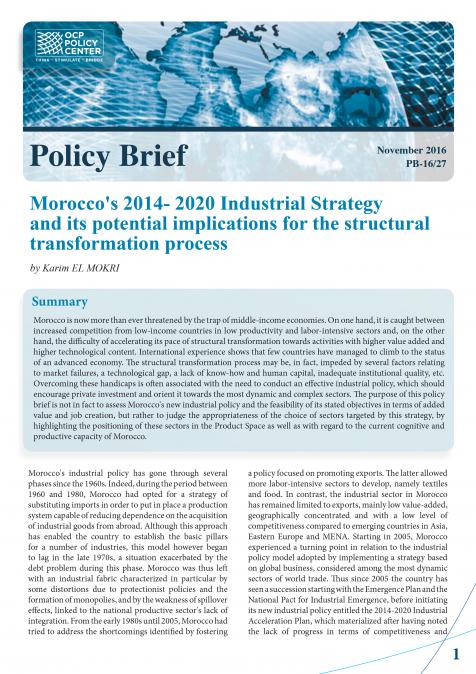
Morocco’s 2014- 2020 Industrial Strategy and its potential implications for the structural transformation process
Authors
Karim EL Mokri
October 13, 2016

Morocco is now more than ever threatened by the trap of middle-income economies. On one hand, it is caught between increased competition from low-income countries in low productivity and labor-intensive sectors and, on the other hand, the difficulty of accelerating its pace of structural transformation towards activities with higher value added and higher technological content. International experience shows that few countries have managed to climb to the status of an advanced economy. The structural transformation process may be, in fact, impeded by several factors relating to market failures, a technological gap, a lack of know-how and human capital, inadequate institutional quality, etc. Overcoming these handicaps is often associated with the need to conduct an effective industrial policy, which should encourage private investment and orient it towards the most dynamic and complex sectors. The purpose of this policy brief is not in fact to assess Morocco's new industrial policy and the feasibility of its stated objectives in terms of added value and job creation, but rather to judge the appropriateness of the choice of sectors targeted by this strategy, by highlighting the positioning of these sectors in the Product Space as well as with regard to the current cognitive and productive capacity of Morocco.

RELATED CONTENT

  • Authors
    May 15, 2026
    This paper is the third in a series of country and comparative studies that together comprise a research program on services as drivers of economic growth and structural transformation in the Global South. The paper analyzes the pattern of Tunisia's services-led economic growth from 2012- 2022 using a specialized three-category framework: knowledge services (KS), enabling services (ES), and local services (LS). Using data from the OECD Trade in Value Added (TiVA), Trade in Employmen ...
  • Authors
    April 30, 2026
    This paper is the second in a series examining services-led development and global value chain (GVC) integration in the Global South. It applies a three-category analytical framework covering knowledge services (ICT and professional business services), enabling services (transport, logistics, and finance), and local services (retail, hospitality, health, and personal services), to OECD Trade in Value Added indicators. The paper thus  ...
  • April 13, 2026
    Résumé exécutif stratégiqueLe Maroc s’est engagé avec détermination dans une trajectoire de modernisation fondée sur la transition numérique, la transition verte et l’innovation. Ces dynamiques sont devenues des leviers stratégiques pour la compétitivité, l’attractivité et la création d’emplois à forte valeur ajoutée. Pourtant, l’analyse des données microéconomiques récentes révèle un paradoxe préoccupant : les entreprises les plus modernisées, moteurs de la croissance de demain, re ...
  • March 31, 2026
    تتناول هذه الحلقة كيفية إعادة صياغة السياسة الصناعية في المغرب في ظل التحولات العالمية وإعادة تشكيل سلاسل القيمة، مع التركيز على الانتقال من موقع إنتاجي إلى فاعل صناعي استراتيجي. كما تسلط الضوء على دور قطاعات السيارات والطاقات المتجددة والصناعات التكنولوجية في تعزيز تموقع المغرب دولياً....
  • Authors
    February 24, 2026
    This Paper was originally published on sciencedirect.com This paper assesses the national and regional impacts of the Marrakech–Fès highway project in Morocco using a Spatial Computable General Equilibrium (SCGE) model combined with GIS-based road network data. The analysis captures how improved connectivity alters economic performance and emissions patterns across space and time. Results show that while overall economic gains are modest, the benefits are unevenly distributed—f ...
  • Authors
    Ahmed Ouhnini
    December 5, 2025
    L’« uberisation », terme né du nom de l’entreprise américaine Uber au début des années 2010, désigne initialement un modèle économique fondé sur la mise en relation directe entre offre et demande via des plateformes numériques. Rapidement popularisé, le concept s’est élargi, avec Airbnb dans l’hébergement, puis à une multitude d’autres secteurs : livraison de repas, services à domicile, commerce en ligne, voire des métiers traditionnellement régulés ou corporatistes. Ce néologisme t ...
  • Authors
    Ahmed Ouhnini
    December 5, 2025
    “Uberization,” a term derived from the American company Uber in the early 2010s, initially refers to an economic model based on directly matching supply and demand through digital platforms. Rapidly popularized, the concept has expanded with Airbnb in accommodation, and then to a wide range of other sectors: food delivery, home services, e-commerce, and even traditionally regulated or corporatist professions. This neologism thus reflects a transformation of economic and social relat ...
  • Authors
    December 2, 2025
    This paper assesses the economic and environmental implications of Morocco’s strategic transition from internal combustion engine vehicle (ICEV) manufacturing to electric vehicle (EV) production, with a particular focus on the regional impacts of localizing high-value battery manufacturing. Using an interregional input-output model, extended with environmental satellite accounts, the study simulates a structural shock related to the wholesale substitution of ICEV-specific inputs wit ...
  • December 2, 2025
    في هذه الحلقة، نحاول اكتشاف ما الذي يجعل المغرب يعيش اليوم تحولاً لافتاً في عالم المدفوعات الرقمية. كيف أصبحت التكنولوجيا المالية أحد مفاتيح الشمول المالي ومحركاً لنمو جديد؟ وكيف يغيّر الاعتماد المتزايد لوسائل الدفع الحديثة حياة التجار الصغار والمقاولات الصغيرة والمتوسطة ويخلق لهم فرصاً...