Publications /
Policy Brief

Back
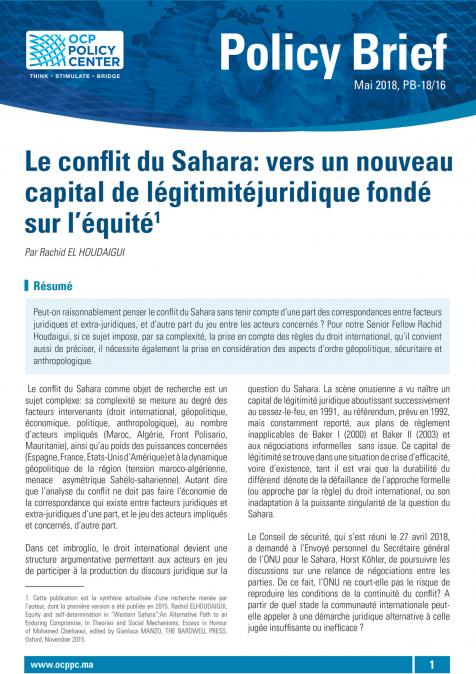
Le conflit du Sahara: vers un nouveau capital de légitimité juridique fondé sur l’équité
May 25, 2018

Peut-on raisonnablement penser le conflit du Sahara sans tenir compte d’une part des correspondances entre facteurs juridiques et extra-juridiques, et d’autre part du jeu entre les acteurs concernés ? Pour notre Senior Fellow Rachid Houdaigui, si ce sujet impose, par sa complexité, la prise en compte des règles du droit international, qu’il convient aussi de préciser, il nécessite également la prise en considération des aspects d’ordre géopolitique, sécuritaire et anthropologique.
RELATED CONTENT

  • October 29, 2026
    Luiz Inácio Lula da Silva’s victory brings to an end one of the most closely contested elections in Brazil’s recent history. Before any broader analysis, however, a qualification is necessary. Supreme Court Justice Cristiano Zanin’s controversial decision to extend voting hours sparked debate over the electoral process. Although the measure was not mathematically decisive in Lula’s come-from-behind victory, the episode risks fuelling challenges to the result and further eroding poli ...
  • October 15, 2026
    The UN Secretary-General’s report of October 1, 2026 marks an important stage in the evolution of the political process concerning the Moroccan Sahara. As the first report issued since the adoption of Resolution 2797 (2025), it highlights renewed diplomatic momentum, marked by the resumption of substantive four-party negotiations led by the United States with United Nations support.This development reflects a gradual shift in a debate long focused on the territory’s final status tow ...
  • October 15, 2026
    Le rapport du Secrétaire général des Nations Unies du 1er octobre 2026 marque une étape importante dans l’évolution du processus politique relatif au Sahara marocain. Le premier présenté depuis l’adoption de la résolution 2797 (2025), le rapport met en évidence une dynamique diplomatique nouvelle, caractérisée par la reprise de négociations substantielles à quatre sous l’impulsion des États-Unis et avec l’accompagnement des Nations Unies. Cette évolution traduit un déplacement ...
  • Authors
    October 2, 2026
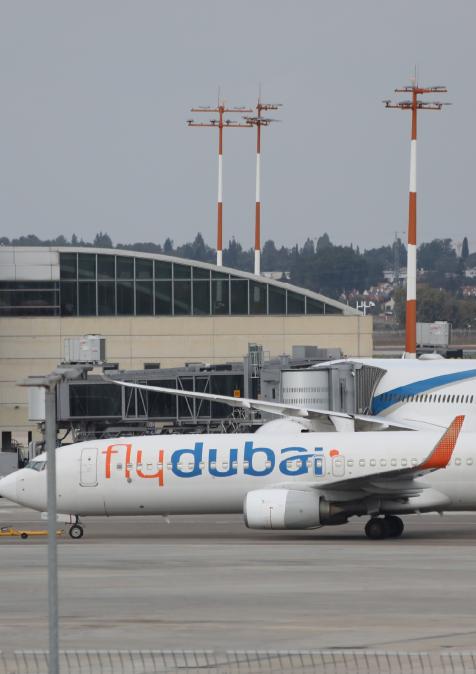
    L’incident du vol FZ1073 entre Dubaï et Tel-Aviv ne permet encore aucune attribution définitive. Il constitue en revanche un révélateur utile : à mesure que la sûreté aérienne ferme les voies classiques d’intrusion, la menace cherche à emprunter des voies alternatives en exploitant les personnes, les prestataires et les systèmes auxquels l’écosystème aéronautique doit nécessairement accorder sa confiance. ...
  • Authors
    October 2, 2026
    The incident involving Flydubai Flight FZ1073 between Dubai and Tel Aviv does not yet support any definitive attribution. It does, however, provide a useful warning sign: as aviation security closes off traditional avenues of intrusion, threats may shift towards alternative pathways by exploiting the people, service providers, and systems that the aviation ecosystem must necessarily trust.  ...
  • Authors
    September 30, 2026
    On August 7, 2026, Saudi Arabia, Turkey, and Pakistan signed the Mecca Joint Défense Agreement, a collective-defense pact widely compared to NATO’s Article 5. This essay argues that the comparison is misleading. Mecca borrows NATO’s language of solidarity without yet possessing NATO’s institutional machinery, and the Houthi offensive against Saudi Arabia in September 2026 provided an early and revealing test of what the agreement actually means in practice. Neither Pakistan nor Turk ...
  • Authors
    Marianna Albuquerque
    September 23, 2026
    The author of this opinion, Marianna Albuquerque, is a 2022 alumna of the Atlantic Dialogues Emerging Leaders Program.As world leaders gather in New York for the 81st United Nations General Assembly, climate change returns to the center of multilateral diplomacy under markedly different circumstances. The debate is no longer confined to whether the world must decarbonize, but increasingly centers on how the transition will happen, who will bear its costs, who will capture ...
  • Authors
    Andy Sumner
    Stephan Klingebiel
    September 4, 2026
    This Paper was originally published on cgdev.org. Escalatory attacks on multilateral rules and institutions in this era of raw power politics have plunged international politics into uncharted territory. Traditional alliances have been fractured and new partnerships between unlikely bedfellows are emerging. No longer in transition, the post-World War II world order is in rupture. This paper examines international cooperation under these conditions and argues that a new "flexi-l ...
  • Authors
    August 25, 2026
    The next Secretary-General should begin with an act of institutional rebellion: refuse to become the Secretary-General ofeverything. Over three decades the office's political and administrative reach has spread across sustainable development, climate, health, migration, digital governance, financing, gender, food systems, and a still-growing list of global priorities. These issues are not unimportant; the trouble is that institutional ambition has simply outrun institutional capabil ...