Publications /
Policy Brief

Back
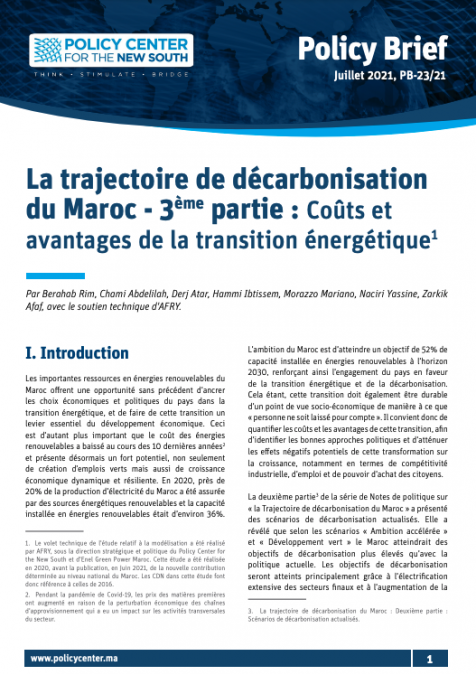
La trajectoire de décarbonisation du Maroc - 3ème partie : Coûts et avantages de la transition énergétique
Authors
Chami Abdelilah
Derj Atar
Hammi Ibtissem
Morazzo Mariano
Naciri Yassine
with the technical support of AFRY
July 9, 2021

Les importantes ressources en énergies renouvelables du Maroc offrent une opportunité sans précédent d’ancrer les choix économiques et politiques du pays dans la transition énergétique, et de faire de cette transition un levier essentiel du développement économique. Ceci est d’autant plus important que le coût des énergies renouvelables a baissé au cours des 10 dernières années2 et présente désormais un fort potentiel, non seulement de création d’emplois verts mais aussi de croissance économique dynamique et résiliente. En 2020, près de 20% de la production d’électricité du Maroc a été assurée par des sources énergétiques renouvelables et la capacité installée en énergies renouvelables était d’environ 36%.

RELATED CONTENT

  • From

    17
    9:00 am November 2026
    In person registrationOnline registrationIndustrialization in North Africa is entering a new phase shaped by global megatrends, the green and digital transitions, evolving value chains, and the growing need for resilient and competitive production systems.Against this backdrop, the Policy Center for the New South and the United Nations Industrial Development Organization (UNIDO) are convening The Future of Industrialization: Building Future-Ready Industries in North Africa on November 17, 2026, at the Policy Center for the New South in Rabat.The event will present key insights from the Industrial Development Report 2026 (IDR26) and bring together policymakers, industry leaders and experts to discuss the region’s industrial opportunities, constraints and policy priorities. The ...
  • November 10, 2026
    يناقش هذا الحوار أبرز التوجهات الاقتصادية والاجتماعية لمشروع قانون المالية لسنة 2027 في المغرب، في ظل الحاجة إلى التوفيق بين دعم النمو والاستثمار وخلق فرص الشغل، وتعزيز الحماية الاجتماعية، والحفاظ على التوازنات المالية. كما يتناول شروط فعالية المجهود الاستثماري، وسبل تمويل الأولويات الا...
  • November 9, 2026
    Cette interview examine les perspectives d’une éventuelle adhésion du Maroc à l’OCDE à l’horizon 2040, en revenant sur les conditions économiques, institutionnelles et réglementaires qu’un tel processus pourrait impliquer. Elle met en perspective les réformes engagées par le Royaume, le...
  • Authors
    Aziz Ajbilou
    Ouidade Sabri
    November 4, 2026
    School dropout remains a major challenge for education systems and public policy, with lasting consequences for human capital, labor market integration, social cohesion, and long-term economic growth. Despite sustained efforts to expand access to schooling, many countries continue to experience high dropout rates, particularly at key transition points in lower- and uppersecondary education. Policy responses have often relied on fragmented, sector-specific interventions—addressing ed ...
  • October 22, 2026
    تتناول هذه الحلقة من «حديث الثلاثاء» تأثير تقلبات أسعار النفط والغاز في الأسواق العالمية على الاقتصاد المغربي، وانعكاساتها على القدرة الشرائية للأسر وتنافسية المقاولات. ونناقش مع ضيفنا السيد أمين سامي كيف تنتقل هذه التقلبات إلى أسعار السلع والخدمات، ولماذا لا تنخفض الأسعار دائمًا مع ترا...
  • October 09, 2026
    Can Nigeria’s Dangote refinery help strengthen Africa’s energy security amid disruptions to global supply routes? This discussion considers how expanding local refining capacity can reduc ...
  • October 8, 2026
    This paper was originaly published on Higher Education Policy Journal This article critically assesses the alignment between Morocco’s public guidance schemes for international students and its national development goals. Specifically, it investigates the capacity of these mechanisms to transform student mobility from a potential ‘brain drain’ into a tangible ‘brain gain’. Employing a qualitative case study approach, we conducted a systematic content analysis of 204 mobili ...
  • September 11, 2026
    Le marché du travail marocain connaît, depuis les années 2000, une expansion continue de la scolarisation qui ne s'est pas accompagnée d'une transformation équivalente de la structure productive de l'économie, ouvrant la voie à des situations d'inadéquation verticale entre le niveau de formation des actifs occupés et les exigences des emplois qu'ils occupent. La présente étude analyse les déterminants du déclassement (sur-éducation) et du surclassement (sous- éducation) à partir des ...
  • September 11, 2026
    Since the early 2000s, the Moroccan labour market has experienced continuous educational expansion that has not been matched by an equivalent transformation of the economy's productive structure, giving rise to situations of vertical mismatch between employed workers' education levels and the requirements of the jobs they hold. This study analyzes the determinants of overeducation and undereducation using anonymized microdata from the 2014 General Population and Housing Census (RGPH ...