Publications /
Book / Report

Back
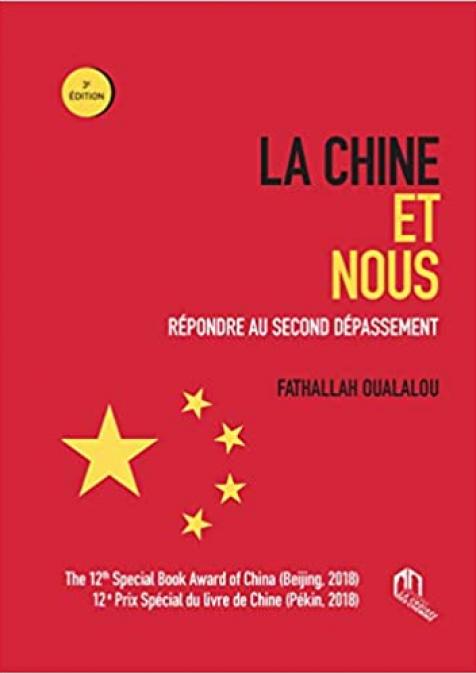
La Chine et nous : Répondre au second dépassement
December 19, 2016

En un tiers de siècle, la Chine, pays en développement, est devenue une économie émergente, puis une puissance économique mondiale. Il s’agit là du principal évènement économique du début du XXIe siècle.

Cet évènement interpelle le Maroc, le Maghreb, l’Afrique et l’espace sudméditerranéen, parce qu’il est porteur d’un second dépassement historique, provenant, cette fois, non pas de l’Occident, mais de la Chine lointaine pourtant tellement présente dans notre quotidien. Répondre à ce dépassement, c’est avant tout tirer les leçons de la grande transformation que vit la Chine.

RELATED CONTENT

  • Authors
    July 16, 2021
    The BDA Currents: Where Diplomacy Meets Business, is the Brussels Diplomatic Academy’s annual report covering the wider geopolitical and other factors influencing and affecting the world of diplomacy, international relations and global business. The journal focuses on issues of topical interest around the centers of global power, influence and importance, including the continents of Europe and Africa, the Middle East, China, India & Asia, Russia and the Commonwealth of Independe ...
  • Authors
    December 30, 2020
    According to this month’s OECD economic outlook, global GDP --- which took a huge hit from the pandemic and is still 3% below its level of a year ago – will not recover its pre-pandemic level until the end of 2021. In a downside scenario, the return could take almost a year longer. The OECD predictions, which imply high and protracted unemployment, are in line with the view of many other official and private organizations. The arrival of effective vaccines such as Pfizer-BioNTech wa ...
  • April 6, 2020
    Depuis l'entrée en vigueur de l'Accord de libre-échange (ALE) entre le Maroc et l'Union européenne (UE), il y a près de deux décennies, les performances des exportations marocaines vers les marchés de l'UE ont été plutôt décevantes, tandis que le déficit commercial du Maroc avec l'UE a augmenté de manière significative. Cela a conduit de nombreux observateurs à percevoir l'accord d'un oeil critique. Cependant, les balances commerciales bilatérales ne sont pas toujours suffisantes po ...
  • Authors
    July 3, 2019
    Twenty years after negotiations began between Mercosur and the European Union (EU), a trade agreement between ministers was reached last Friday in Brussels. Its first phase, from 1999 to 2014, had among the motivations on the European side not to be left behind while the US then pursued a Free Trade Agreement for Latin America (FTAA). Symptomatically, such enthusiasm cooled after FTAA negotiations came to a halt and the United States embarked on bilateral agreements with some c ...
  • Authors
    June 3, 2019
    In a recent brief, titled” The Crisis in World Trade”, my co-authors and I conclude that whether we still have a rules-based system a few years from now depends on the answer to three questions: Can the WTO be revitalized? Is protectionism in the United States a temporary aberration? Will China reform and fit the liberal economic order? If the answer to these three questions is yes, the system will likely endure. If the answer is no, we will return to the power based non system ...
  • Authors
    Yana Myachenkova
    November 27, 2018
    - The trade agreements that the European Union has with North African countries – with Algeria, Egypt, Morocco and Tunisia – are often seen as having delivered disappointing results since they came into force during the 2000s. The four North African countries have seen insufficient growth in their exports to the EU, and have undergone only limited diversification. In the meantime, the EU’s exports to North Africa have grown quite rapidly. - Economic growth in North Africa has been ...
  • Authors
    July 10, 2018
    Historians often offer different interpretations of the events that have shaped our destiny, yet, with respect to World War 2, the bloodiest conflict in history, they seem to concur on two points. First, that those yearning for peace underestimated the National Socialists’ determination to wage a war of conquest until it was far too late to deter them, and, second, that Nazi Germany failed to anticipate that Britain, the United States, and the Soviet Union – each of which it provok ...