Publications /
Policy Paper

Back
Innovation in Africa: Evidence and Implications for Growth and the Transition to High-Income Status
Authors
Rishita Mehra
June 24, 2022

For today’s middle-income countries in Africa, innovation is essential to sustain growth and promote the transition to high-income status. This paper begins by providing an in-depth review of the region’s innovation performance during the last three decades. A distinction is made between residents and non-residents, and outcomes at different income levels. Using cross-country regressions, we then study the determinants of innovation and assess the impact of innovation on growth in the region. The analysis shows that the broadband penetration rate (which facilitates the development of knowledge networks) is a highly significant determinant of innovation. In addition, among the three types of intellectual property—patents, trademarks, and industrial design applications—only the last has a positive and significant impact on growth. Based on this analysis, and the broader literature on middle-income traps, we make policy recommendations to promote innovation in terms of both national strategies (with respect, in particular, to protecting intellectual property rights) and regional strategies, with an emphasis on the role of multilateral institutions.

RELATED CONTENT

  • Authors
    March 25, 2015
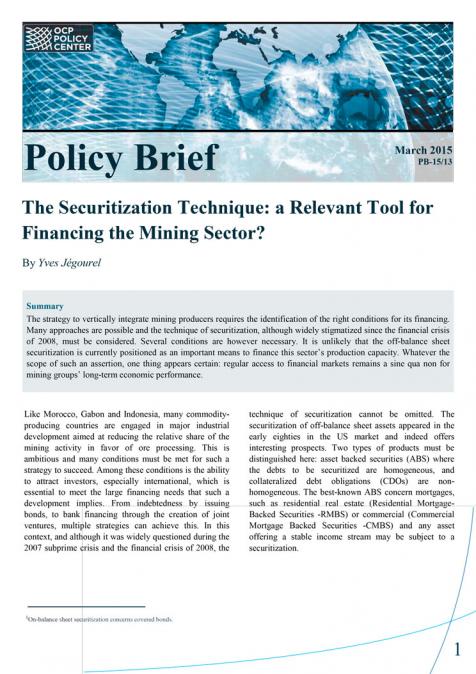
    The strategy to vertically integrate mining producers requires the identification of the right conditions for its financing. Many approaches are possible and the technique of securitization, although widely stigmatized since the financial crisis of 2008, must be considered. Several conditions are however necessary. It is unlikely that the off-balance sheet securitization is currently positioned as an important means to finance this sector’s production capacity. Whatever the scope of ...
  • Authors
    February 10, 2015
    Manufacturing is declining as a share of GDP not only in advanced countries, but in developing countries as well. This new trend, a result of complex forces, should be seen on balance as a reason for development-optimism, not pessimism. In the 21st century economy, manufacturing remains important, but poor countries can attract investment, grow rapidly and diversify away from agriculture on the basis of many possible sources of comparative advantage, without artificially promoting m ...
  • Authors
    Pierre-Richard Agénor
    January 24, 2015
    L’économie marocaine fait actuellement face au risque de se retrouver « prise en tenaille », entre, d’un côté les pays à faible revenu en croissance rapide, bénéficiant d’une main-d’oeuvre abondante et bon marché, et, de l’autre, les pays à moyen revenu, capables d’innover rapidement. De plus, les investissements massifs de la Chine en Afrique subsaharienne ont contribué à accélérer la participation de certains pays de cette région à la nouvelle division internationale du travail, p ...
  • Authors
    Pierre-Richard Agénor
    January 24, 2015
    The Moroccan economy is currently facing the risk of becoming caught between the rapid-growing low-income countries with abundant and cheap labor, and middle-income countries that are able to innovate quickly. In addition, China’s massive investments in Sub-Saharan Africa have accelerated the participation of some countries in the region in a new international division of labor, especially in low-skill-intensive light manufacturing. In parallel, through the structure of its trade a ...
  • Authors
    Pierre-Richard Agénor
    January 24, 2015
    OCP Policy Center est ravi de recueillir vos commentaires et d’engager la discussion autour de la publication de son dernier livre sur la stratégie de croissance du Maroc à l’horizon 2025 dans un environnement international en mutation, co-écrit par Pierre Richard Agénor et Karim El Aynaoui. L’économie marocaine fait actuellement face au risque de se retrouver « prise en tenaille », entre, d’un côté les pays à faible revenu en croissance rapide, bénéficiant d’une main-d’œuvre abond ...
  • From

    17
    3:00 pm November 2026
    The Oxford Handbook of the Moroccan Economy propose une analyse approfondie, structurée et rigoureuse de la trajectoire économique du Maroc de 1960 à 2025. Réunissant 53 contributeurs autour de 34 chapitres, l’ouvrage se présente comme une référence académique et analytique majeure, fondée sur l’étude des tendances de long terme, des faits stylisés, des transformations sectorielles et des principaux défis de politiques publiques qui façonnent le développement économique du Royaume.Au-delà d’une lecture centrée uniquement sur les agrégats macroéconomiques ou les indicateurs de progrès social, le Handbook interroge les ressorts profonds de la transformation structurelle de l’économie marocaine : dynamiques de productivité, diversification du tissu productif, qualité de l’emploi, ...
  • From

    12
    9:30 am November 2026
    The Oxford Handbook of the Moroccan Economy propose une analyse approfondie, structurée et rigoureuse de la trajectoire économique du Maroc de 1960 à 2025. Réunissant 53 contributeurs autour de 34 chapitres, l’ouvrage se présente comme une référence académique et analytique majeure, fondée sur l’étude des tendances de long terme, des faits stylisés, des transformations sectorielles et des principaux défis de politiques publiques qui façonnent le développement économique du Royaume.Au-delà d’une lecture centrée uniquement sur les agrégats macroéconomiques ou les indicateurs de progrès social, le Handbook interroge les ressorts profonds de la transformation structurelle de l’économie marocaine : dynamiques de productivité, diversification du tissu productif, qualité de l’emploi, ...